Polybutene
Identity
In current useas of 22 Sep 2026
- INCI name
- POLYBUTENE
- CAS
- 9003-29-69003-28-5
- EC
- 500-004-7
- Origin
- Synthetic
- Also known as
- liquid polybutene · butene homopolymer · butylene polymer
What it does
No regulatory dataset is loaded. The status above is this archive's editorial summary of the documented record, not a statement of any substance's legal position in your jurisdiction, and nothing here is advice on whether to use it.
In short
A viscous, non-volatile hydrocarbon polymer that gives lip gloss its thickness, its cling and much of its shine; it is the fraction that stays behind once the volatile solvent it was dissolved in has gone.
- 3min read
- 4chapters
- 4sources

Vivien
Your guide through time
Listen to this entry
5 min listenVivien reads our essays aloud, word for word — every date and every name in its place — so you can listen the way you would be walked through a gallery.
An AI voice, designed for History of Makeup
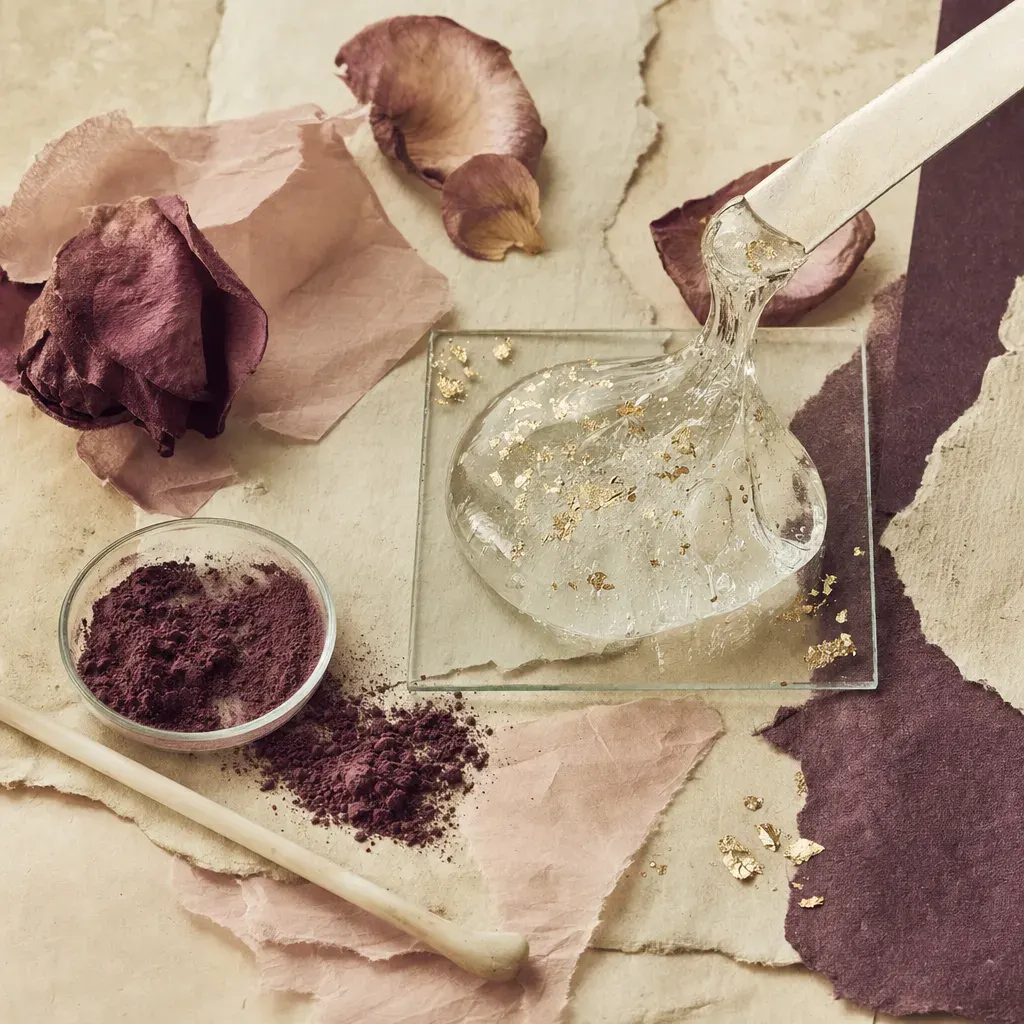
Polybutene is the material responsible for how a lip gloss behaves: thick, slow, faintly sticky, and very shiny. It is a short-chain hydrocarbon polymer, liquid rather than solid, optically denser than the oils it is usually blended with and with almost no volatility at all.
In the European cosmetic ingredient database its declared functions are binding and viscosity controlling.[1] Both are accurate and neither quite conveys the point, which is adhesion. Polybutene makes a film that stays where it is put, and it does so without ever drying.
What It Is
Polybutene is made by polymerising the C4 olefin fraction from petroleum refining, primarily isobutene together with some normal butenes. The product is not a single molecule but a distribution of chain lengths, and the average chain length sets the viscosity; the supplier offers a wide range of viscosities, from thin mobile liquids to materials that pour like cold treacle.[2]
The chains carry an olefinic end-group, and supplier literature describes them as reactive by virtue of it.[2] Where that residual unsaturation is unwanted, formulators reach for a hydrogenated relative - registered under its own INCI name, Hydrogenated Polyisobutene, and a separate ingredient rather than a grade of polybutene.[3] Polybutene itself is colourless and optically denser than most cosmetic esters and plant oils; a gloss built on it looks wet rather than merely oily.
In History
Polybutene reached cosmetics from heavy industry rather than from the perfumer's bench. It is sold into lubricants, adhesives, sealants and caulking compounds, and the grades used in lip products come from the same commercial range.[5] The date of its first cosmetic use is not well documented: the trail runs through supplier literature and formulation patents rather than through any published history of the trade.
Nor is the date of its prominence secure. What the patent record of the 1990s does document is the problem polybutene is asked to solve. Revlon's transfer-resistant lipstick patent puts shine and immobility in the same specification - its first worked example is a transfer-resistant lipstick composition with shine - without naming polybutene anywhere in the document.[4] A lip product asked not to move still has to look wet, and the two requirements pull against each other; gloss formulation over the following two decades was largely an argument about how to reconcile them.
What It Does
Three things at once. It thickens,[6] because long chains entangle with one another. It adheres, because those same chains are tacky against a surface and against each other. And it refracts, because it is clear and optically dense enough to throw a specular highlight rather than a diffuse one.
In a long-wear formulation polybutene plays the part the volatile solvent cannot. Dissolved in isododecane it is fluid enough to apply; once the isododecane has gone, what remains is a tacky, glossy, non-drying layer holding pigment against the lip. It is the counterweight to the brittle resins, which hold colour well but leave a film that feels tight and looks flat.
Safety and Status
Polybutene is in ordinary cosmetic use. As of 22 September 2026 it is not listed in Annex II, the list of substances prohibited in cosmetic products, or in Annex III, the list of those restricted, to Regulation (EC) No 1223/2009 on cosmetic products,[7] and the European Commission's CosIng database records it at EC 500-004-7 with the functions binding and viscosity controlling.[8] That describes its regulatory position rather than settling any question about it.
Two practical points are worth making about the material itself. Polybutene is petroleum-derived, which is a matter of provenance rather than of hazard. And its molecular weight distribution matters a great deal: the light grades and the heavy ones behave so differently on the lip that a single INCI name on a label says much less about the feel of a product than the name appears to promise.[9]
Sources
- [1, 3, 6, 8]CosIng: the European Commission database for information on cosmetic substances and ingredients European Commission, Directorate-General for Internal Market, Industry, Entrepreneurship and SMEs, 2026.View source (opens in a new tab) Accessed 2026-09-22.
- [2, 5, 9]Indopol Polybutene: product information INEOS Oligomers, 2026.View source (opens in a new tab) Accessed 2026-09-22.
- [4]Cosmetic compositions with improved transfer resistance. United States Patent 5,505,937, assigned to Revlon, priority 15 December 1992, granted 9 April 1996 United States Patent Office, 1996.View source (opens in a new tab)
- [7]Regulation (EC) No 1223/2009 on cosmetic products 2009.View source (opens in a new tab) Accessed 2026-09-22.