Beeswax
Identity
In current useas of 22 Sep 2026
- INCI name
- BEESWAX
- CAS
- 8012-89-3
- EC
- 232-383-7
- Origin
- Animal
- First attested
- 7,000 BCE
- Also known as
- cera alba · cera flava · white beeswax · yellow beeswax · E 901
What it does
How it is dated
The earliest secure evidence is chemical rather than textual: beeswax biomarkers survive in pottery from the seventh millennium BC, the oldest identified at Çayönü Tepesi in south-eastern Anatolia.
No regulatory dataset is loaded. The status above is this archive's editorial summary of the documented record, not a statement of any substance's legal position in your jurisdiction, and nothing here is advice on whether to use it.
In short
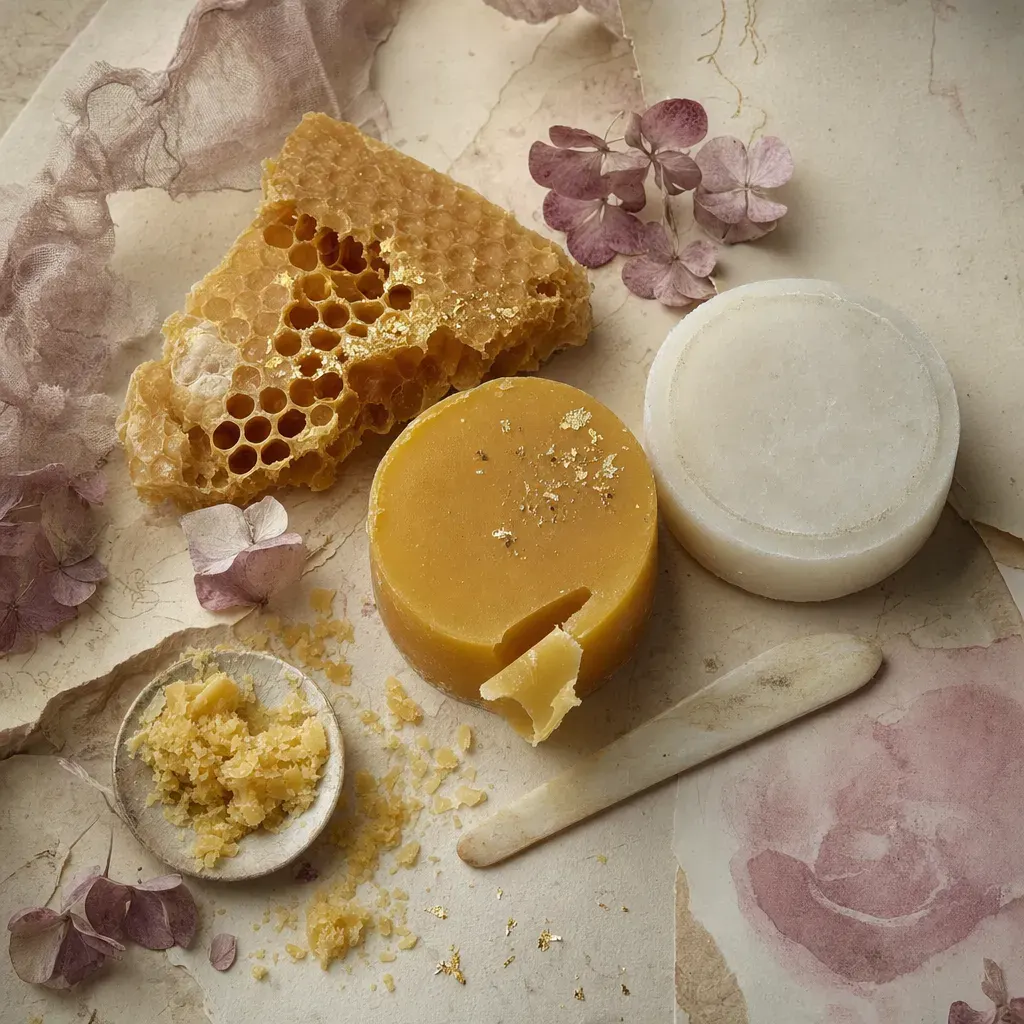
Beeswax is the material a honeybee colony builds its comb from, and the oldest wax with a documented place in cosmetics: it sets the shape of a lipstick, thickens a balm, and holds oil and water together in a cream.
- 3min read
- 4chapters
- 8sources

Vivien
Your guide through time
Listen to this entry
4 min listenVivien reads our essays aloud, word for word — every date and every name in its place — so you can listen the way you would be walked through a gallery.
An AI voice, designed for History of Makeup
Beeswax is what a honeybee colony builds with. Worker bees secrete it as thin flakes from glands on the underside of the abdomen, chew it soft, and press it into comb. Beekeepers recover it by rendering the comb down once the honey has been taken.
It is the oldest wax with a documented place in human craft, and still among the most used in cosmetics.[1] Anything that must hold a shape at room temperature and soften at skin temperature owes that behaviour to a wax, and for most of recorded history the wax in question was this one.
What It Is
Beeswax is a mixture, not a compound. Roughly seventy per cent of it is esters formed between long-chain fatty acids and long-chain alcohols; the remainder is free fatty acids, hydrocarbons and trace material carried over from the hive. The exact proportions shift with the colony, the season and the forage, which is why beeswax is specified by melting range and acid value rather than by formula.
It softens well below its melting point, and that gradual softening is the property formulators actually want. Two grades are traded: cera flava, the yellow wax as rendered, and cera alba, the same wax bleached. British pharmacy had already separated the two into distinct entries by the early twentieth century.[2]
In History
Residue analysis has pushed the documented use of beeswax a long way back. A survey of more than six thousand potsherds from Europe, the Near East and North Africa found beeswax biomarkers from the seventh millennium BC onward, the earliest at Çayönü Tepesi in south-eastern Anatolia.[3] What the wax was for in each case is not recoverable from the residue alone. Waterproofing, adhesive, fuel and medicine are all plausible, and the study does not claim to distinguish between them.
Its cosmetic role is better attested for the Roman period, where preparations of wax and oil appear in the medical and household literature.[4] The specific recipe now circulated as Galen's cold cream — beeswax, olive oil and rose water in fixed proportions — is a modern reconstruction built on a genuine ancient class of preparation, not a transcription of a surviving text.
What It Does
In a stick, beeswax is the binder. It holds oils and pigments in a solid that survives being carried in a bag and still deposits colour when drawn across the lip. In a cream it does two jobs at once, thickening the oil phase and helping to stabilise the emulsion, and it leaves an occlusive film that slows water loss from the skin.
It is rarely the only wax in a formula. Beeswax on its own gives a stick that is too soft and too dull, so it is normally blended with a harder, higher-melting wax for structure and gloss.[5]
Safety and Status
The Cosmetic Ingredient Review panel assessed beeswax together with candelilla, carnauba and Japan wax, publishing its conclusion of safety as used in 1984 and leaving that conclusion in place on re-review.[6] Beeswax does not appear in the prohibited or restricted annexes of the EU Cosmetic Products Regulation, Regulation (EC) No 1223/2009 of 30 November 2009.[7]
It is also a permitted food additive, E 901, under Regulation (EC) No 1333/2008 of 16 December 2008,[8] and Commission Regulation (EU) No 1147/2012 of 4 December 2012 set out the conditions for its use as a glazing agent on certain fruits.[9] None of that is a statement about whether any particular product suits any particular person.
Sources
- [1, 3]Widespread exploitation of the honeybee by early Neolithic farmers Nature, volume 527, pages 226-230, 2015.View source (opens in a new tab)
- [2]Cera Alba, B.P. White Beeswax; Cera Flava, B.P. British Pharmaceutical Codex, 1911, via Henriette's Herbal Homepage, 1911.View source (opens in a new tab) Accessed 2026-09-22.
- [4]Cosmetics in Roman Antiquity: Substance, Remedy, Poison The Classical World 102.3, 2009.
- [5]Lipstick Formulation Cosmetics and Skin.View source (opens in a new tab) Accessed 2026-09-22.
- [6]Final Report on the Safety Assessment of Candelilla Wax, Carnauba Wax, Japan Wax, and Beeswax Journal of the American College of Toxicology, volume 3, issue 3, 1984.View source (opens in a new tab)
- [7]Regulation (EC) No 1223/2009 of the European Parliament and of the Council of 30 November 2009 on cosmetic products Official Journal of the European Union, 2009.View source (opens in a new tab) Accessed 2026-09-22.
- [8]Regulation (EC) No 1333/2008 of the European Parliament and of the Council of 16 December 2008 on food additives Official Journal of the European Union, 2008.View source (opens in a new tab) Accessed 2026-09-22.
- [9]Commission Regulation (EU) No 1147/2012 of 4 December 2012 amending Annex II to Regulation (EC) No 1333/2008 as regards the use of beeswax (E 901), carnauba wax (E 903), shellac (E 904) and microcrystalline wax (E 905) on certain fruits Official Journal of the European Union, 2012.View source (opens in a new tab) Accessed 2026-09-22.