Zinc Oxide
Identity
Restrictedas of 22 Sep 2026
- INCI name
- ZINC OXIDE
- CAS
- 1314-13-2
- EC
- 215-222-5
- Colour Index
- CI 77947
- Origin
- Synthetic
- First attested
- 1782 CE
- Also known as
- zinc white · Chinese white · flowers of zinc · ZnO · CI 77947
What it does
How it is dated
Guyton de Morveau reported on white pigments to the Académie de Dijon in 1782 and proposed zinc oxide as a substitute for white lead; this is a proposal rather than evidence of cosmetic use, which followed later.
No regulatory dataset is loaded. The status above is this archive's editorial summary of the documented record, not a statement of any substance's legal position in your jurisdiction, and nothing here is advice on whether to use it.
In short
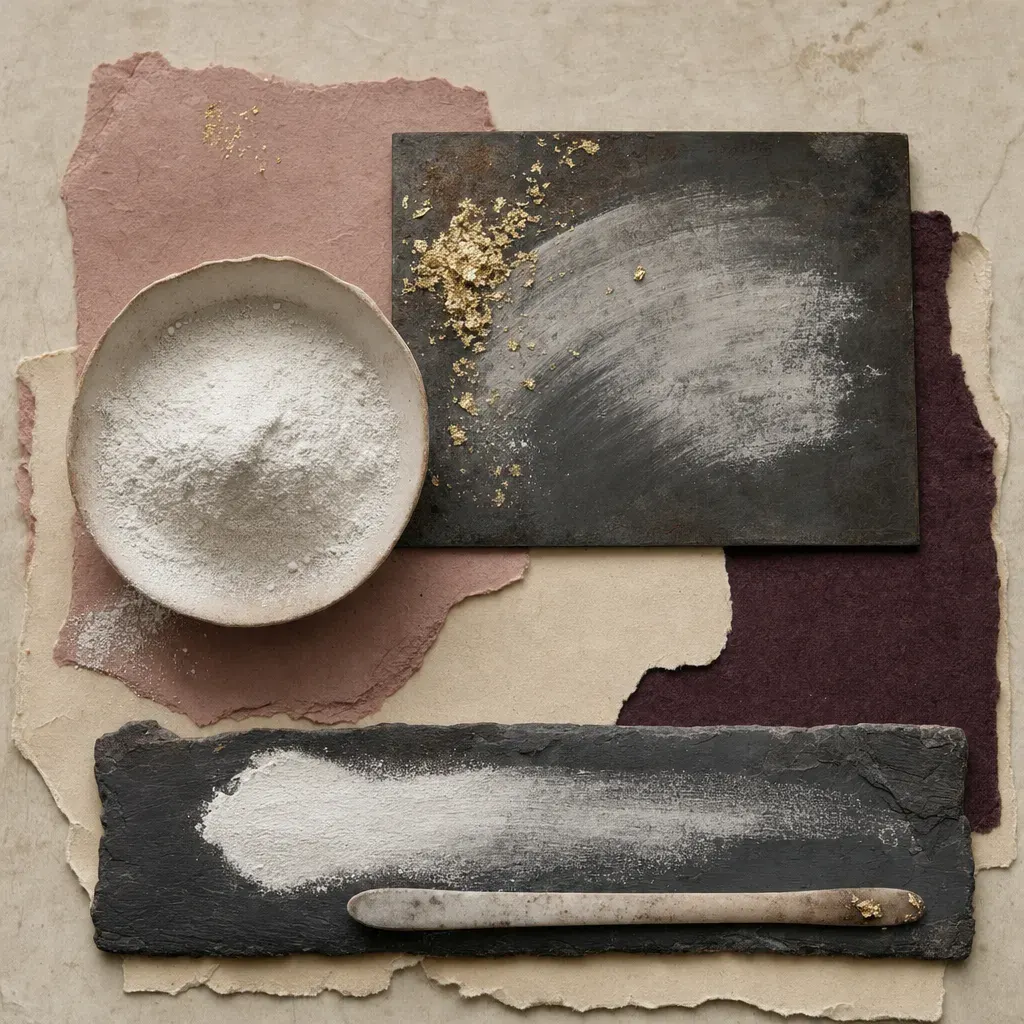
The white that came between lead and titanium: a manufactured zinc oxide, mildly astringent and mildly soothing, now met as often in a mineral sunscreen as in a face powder.
- 3min read
- 4chapters
- 5sources

Vivien
Your guide through time
Listen to this entry
5 min listenVivien reads our essays aloud, word for word — every date and every name in its place — so you can listen the way you would be walked through a gallery.
An AI voice, designed for History of Makeup
Zinc oxide is the white that came between lead and titanium. It is less opaque than either, faintly astringent on the skin, and it does one thing neither of the others does — it is mildly soothing, which is why it has spent two centuries in nappy creams and calamine lotion as well as in face powder.
Its appeal when it arrived was negative rather than positive. It was proposed, and adopted, as the white that was not white lead.[1]
What It Is
Zinc oxide is ZnO: CAS 1314-13-2, EC 215-222-5, and as a colourant CI 77947.[2] Cosmetic grades are manufactured rather than mined. Zinc metal is vaporised and burned in air, and the oxide is collected as a fine white smoke. The mineral zincite exists, but it is not the commercial source.
Calamine is not a synonym for it. The name has historically covered zinc ores, and then zinc oxide tinted with a small quantity of ferric oxide, which is what gives calamine lotion its pink.
In History
In 1782 Guyton de Morveau reported on white pigments to the Académie de Dijon and proposed zinc oxide as a substitute for white lead. Adoption was slow. Winsor and Newton introduced a particularly dense grade as "Chinese white" in 1834, and zinc white was accepted as a watercolour well before its difficulties in oil were solved.[3]
Cosmetics followed the paint trade rather than leading it. Across the nineteenth century zinc oxide gained ground on white lead in commercial face powders, helped less by any single prohibition than by the accumulating and very public record of lead poisoning. It did not displace it: lead powders such as Laird's Bloom of Youth were still on sale, and still producing documented poisoning cases, into the twentieth century.[4]
What It Does
Zinc oxide covers, but with a softer edge than titanium dioxide. It scatters less, so it reads as a veil rather than a mask. In a pressed or loose powder it contributes opacity and a slight dryness that keeps the surface matte, and in an anhydrous stick it thickens.
It is also mildly astringent and mildly antibacterial, which is the basis of its long use on irritated skin. The trade-off is familiar to formulators. Zinc oxide is basic enough to react with acidic ingredients and with some emulsifiers, so a formula built around it is constrained in what else it can hold.
Safety and Status
Zinc oxide is listed in Annex IV to Regulation (EC) No 1223/2009 as the permitted colourant CI 77947, and in Annex VI as a permitted ultraviolet filter at up to 25 per cent in both its non-nano form (entry 30) and its nano form (entry 30a). Unlike titanium dioxide, where the inhalation condition attaches only to the nano entry, both zinc oxide entries are barred from applications that may lead to exposure of the end-user's lungs by inhalation.[5]
In the United States it is listed at 21 CFR 73.2991 for use in cosmetics, including in the area of the eye, at levels consistent with good manufacturing practice.[6] Section 505G of the Federal Food, Drug, and Cosmetic Act, added by the CARES Act in March 2020, made the over-the-counter sunscreen monograph a deemed final order. Zinc oxide and titanium dioxide are the two active ingredients the Food and Drug Administration has proposed to classify as generally recognised as safe and effective, in the proposed rule of 26 February 2019 and again in the proposed order of September 2021.[7] Both remain proposals rather than final determinations.
Sources
- [1, 3]Pigments through the Ages: Zinc whiteView source (opens in a new tab) Accessed 2026-09-22.
- [2, 5]Regulation (EC) No 1223/2009 on cosmetic products 2009.View source (opens in a new tab) Accessed 2026-09-22.
- [4]The Arsenic Century: How Victorian Britain was Poisoned at Home, Work, and Play Oxford University Press, 2010.
- [6]Color Additives Permitted for Use in Cosmetics, 21 CFR Parts 73 and 74View source (opens in a new tab) Accessed 2026-09-22.
- [7]Over-the-Counter Monograph M020: Sunscreen Drug Products for Over-the-Counter Human Use; Proposed Order (86 FR 53024) 2021.View source (opens in a new tab) Accessed 2026-09-22.