Kaolin
Identity
In current useas of 22 Sep 2026
- INCI name
- KAOLIN
- CAS
- 1332-58-7
- EC
- 310-194-1
- Colour Index
- CI 77004
- Origin
- Mineral
- First attested
- 1712 CE
- Also known as
- china clay · white clay · kaolinite · Gaoling clay · CI 77004
How it is dated
The earliest secure documentary attestation used here is François Xavier d'Entrecolles's letter of 1712 describing the clay and its use at Jingdezhen; the clay itself had been worked there long before, and the date records the description rather than the practice.
No regulatory dataset is loaded. The status above is this archive's editorial summary of the documented record, not a statement of any substance's legal position in your jurisdiction, and nothing here is advice on whether to use it.
In short
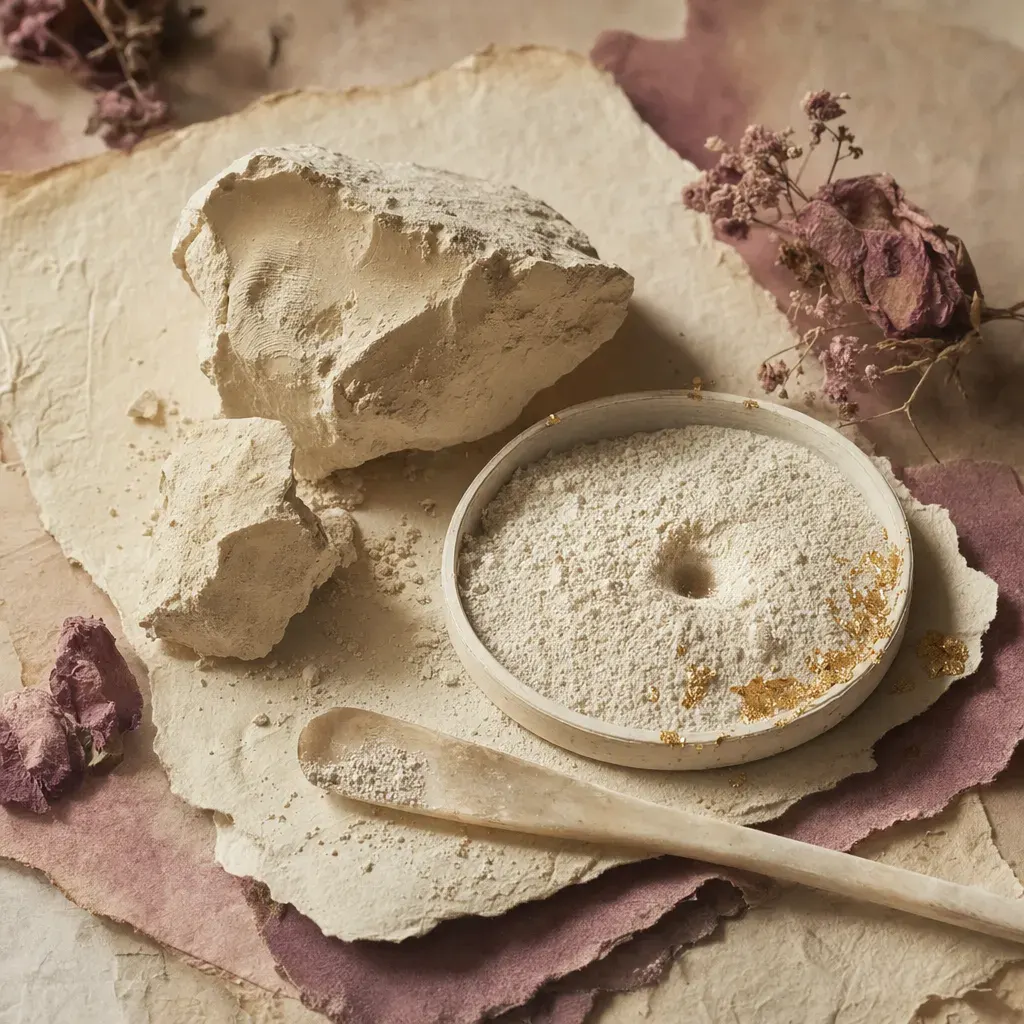
A white aluminium-silicate clay named after the hill near Jingdezhen where it was dug for porcelain; in cosmetics it mattifies by absorbing oil rather than by covering it.
- 2min read
- 4chapters
- 2sources

Vivien
Your guide through time
Listen to this entry
4 min listenVivien reads our essays aloud, word for word — every date and every name in its place — so you can listen the way you would be walked through a gallery.
An AI voice, designed for History of Makeup
Kaolin is the white clay that made porcelain possible, and it is named after a hill. Gaoling — high ridge — is a village near Jingdezhen in Jiangxi province where the clay was dug, and the word reached European languages through Jesuit correspondence and stayed there.[1]
In cosmetics it does something talc does not. Kaolin absorbs. Where talc slides, kaolin drinks oil, so a powder built on it mattifies by taking sebum out of the surface rather than by laying something over it.
What It Is
Kaolin is a rock rather than a single compound, composed largely of the mineral kaolinite, a hydrous aluminium silicate. It is mined, washed and graded, and the whiteness of any given grade depends chiefly on how little iron it contains.
As a cosmetic ingredient it is KAOLIN, CAS 1332-58-7, EC 310-194-1, and as a colourant it is CI 77004.[2] The English trade name is china clay, which records the same origin as the word kaolin by a different route.
In History
Kaolin had been worked at Jingdezhen for centuries before Europe had a name for it. What can be dated is the description rather than the practice. In letters of 1712 and 1722 the French Jesuit François Xavier d'Entrecolles, stationed at Jingdezhen, set out how local potters combined kaolin with a ground porcelain stone called petuntse, and gave the proportions used for different qualities of ware.[3]
The year recorded in this entry is that of the first letter. The gap between when a material was used and when it was written down is real, and collapsing the two is how a dictionary quietly becomes wrong.
What It Does
Kaolin's platelets are smaller and blockier than talc's, so it gives less slip and more absorbency. In a loose or pressed powder it controls shine. In a clay mask it is the mild option, drawing oil without the tightening pull of bentonite. In toothpaste it works as a gentle abrasive.
It also brings bulk and some opacity, though much less of the latter than titanium dioxide, and it takes pigment cleanly — which matters in a product where the clay is most of the mass.
Safety and Status
Kaolin appears in Annex IV to Regulation (EC) No 1223/2009, the European Union's list of colourants permitted in cosmetic products, as CI 77004.[4] It carries none of the reclassification activity that has recently surrounded talc, and it is not subject to the amphibole contamination question, which is specific to talc's geology.
That is a statement about what is documented, not a comparative safety claim. Kaolin is a mined mineral dust, and what literature exists on it addresses occupational exposure during extraction and milling rather than the finished cosmetics it ends up in.
Sources
- [1, 3]Letters of 1712 and 1722 on the manufacture of porcelain at Jingdezhen, in Lettres édifiantes et curieuses, écrites des missions étrangères 1712.
- [2, 4]Regulation (EC) No 1223/2009 on cosmetic products 2009.View source (opens in a new tab) Accessed 2026-09-22.