Carbon Black
Identity
Restrictedas of 22 Sep 2026
- INCI name
- CI 77266
- CAS
- 1333-86-4
- EC
- 215-609-9
- Colour Index
- CI 77266
- Origin
- Synthetic
- Also known as
- lamp black · furnace black · D&C Black No. 2 · Pigment Black 7
No regulatory dataset is loaded. The status above is this archive's editorial summary of the documented record, not a statement of any substance's legal position in your jurisdiction, and nothing here is advice on whether to use it.
In short
Near-pure elemental carbon made by burning hydrocarbons under controlled conditions: the densest black available to a formulator, certified batch by batch in the United States and carrying a separate European authorisation for its nano form.
- 4min read
- 4chapters
- 5sources

Vivien
Your guide through time
Listen to this entry
6 min listenVivien reads our essays aloud, word for word — every date and every name in its place — so you can listen the way you would be walked through a gallery.
An AI voice, designed for History of Makeup
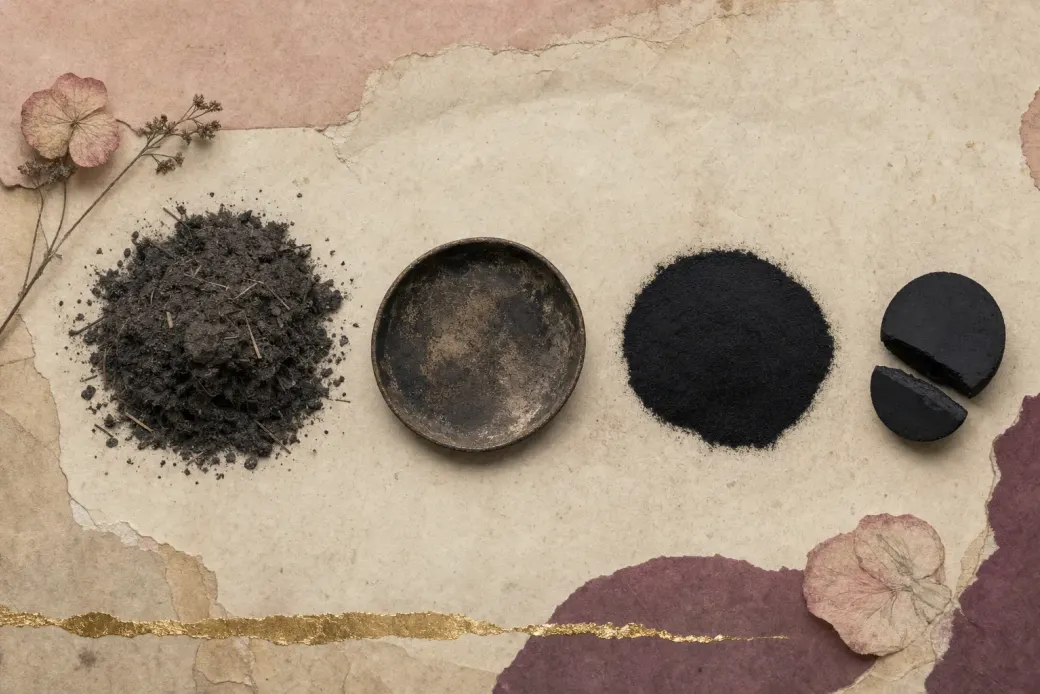
Carbon black is what soot becomes when it is made deliberately. Hydrocarbons are burned or thermally cracked under controlled conditions and the particles are collected. The grade listed for cosmetics in the United States comes from one of those routes in particular, the oil furnace process, burning an aromatic petroleum feedstock, and is a high-purity carbon in aggregates of extremely fine primary particles.[1]
It is the blackest pigment in ordinary cosmetic use, which is why it appears in mascara, eyeliner and pressed eyeshadow. Its American listing is unusual in two ways: it names the specific products the colour may go into rather than granting a general permission, and it requires every batch to be certified before use.[1]
What It Is
The material is elemental carbon in colloidal form. What separates one grade from another is not chemistry but structure: the size of the primary particles, the degree to which they fuse into aggregates, and the total surface area. Soot is not the same material under another name. Soot is an uncontrolled combustion by-product of variable composition, carrying a large organic fraction; carbon black is manufactured to a specification and is very largely carbon, which is why this entry keeps the two apart in its identifiers and explains the relationship in prose instead.
The grade listed for cosmetics in the United States is a high-purity furnace black, made by burning an aromatic petroleum feedstock, with a surface area between 200 and 260 square metres per gram.[2] Those figures are part of the legal identity of the colour additive. A carbon black outside them is a different substance as far as the regulation is concerned.
In History
Soot has been used to darken eyes for as long as there have been lamps, but dating that use precisely is harder than it looks, because amorphous carbon is difficult to identify by the analytical methods normally applied to ancient cosmetics.
A study published in 2022 of kohls held in the Petrie Museum found recipes that were manganese-based, silicon-based and carbon-based as well as the familiar lead-based ones, and noted directly that confirming carbon black in its amorphous phase would require Raman spectroscopy, which the project did not have available.[3] The honest position is that carbon eye cosmetics are old and under-detected rather than firmly dated.
The modern material has a separate and industrial history. Carbon black was developed at scale for rubber and printing ink, and cosmetics take a small, high-purity share of that output.
What It Does
Carbon black absorbs across the visible spectrum more completely than any other pigment a formulator can reach for, so a very small loading gives a very deep black. Black iron oxide, its main alternative, is greyer and has to be used at higher levels to approach the same depth. Its fineness is what lets it build an even film on a lash without weighting it, which is an observation about formulation and not a regulatory statement.
What the American listing supplies is a permission: mascara is one of the nine product types the colour may be used in.[4] The European conditions attach to the nano form specifically. Entry 126a of Annex IV permits Carbon Black (nano) at up to 10 per cent by weight, with a primary particle size of 20 nanometres or larger, and not for use in applications that may lead to exposure of the end user's lungs by inhalation.[5] The recitals to that regulation record that the exclusion turns on sprayable applications, so it is not the fineness needed to coat a lash that the rule addresses, and the ordinary furnace grade in a mascara is not the nano form at all.
Safety and Status
In the United States the relevant listing is D&C Black No. 2, at 21 CFR 74.2052. The final rule appeared in the Federal Register on 28 July 2004 and, by its own dates section, took effect on 30 August 2004, permitting the colour in eyeliner, brush-on-brow, eye shadow, mascara, lipstick, blushers and rouge, makeup and foundation, and nail enamel.[6] Unlike iron oxides or mica, every batch must be certified by the agency before it is used.[7]
In the European Union, non-nano carbon black is entry 126 of Annex IV to Regulation (EC) No 1223/2009, where it carries a purity and impurity profile but no maximum concentration and no restriction by product type.[8] Commission Regulation (EU) 2016/1120 of 11 July 2016 inserted a separate entry, 126a, for Carbon Black (nano): up to 10 per cent by weight, a primary particle size of 20 nanometres or larger, and not to be used in applications that may lead to exposure of the end user's lungs by inhalation.[9] The recitals to that regulation record the Scientific Committee on Consumer Safety's view that carbon black in nano form, at up to 10 per cent by weight, posed no risk of adverse effects after application on healthy, intact skin; the condition the regulation enacted addresses inhalation only.[9] The distinction is the committee's and the legislator's, not this entry's.
Sources
- [1, 2, 4, 7]21 CFR 74.2052 - D and C Black No. 2 Code of Federal Regulations, title 21, part 74, subpart C, 2026.View source (opens in a new tab) Accessed 2026-09-22.
- [3]Recipes of Ancient Egyptian kohls more diverse than previously thought Scientific Reports, volume 12, 2022.View source (opens in a new tab)
- [5, 9]Commission Regulation (EU) 2016/1120 of 11 July 2016 amending Annex IV to Regulation (EC) No 1223/2009 on cosmetic products Official Journal of the European Union, 2016.View source (opens in a new tab) Accessed 2026-09-22.
- [6]Listing of Color Additives Subject to Certification; D and C Black No. 2 (final rule) Federal Register, 28 July 2004, 2004.View source (opens in a new tab) Accessed 2026-09-22.
- [8]Regulation (EC) No 1223/2009 on cosmetic products 2009.View source (opens in a new tab) Accessed 2026-09-22.