The Long Argument Between Adornment and Concealment
Four centuries in which the face was painted with great effort and the painting denied with equal effort — traced here through England, Ireland and Venice.
HOM · Culture5th century BCE – 1930Artifice & Denial
All of The European Tradition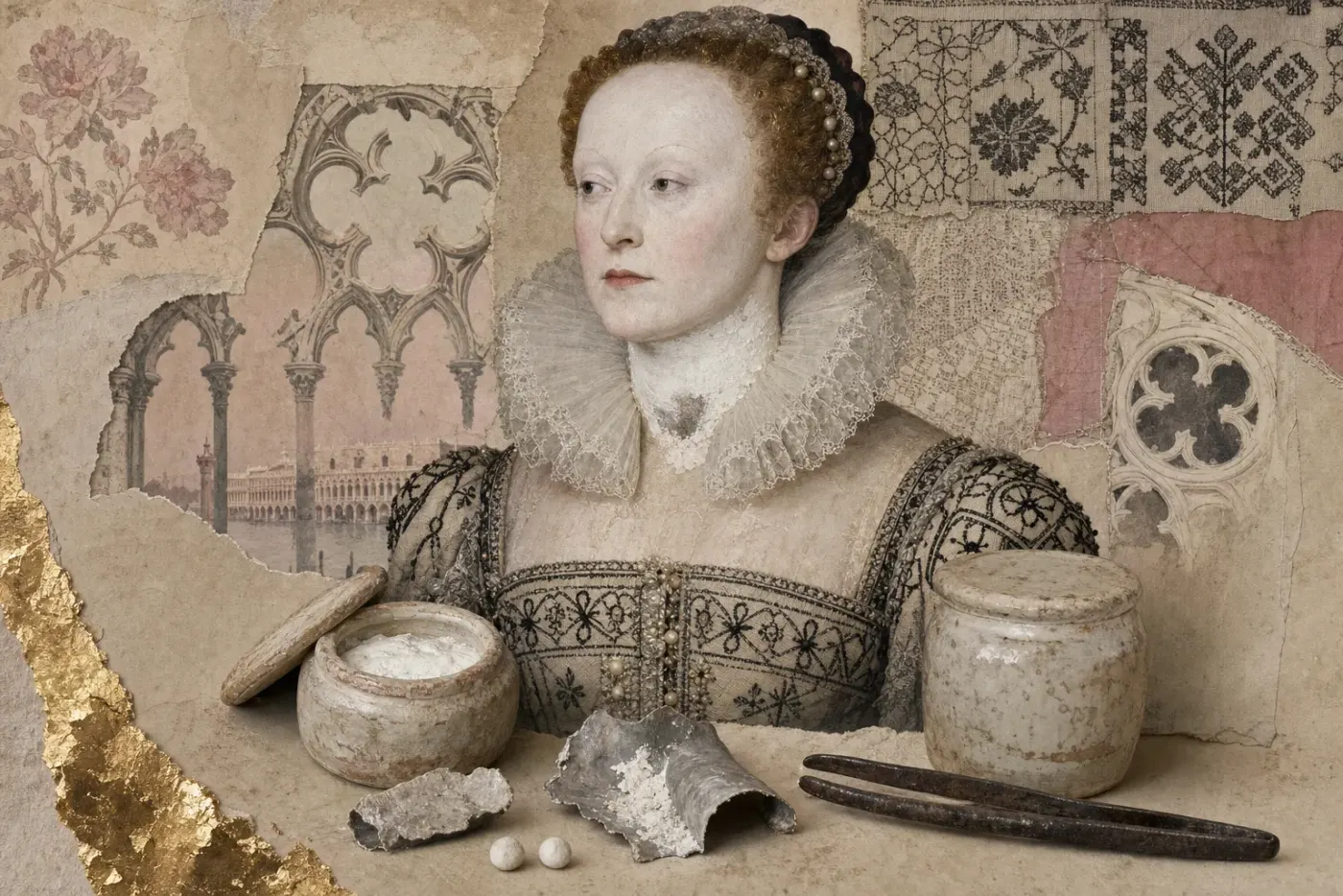
In short
What this archive can show of the European tradition is not a sequence of looks but one unresolved argument: cosmetics were used continuously for four centuries by people who agreed, in public and frequently in print, that using them was a form of lying.
- 13min read
- 6chapters
- 19sources
Vivien
Your guide through time
Listen to this essay
12 min listenVivien reads our essays aloud, word for word — every date and every name in its place — so you can listen the way you would be walked through a gallery.
An AI voice, designed for History of Makeup
Europe's cosmetic history is usually told as a sequence of looks. It reads better as a single argument that never resolved: whether a face that has been worked on is a beautiful face or a dishonest one. The evidence gathered below is English, Irish and Venetian, with a Greek prehistory at the far end of it; the German lands, Iberia, Scandinavia and everything east of Venice had their own versions of the argument, and they are not covered here.
Both positions were held at once, often by the same people. The centuries that produced the most elaborate technology of concealment also produced the largest literature denouncing it, and the denunciations are among the better evidence that the technology was in use. Almost everything strange about the record follows from that.
The White, and What It Cost
Lead-carbonate face whites are attested from at least the fifth century BCE. Pellets of cosmetic psimythion survive from burials at Athens and Tanagra, dated between the late fifth and the third centuries BCE, and diffraction analysis finds them to be 97 to 99.7 per cent cerussite — the neutral lead carbonate.[1]
That is not quite the same material as the white the Renaissance used, and the difference is the point of the paper that reports it. The European stack process, sheet lead corroded over vinegar in a warm bed, yields hydrocerussite, the basic carbonate; hydrocerussite is the trace component in the Greek pellets, at 0.3 to 3 per cent. Photos-Jones and her colleagues argue that producing cerussite in preference to hydrocerussite calls for a different mechanism — an excess of carbon dioxide held over a fermenting liquid through a ten-day cycle, rather than acetic acid vapour over metal.[1] Two industries, a millennium and a half apart, making two chemically distinct whites for the same job.
Whichever carbonate it was, nothing else available did what it did. Lead white is dense, opaque and fine-grained, and those are pigment properties before they are cosmetic ones: it was the standard white of European easel painting, Pigment White 1, until zinc white and titanium white displaced it.[2] On skin it gave a flat, continuous, light-reflecting surface that chalk, talc and starch could not match, and the cosmetic literature treats it accordingly, with Venetian ceruse as the luxury grade and a status good in its own right.[3][4]
It also damaged the skin it covered, which is what made it durable rather than what should have ended it. Greying and coarsening of the complexion are the visible consequences of lead applied over years, and they are best concealed by more of the same material.[3] A cosmetic that spoils the surface it improves manufactures its own demand.
The Forehead
The other long-running European specification was the hairline. From the later medieval centuries into the sixteenth, the admired forehead was high, broad and bare, which meant plucking the hair back from it — sometimes by a considerable distance — and thinning the brows almost to nothing.[5][6]
Portraits show it consistently, and that consistency is a trap. A commissioned portrait is strong evidence of what was thought beautiful and weak evidence of what any particular face looked like, since painters worked to conventions of colour and proportion for patrons who were paying.[7] The gap between the two is the space the recipe books were selling into.
…I find they are frequently Fairer than they ought to be. Such Impostures are not to be tolerated in Civil Society…
Two Deaths, and What the Sources Say
European beauty history supplies two famous deaths by cosmetics. Neither survives close reading in the form it is usually given.
Elizabeth I is said to have been killed by ceruse. The painted appearance of her later portraits is a real and deliberate convention, but the poisoning narrative is a nineteenth- and twentieth-century reconstruction rather than a contemporary claim — and scholars working on her image have gone further, questioning how much evidence there is that she used ceruse at all.[9]
Maria Gunning, Countess of Coventry, died in 1760 at twenty-seven, and the attribution to cosmetics was contested from the beginning. The Dictionary of Irish Biography records both accounts side by side: that she is thought to have destroyed her health through persistent use of white lead, and that she died of tuberculosis.[10] The disagreement has never been settled.
The general fact needs neither anecdote, and it should not rest on a costume historian. The firmest measurement of the exposure comes from another continent and the same cosmetic: skeletal analysis of an Edo-period Japanese cemetery found a median lead concentration of 1,241 micrograms per gram of dry bone in children aged three and under, against 14.3 in the adult men buried with them, and the authors attribute it to lead-based face powder.[11] Lead worn on the face over years does measurable harm. Keeping the two English stories intact is what costs an archive the right to be believed about the part that is true.
The Act of Parliament That Never Was
A text circulates, and has circulated since the late eighteenth century, purporting to be an Act of 1770 under which a woman who had seduced and betrayed a man into matrimony by means of scent, paint, false hair, iron stays or high-heeled shoes would have her marriage declared void and would incur the penalties then in force against witchcraft.
No such Act exists. Alison Daniell's study of the text, published in the Journal for Eighteenth-Century Studies in 2022, treats it as eighteenth-century satire and sets out what it was assembled from: contemporary understandings of witchcraft, the moral panic over divorce and adultery, and a long tradition of satire on cosmetics.[12]
There is also an internal tell. The penalties the text invokes were not available in 1770. The Witchcraft Act 1735 had already ended prosecution for witchcraft in Great Britain, making it an offence instead to claim that any person possessed magical powers.[13]
It is quoted in good faith constantly, usually as the moment Britain tried to ban makeup. It is the clearest case in this archive of a claim that survives because it is too good to check.
The Victorian Prohibition Had No Instrument
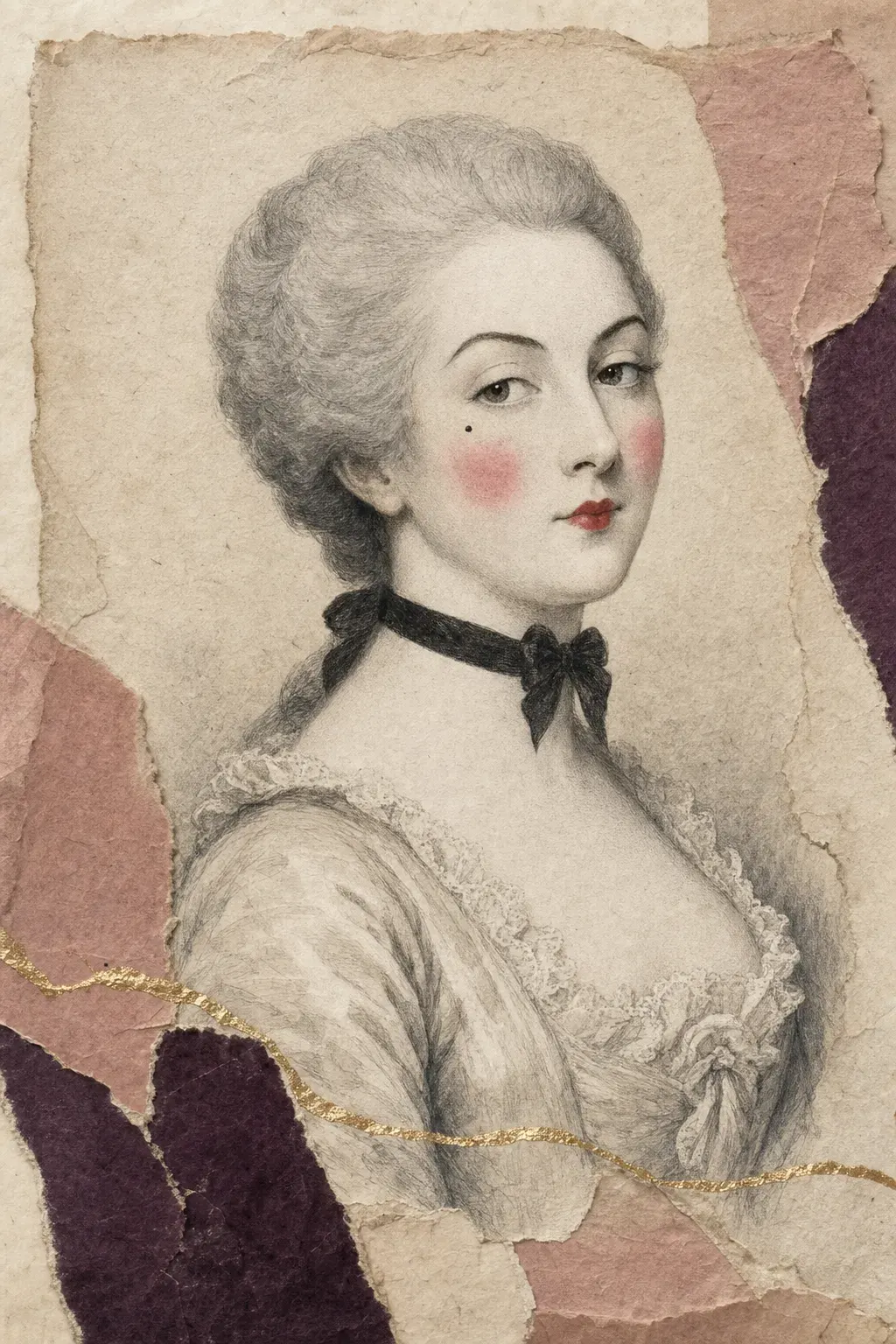
The nineteenth century is where the argument hardened into a rule, and the rule is routinely described as a ban. It had no instrument that anyone has been able to produce. What enforced it was a British conduct literature of great volume and near-total consistency, holding that paint belonged to the stage and to prostitution, and the enforcement was social — exercised by readers on one another.[14][15] In the United States the same decades produced a trade that grew by calling its products something other than cosmetics — creams, lotions, complexion aids — and Kathy Peiss's history of that market is the standard account of how the euphemism worked.[16]
What the period did prosecute was fraud. Sarah Rachel Leverson traded from 47a New Bond Street as Madame Rachel, selling some sixty preparations presented as the beauty secrets of ancient Arabia and the harem. She was tried at the Old Bailey in 1868 and again in 1878, and died in Woking gaol in 1880.[17] The charge was obtaining money by false pretences, not selling cosmetics — which is the point. The objection was never to the jars.
Two things are worth noticing in that sales pitch. The first is that a Victorian customer would take an orientalist fantasy as a warrant of efficacy. The second is that a real transmission of cosmetic technique from the Islamic world into Europe had happened some seven centuries earlier, in the Salernitan compendium that carries De ornatu mulierum, and nobody was selling that.[18]
The 1920s Break
The argument did not so much end as become unsustainable. Within about a decade, visible cosmetics moved from a mark of disrepute to an ordinary part of respectable dress — a shift too fast to be explained by any change in what the products were. The business history of the period tracks it as an international movement, with firms, distribution and advertising crossing the Atlantic in both directions.[19]
Part of what enabled it was mechanical, and the usual account of that is wrong in its details. The metal lipstick case was not an American invention of 1915. Blondeau et Cie's Vinolia Lypsyl was on sale in Britain in a metal tube by 1892, and a Dorin catalogue of 1893 lists lipsticks in nickel cases, some pushed up from the base with a finger and some on a sliding mechanism. Scovill's 1915 case is credited as the first American one and is then routinely mis-credited as the first anywhere, and the Maurice Levy usually named as its inventor was an investor in the venture rather than a patentee.[20]
What did change was the mechanism. James Bruce Mason Jr of Nashville filed on 17 July 1922 and was granted US Patent 1,470,994, Toilet article, on 16 October 1923: a threaded rod on the cup engaging an interiorly threaded sleeve, turned by a knurled head at the closed end of the barrel, running the stick up and back down again.[21] His own specification states the purpose — devices for holding articles such as lip sticks which are worn away during the use thereof — and the effect: the stick can be instantly projected from the casing for use and as quickly moved to retracted position. A cosmetic that can be applied at a restaurant table is a different social proposition from one that needs a dressing room.
The rest was cinema, the visible working woman, and a generation with its own reasons to break with what preceded it. Both standard accounts of that decade are American — Peiss on the industry and its customers, Zeitz on the flapper — and this archive has not yet found their European equivalents, so the causal story told here should be read as an American one that Europe also lived through.[22][23] What the decade did not do was settle the argument. The requirement that a face look effortless survived intact, and the phrase no-makeup makeup is a direct descendant of the medieval rule that artifice must not be detectable. The products stopped being concealed. The effort never has.
Sources
- [1]On metal and 'spoiled' wine: analysing psimythion (synthetic cerussite) pellets (5th–3rd centuries BCE) and hypothesising gas-metal reactions over a fermenting liquid within a Greek pot Archaeological and Anthropological Sciences 12.10, article 243, 2020.View source (opens in a new tab) Accessed 2026-09-22.
- [2]Lead whiteView source (opens in a new tab) Accessed 2026-09-22.
- [3, 5]Fashions in Makeup: From Ancient to Modern Times Peter Owen, 1972.
- [4, 6, 15]The Artificial Face: A History of Cosmetics David & Charles, 1973.
- [7]Italian Renaissance portraiture, European Paintings collectionView source (opens in a new tab) Accessed 2026-09-22.
- [8]The Spectator, No. 41, Tuesday 17 April 1711 Project Gutenberg eBook #12030 (The Spectator, volumes 1, 2 and 3), 1711.View source (opens in a new tab) Accessed 2026-09-25.
- [9]The Face of Queenship: Early Modern Representations of Elizabeth I Palgrave Macmillan, 2010.
- [10]Gunning, Maria Royal Irish Academy and Cambridge University Press, 2026.View source (opens in a new tab) Accessed 2026-09-22.
- [11]Severe lead contamination among children of samurai families in Edo period Japan Journal of Archaeological Science 38(1), 23-28, 2011.View source (opens in a new tab) Accessed 2026-09-22.
- [12]Of False Hair, Spanish Wool, and Witchcraft: The Act of Parliament That Never Was Journal for Eighteenth-Century Studies 45(4), 447-462, 2022.View source (opens in a new tab) Accessed 2026-09-22.
- [13]Witchcraft Act 1735 (9 Geo. 2 c. 5) Parliament of Great Britain, 1735.
- [14]Beauty and Cosmetics 1550–1950 Shire Publications, 2012.
- [16, 22]Hope in a Jar: The Making of America’s Beauty Culture Metropolitan Books, 1998.
- [17]The True Story of Madame Rachel helenrappaport.com; author of Beautiful For Ever: Madame Rachel of Bond Street, 2026.View source (opens in a new tab) Accessed 2026-09-22.
- [18]The Trotula: A Medieval Compendium of Women’s Medicine University of Pennsylvania Press, 2001.
- [19]Beauty Imagined: A History of the Global Beauty Industry Oxford University Press, 2010.
- [20]Lipsticks Cosmetics and Skin.View source (opens in a new tab) Accessed 2026-09-22.
- [21]US Patent 1,470,994 — Toilet article (swivel-up lipstick holder) United States Patent and Trademark Office, 1923.View source (opens in a new tab) Accessed 2026-09-22.
- [23]Flapper: A Madcap Story of Sex, Style, Celebrity, and the Women Who Made America Modern Crown, 2006.
Filed under