The Experimenti: Caterina Sforza’s Working Notebook
A collection in which cosmetics, medicine and alchemy sit on the same page, assembled by somebody with no interest in keeping them apart.
In short
Caterina Sforza’s Experimenti is a collection of recipes in which cosmetic, medical and alchemical procedures appear together without distinction, and it stands as the clearest surviving example of cosmetic knowledge treated as technical literature in early modern Italy.
- 12min read
- 6chapters
- 3sources
Vivien
Your guide through time
Listen to this essay
5 min listenVivien reads our essays aloud, word for word — every date and every name in its place — so you can listen the way you would be walked through a gallery.
An AI voice, designed for History of Makeup
Caterina Sforza is remembered for a siege. She was also the compiler of a substantial collection of recipes, and that collection is a far better source for how the period actually handled cosmetic knowledge than any portrait or any chronicle.[1]
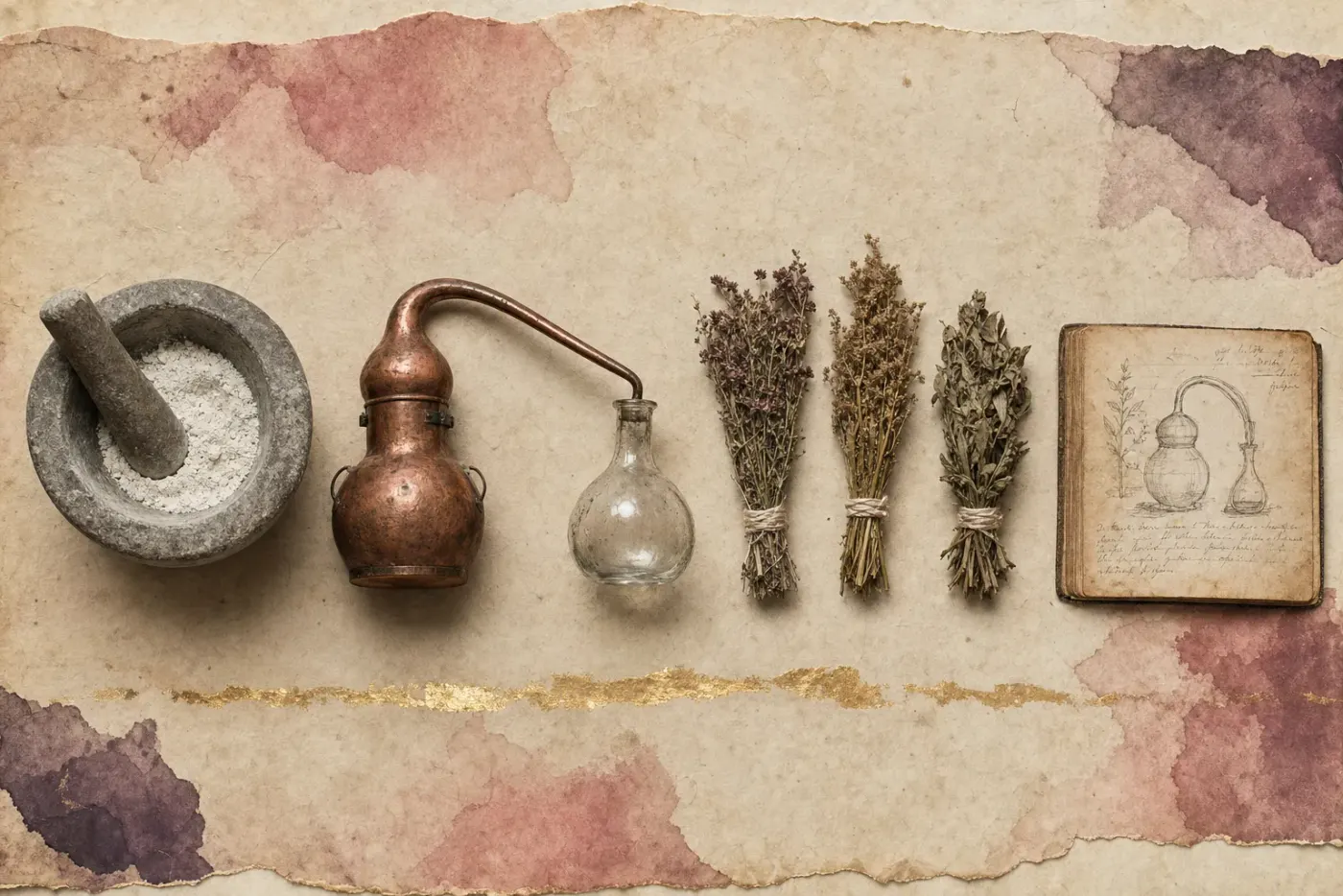
The Experimenti is a working document rather than a literary one. It gathers procedures — for the skin, for the hair, for illness, for the treatment of metals — and arranges them by what they do. Nothing in its organisation suggests that its compiler regarded a face wash and a medicine as belonging to different enterprises.[1]
The Categories Do Not Separate
The single most useful thing about the collection is what it declines to distinguish. Cosmetic, medical and alchemical material sits together, and the boundaries a modern reader expects — between treating a body, decorating it, and transforming a substance — are simply not being drawn.[2]
That is not muddle. It reflects a coherent understanding in which all three are operations on matter, conducted with the same apparatus, by the same person, using overlapping materials, and judged by whether the intended change occurred. Reading it as three subjects accidentally bound together imports a division that took another two centuries to appear.[2]
What Experiment Meant
The title is the trap. An experimento in this literature is a tried procedure — something that has been done and reported as working — rather than a controlled test in the later scientific sense.[3]
The distinction matters because the modern word invites a claim the source cannot support. What these collections record is accumulated practice, corrected where it failed and transmitted where it succeeded, without any mechanism for isolating why. That is a real and valuable epistemology, and it is not the experimental method, and the resemblance of the words has misled a great deal of popular writing about the period.[3]
Nothing in its organisation suggests that its compiler regarded a face wash and a medicine as belonging to different enterprises.
A Noblewoman Doing Technical Work
The collection matters to a larger argument about who was doing technical work in early modern Italy. Its compiler was a noblewoman with a laboratory’s worth of concerns, gathering procedures from correspondents and practitioners and recording results — an activity with no place at all in the standard account of who practised science in the period.[4]
Cosmetics are central to that rather than incidental to it. Because cosmetic preparation was an acceptable domestic activity for a woman of standing, it provided a legitimate route into materials work of a kind that would have been harder to justify in any other frame.[4]
What the Recipes Are Like
They are specific, procedural and demanding. They call for distillation, infusion, grinding and repeated washing; they specify materials that had to be bought rather than gathered; and they assume the reader can judge when a preparation has reached the right state without being told how it should look.[5]
They are also, in places, unattainable — procedures requiring materials or apparatus that even a wealthy household would have struggled to assemble. A collection is an ambition as well as a record, and the presence of a recipe is not proof that its compiler ever attempted it.[6]
Why This One Survived
Survival in this literature correlates with the fame of the name attached, not with the quality of the contents. A collection associated with a well-known figure is preserved, catalogued and eventually edited; an identical collection assembled by an unremarkable household is not.[7]
So the Experimenti should be read as one surviving example of something that was almost certainly common rather than as an exceptional document. The exceptional thing about it is the name on the cover, which is exactly the property that has nothing to do with its contents.[7]
What Is Not Known
How much of the collection its named compiler assembled personally, as against inherited, commissioned or received, is not recoverable, and the manuscript tradition for collections of this kind is generally too tangled to settle such questions.[8]
Nor does the collection tell us what anyone looked like. A book of procedures records what was thought worth doing to a face, which is a different claim from what faces in Italy actually were — and the gap between those two is where most confident writing about Renaissance beauty goes wrong.[9]
Sources
- [1, 2, 3, 4, 5, 7, 8]Daughters of Alchemy: Women and Scientific Culture in Early Modern Italy Harvard University Press, 2015.
- [6]Fashions in Makeup: From Ancient to Modern Times Peter Owen, 1972.
- [9]Italian Renaissance portraiture, European Paintings collectionView source (opens in a new tab) Accessed 2026-09-22.
Filed under