The Patch Box: Black Spots, Party Politics and a Mirror in the Lid
Small black patches were worn on the face for more than a century, and they needed a box with a mirror to be put on in company.
In short
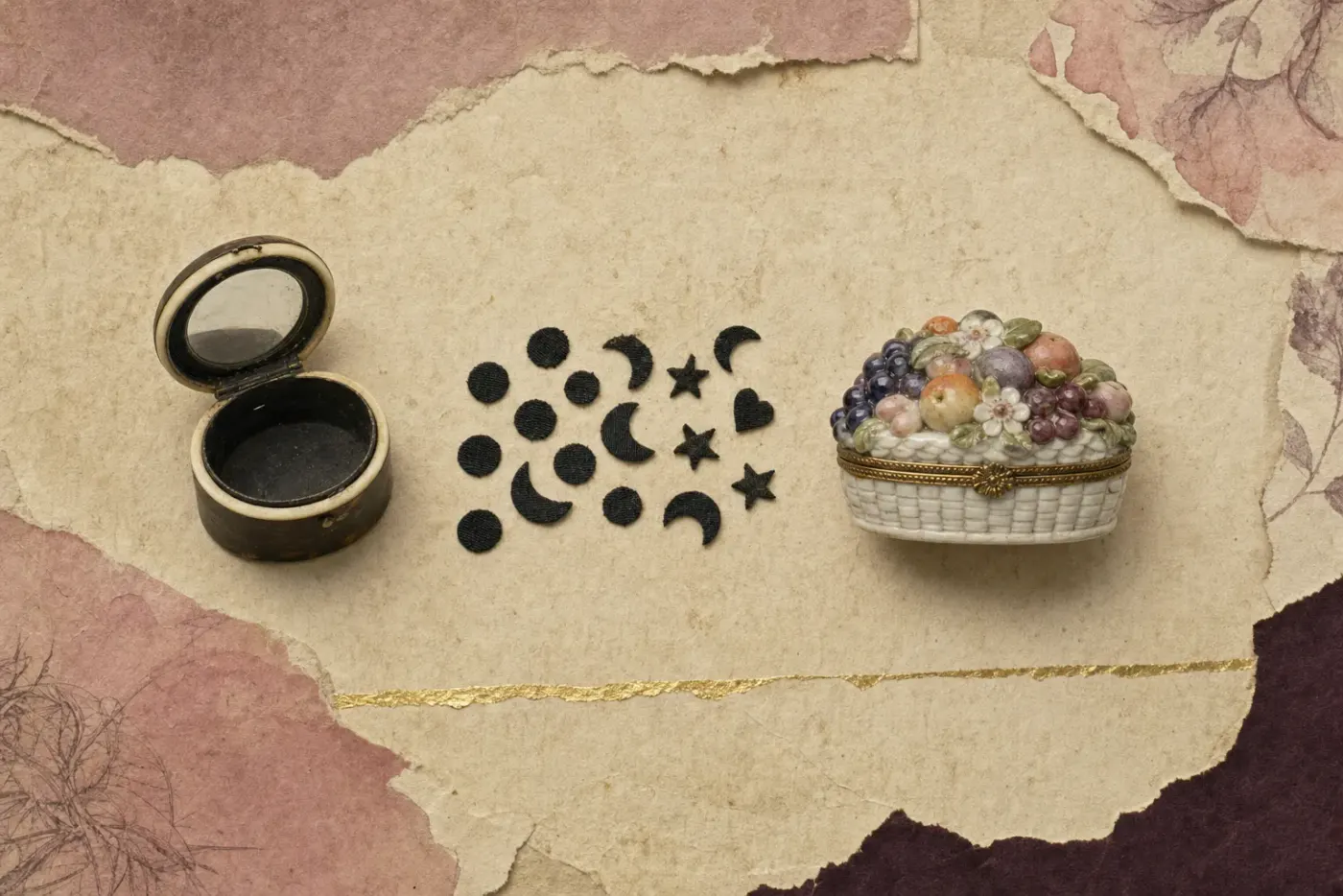
Samuel Pepys recorded on 30 August 1660 the first day he saw his wife wear black patches, and the boxes that held them, like a Meissen porcelain example of about 1750, were fitted with a mirror in the lid.
- 3min read
- 4chapters
- 5sources

Vivien
Your guide through time
Listen to this essay
4 min listenVivien reads our essays aloud, word for word — every date and every name in its place — so you can listen the way you would be walked through a gallery.
An AI voice, designed for History of Makeup
On 30 August 1660 Samuel Pepys wrote in his diary: This the first day that ever I saw my wife wear black patches since we were married! His nineteenth-century editor added a note that the fashion had come in towards the end of the reign of Charles I, and that it was ridiculed in the Spectator.[1]
Pepys got used to it quickly. By November he thought his wife, with two or three black patches on, much handsomer than the king's sister.[1] A patch was a small black spot stuck to the face. It needed somewhere to be kept, and a mirror to be placed by. The patch box supplied both.
What the Box Was For
The Victoria and Albert Museum describes patch boxes as small boxes used to contain patches applied to the skin to hide blemishes in the eighteenth century.[2] They survive in horn, ivory and porcelain among other materials. One French box of the first half of the century is an oval of pressed horn, eight centimetres across, with an ivory rim and a gilt openwork panel of flowers and two animals in the lid.[3]
The mirror is what makes a box a patch box. A Meissen porcelain box of about 1750, shaped as a grape-picker's basket, repeats a snuff box that Johann Joachim Kändler first modelled in 1737. This one has a mirror inside the lid, and the museum concludes that it must have been intended for cosmetic patches.[4]
Party Signals
In June 1711 Joseph Addison gave an issue of the Spectator to patches. At the opera in the Haymarket, he wrote, he had seen two parties of fine women in opposite boxes, patched on opposite sides of the forehead as Party-Signals to distinguish Friends from Foes: Whigs on one side, Tories on the other, and a neutral party in the middle boxes who patched on both. He had heard of marriage articles in which a lady stipulated that she might patch on whichever side she pleased, and he pitied a Whig lady with a natural mole on the Tory side of her forehead.[5]
It is a joke, and it is often quoted as a report. What it establishes is that in 1711 patches were common enough, and conspicuous enough, for a London essayist to build a political satire on where they sat. It does not establish that anyone patched by party.
The mirror in the lid is what makes a box a patch box.
A Worn Brush
The box outlasted the height of the fashion. One made by Josiah Wedgwood and Sons in the late 1780s is ivory, set with a three-coloured jasper cameo of a classical figure behind glass. Its lid held a mirror, now detached and cracked, and inside, between two hinged compartments, lies a small brush with a turned ivory handle and very worn bristles.[6]
The worn brush is the most eloquent thing in it. Whatever the box was used for by the end of its life, somebody used it long enough to wear its brush down.
What Is Not Known
How far down society the fashion went. The boxes that survive are the costly ones, and the diarist and the satirist wrote about the fashionable; Pepys himself thought it strange when his patron wanted his own wife and child patched, and put it down to his having become a perfect courtier.[7]
Why any one person wore a patch is harder still. Addison's satire mentions a lady forced by a pimple to patch on the wrong side, and matrons who had been taught that such spotting of the face was unlawful.[8] Concealment, loyalty, fashion and scruple all appear in the sources, and the objects cannot tell us which applied to whom.
Sources
- [1, 7]The Diary of Samuel Pepys, entries for 30 August, 20 October and 21 November 1660 Project Gutenberg eBook #4125 (Diary of Samuel Pepys, complete 1660), 1660.View source (opens in a new tab) Accessed 2026-09-25.
- [2, 6]Patch box, Josiah Wedgwood and Sons, Etruria, 1785-1790, museum number WE.4650-2014View source (opens in a new tab) Accessed 2026-09-25.
- [3]Patch box with floral motifs and animals, France, first half of the eighteenth century, museum number 807:1-1864View source (opens in a new tab) Accessed 2026-09-25.
- [4]Patch box, Meissen porcelain factory, about 1750, museum number 939-1882View source (opens in a new tab) Accessed 2026-09-25.
- [5, 8]The Spectator, No. 81, Saturday 2 June 1711 Project Gutenberg eBook #12030 (The Spectator, volumes 1, 2 and 3), 1711.View source (opens in a new tab) Accessed 2026-09-25.
Filed under