The Bonfire of the Vanities: Burning the Toilette in Public
In fifteenth-century Italy, preachers persuaded whole cities to pile their mirrors, scents and false hair in the square and set them alight.
In short
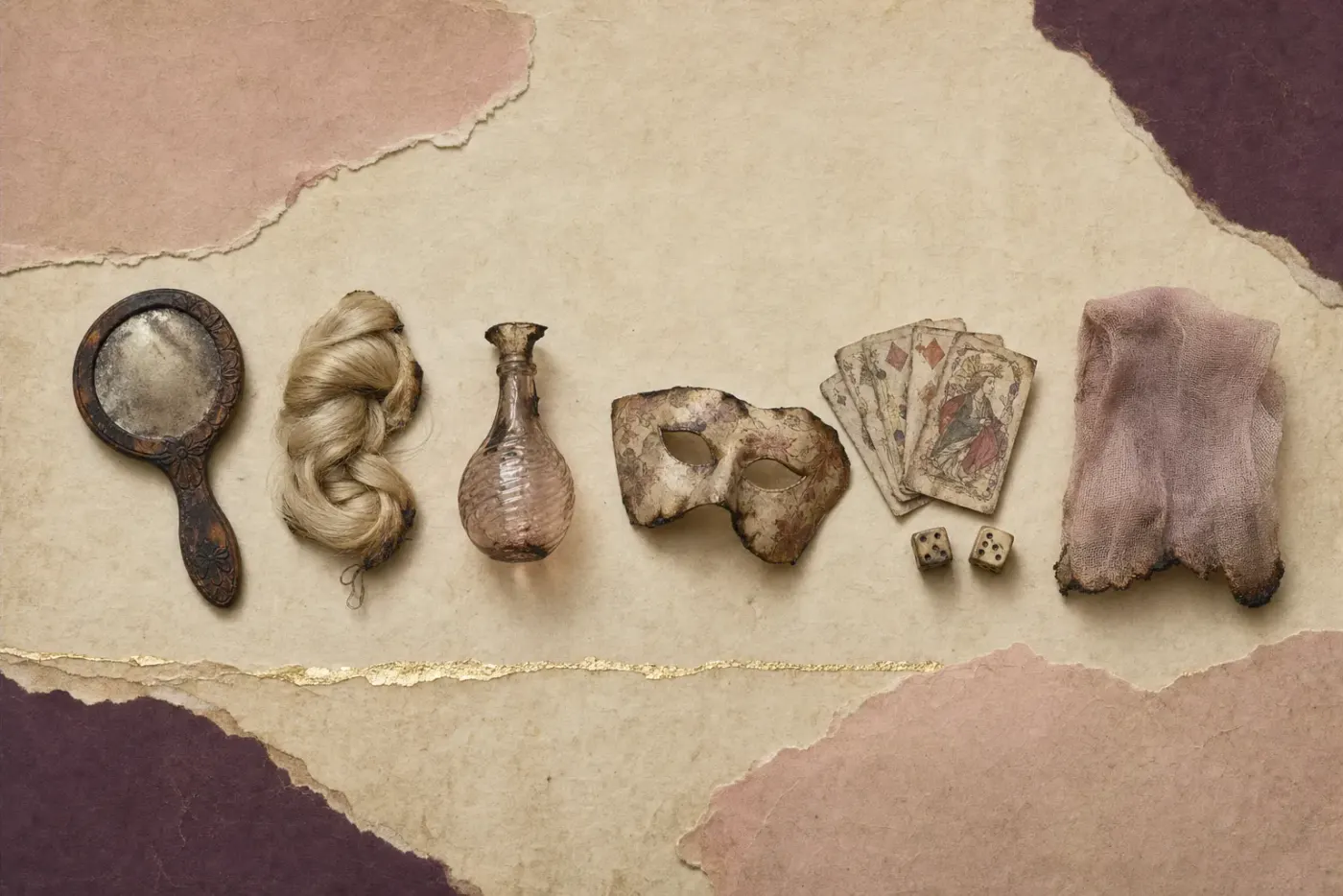
On the last day of Carnival in 1497, and again the following year, Florence burned a stepped pyramid of vanities on the Piazza della Signoria, with women's toilette articles, scents, mirrors, veils and false hair on one of its tiers.
- 3min read
- 5chapters
- 2sources

Vivien
Your guide through time
Listen to this essay
5 min listenVivien reads our essays aloud, word for word — every date and every name in its place — so you can listen the way you would be walked through a gallery.
An AI voice, designed for History of Makeup
On 27 February, the last day of Carnival, the Florentine apothecary Luca Landucci wrote in his diary: There was made on the Piazza de' Signori a pile of vain things, nude statues and playing-boards, heretical books, Morganti, mirrors, and many other vain things, of great value, estimated at thousands of florins. Boys in procession, carrying crosses and olive branches, set it alight, and although "lukewarm people" threw dead cats and dirt on the pile, they "burnt everything".[1]
The pile was not improvised. It was a rectangular structure more than twelve braccia on each side, built by carpenters over several days and guarded by armed men the night before, and the procession was made, Landucci says, as it had been the year before.[1]
A Ritual with a Form
Landucci was watching the second of Girolamo Savonarola's two great bonfires, but the form was older. The historian Jacob Burckhardt describes how a successful preacher's sermons would end in a burning: dice, cards, games, masks, musical instruments, song-books and false hair were arranged on a scaffold, a figure of the devil was fastened to the top, and the whole was set on fire.[2]
One of the preachers he names is Bernardino of Siena. A sermon Bernardino preached in Rome in 1424 was followed, Burckhardt records from a Roman diarist, by a bonfire of vanities on the Capitol.[2] Renunciation had a procedure: preach, collect, build, burn.
What Was on the Pyramid
Burckhardt's account of the Florentine bonfire of 1497 describes a stepped pyramid on the Piazza della Signoria. False beards, masks and carnival disguises lay on the lowest tier; then books of the Latin and Italian poets; then women's ornaments and toilette articles, scents, mirrors, veils, and false hair; above them lutes, harps, chess-boards and playing-cards; and at the top, paintings, especially of beautiful women.[3]
A Venetian merchant, he adds, offered the city 22,000 gold florins for everything on the pyramid, and the answer was to take his portrait too and burn it with the rest. The objects were collected partly by bands of boys who went into houses to take them, and who were sometimes beaten and sent away.[3]
A list of what was burned is also a list of what people owned.
The Toilette Being Renounced
What the fires were aimed at is clear from Burckhardt's description of the Italian toilette. False hair, often made of white or yellow silk, was worn in defiance of the law. The ideal colour was blond, and women sat for whole days in the sun to bleach their hair. There was "an endless list of beautifying waters, plasters, and paints for every single part of the face — even for the teeth and eyelids".[4]
He also records a double standard that a bonfire could not touch: the most honourable matrons, who never used paint through the year, used it on holidays when they showed themselves in public.[4] The fires were a single public day. The toilette was every day.
A Performance Against a Performance
The bonfire borrowed the forms it condemned. It had a stage built by carpenters, costumes and props in the boys' crosses and olive branches, an audience, a guard and a climax.[5] When the pile was lit, Burckhardt writes, the Signoria appeared on the balcony and the air rang with song.[6]
The toilette it attacked was itself a performance with an audience. The bonfire answered it in kind: renunciation made as public and as spectacular as the adornment it renounced.
What Is Not Known
How much face paint was burned. Neither source read here names a single pot of it: Landucci lists mirrors, and Burckhardt's inventory lists toilette articles, scents, mirrors, veils and false hair.[7][8] Paint may have been among the toilette articles, or it may have been kept back, being cheap, private and easily replaced. Nor is it known how many of the objects were given willingly and how many were taken by the boys, or whether anyone painted less the week after.
Sources
- [1, 5, 7]A Florentine Diary from 1450 to 1516 J. M. Dent and Sons, London; E. P. Dutton, New York (digitised by Columbia University Libraries), 1927.View source (opens in a new tab) Accessed 2026-09-25.
- [2, 3, 4, 6, 8]The Civilisation of the Renaissance in Italy Project Gutenberg eBook #2074.View source (opens in a new tab) Accessed 2026-09-25.
Filed under