The Lipstick Tube: How a Case Made Lipstick Public
Paper, then metal, then a screw. Each change to the case removed a reason not to use it in company.
In short
James Bruce Mason Jr of Nashville filed in July 1922 and was granted United States Patent 1,470,994 in October 1923 for a threaded toilet article that drove a stick of lip colour up a metal barrel: the mechanism that let the stick be advanced and retracted with one hand.
- 8min read
- 5chapters
- 6sources

Vivien
Your guide through time
Listen to this essay
7 min listenVivien reads our essays aloud, word for word — every date and every name in its place — so you can listen the way you would be walked through a gallery.
An AI voice, designed for History of Makeup
The case is not a detail of the product. For most of lipstick's history the case has been the product's constraint. A pot needs a brush or a finger, and something to wipe them on. A stick wrapped in paper marks whatever it touches. A case that protects the stick, advances it as it wears and closes over it again is a different proposition from either, and a case that can also be opened and shut by the hand already holding it is different again.
The modern tube arrived in stages. The popular account compresses those stages into a single American invention with a date attached. The record is longer, and less tidy.
Sticks Before Tubes
Coloured lip salves in stick form are reported before 1840, and by the 1840s Pierre-François-Pascal Guerlain was selling rouges suitable for the lips.[1] The firm's Ne m'Oubliez Pas of 1870 is widely described as the first stick lip rouge. James Bennett, whose history of cosmetic manufacture works from trade catalogues and company literature, reports that he has been unable to find any first-hand evidence backing that claim.[1]
The advantage of a stick over a pot was practical rather than cosmetic. A stick did not spill as a liquid rouge did, and applied directly to the lips it left no colour on the fingers to be cleaned off afterwards.[1]
Metal, and Where It Came From
The metal case is European and nineteenth-century. A product called Vinolia Lypsyl, made by Blondeau et Cie, was sold in a metal tube no later than 1892, and a Dorin catalogue of 1893 shows lipsticks in nickel cases.[2]
The familiar date in the English-language account is 1915. The Scovill Manufacturing Company of Connecticut is generally credited with the first American metal case, following a meeting in New York that year between the French cosmetics manufacturer Anthony Guash and the American investor Maurice Levy, arranged by a Scovill official, out of which came the French Cosmetic Manufacturing Company.[2] A meeting that founds a company is not an order placed for cartridges. Levy, routinely credited with inventing the metal lipstick container, was the investor in that arrangement.
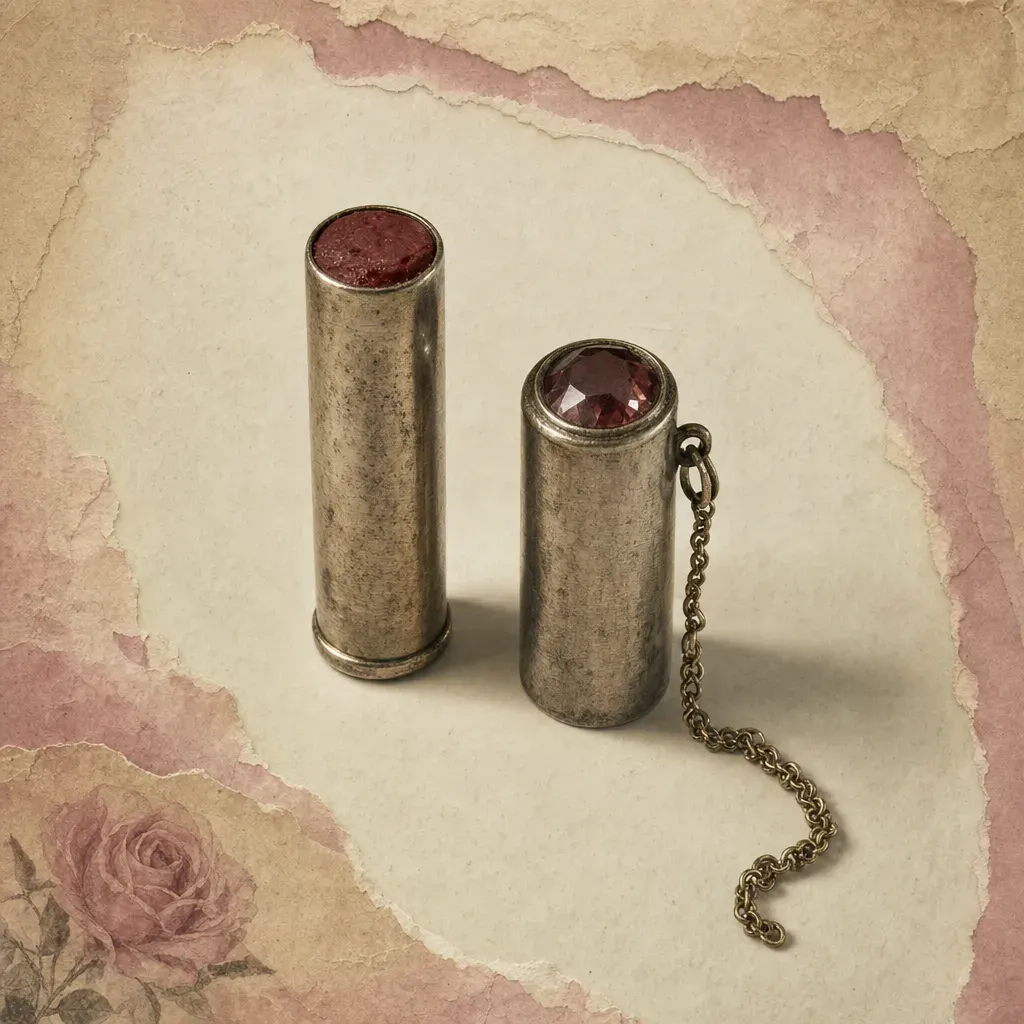
Even the narrower American claim is unsteady. Bennett records that Scovill may have made a metal lipstick container for the Luxor Company of Chicago as early as 1914, and that a newspaper advertisement of 1913 already offers lip pomade in gilt metal cases about two inches long, finished at the top with an imitation jewel and a ring by which they could be attached to a chain.[2] Cases in metal had by then been on sale in Europe for more than twenty years.
Each change to the case removed a reason not to use it in company: no brush, no marked fingers, no separate tool to bring the colour up.
The Screw
The mechanism that matters is a screw. James Bruce Mason Jr of Nashville, Tennessee filed on 17 July 1922 and was granted United States Patent 1,470,994, titled simply Toilet article, on 16 October 1923.[3] The specification opens by describing devices for holding articles such as lip sticks which are worn away during use.
The design is a tubular casing holding a cup on a threaded rod, engaged by a threaded sleeve through the closed end. Turning a head at the base drives the cup up or down, so the stick advances as it wears and retracts for closing, and that much takes one hand and no attention.[3] The casing is still closed by a separate cap slipped over its open end, so the case as a whole is not yet a one-handed object.
Cases that could be opened, used and closed with one hand were sold as automatic lipsticks, and they are a development of the 1930s: Jean Patou's Lift in 1930, Helena Rubinstein's Automatic Lipstick in 1931 and Golden Automatic in 1935, Harriet Hubbard Ayer's in 1933, Elizabeth Arden's in 1934.[4] Bennett records Mason's as the earliest known patent for a lipstick with a swivel mechanism, which is a more careful claim than calling it the first.[4]
What the Tube Holds
The case also specifies the formula. A stick has to be firm enough to hold its shape in a warm bag, soft enough to deposit colour under light pressure, and castable, because it is made by pouring into a mould. That is a wax problem, and it is solved with a blend rather than a single material: waxes with a higher melting point give the stick greater strength, while those with a lower melting point let it soften as it is applied. The substances that recur in lipstick bases across the last century are beeswax, candelilla and carnauba waxes, ozokerite and ceresin, castor oil, lanolin and lanolin absorption bases, cocoa butter, lard, cetyl alcohol, petroleum jelly and liquid paraffin.[5]
Solvent and colour follow from the same constraint. By the 1930s castor oil was almost universally preferred as the solvent for the staining bromo acids used in indelible shades, though glycol-based alternatives were in production alongside it, among them Baudecroux's Rouge Baiser of 1927. Its high ricinoleic content is the property that dissolves those stains; it was not readily compatible with the other ingredients of the base, which forced cosmetic chemists into more complex formulations.[6] The tube did not merely carry the stick. It set its terms.
Where It Could Then Be Used
The change in use follows the change in hardware closely enough to be worth stating plainly. Through the nineteenth century, visible lip colour on a respectable woman was something to be denied rather than displayed.[7] By the late 1920s, in the Australian print culture Liz Conor examines, a woman redrawing her mouth in public had become a stock subject for commentary and caricature.[8]
The tube is not the cause of that shift. Wartime work, the cinema, the department store and a decade of public argument about what women did in public all bear on it. What the tube did was remove the practical objections one at a time, until the objections that remained were about manners.
Sources
- [1, 2, 4]Lipsticks Cosmetics and Skin.View source (opens in a new tab) Accessed 2026-09-22.
- [3]US Patent 1,470,994 - Toilet article United States Patent Office, 1923.View source (opens in a new tab) Accessed 2026-09-22.
- [5]Lipstick Formulation Cosmetics and Skin.View source (opens in a new tab) Accessed 2026-09-22.
- [6]Indelible Lipsticks Cosmetics and Skin.View source (opens in a new tab) Accessed 2026-09-22.
- [7]Hope in a Jar: The Making of America’s Beauty Culture Metropolitan Books, 1998.
- [8]The Spectacular Modern Woman: Feminine Visibility in the 1920s Indiana University Press, 2004.
Filed under