Bridal Adornment: Four Traditions That Are Not One Tradition
A veil in Rome, henna from Morocco to Bengal, a white robe in Japan, a white dress in England. They are not versions of one another.
In short
In Rome the bride was defined by a single garment: the flame-coloured flammeum, a veil so closely identified with the ceremony that Latin authors could name it alone and be understood to mean a wedding.
- 8min read
- 5chapters
- 8sources

Vivien
Your guide through time
Listen to this essay
7 min listenVivien reads our essays aloud, word for word — every date and every name in its place — so you can listen the way you would be walked through a gallery.
An AI voice, designed for History of Makeup
Weddings collect adornment because they mark a change of status, and a change of status has to be visible to be useful. Beyond that, the traditions have very little in common, and the habit of describing them as variations on one impulse tends to erase what each of them actually says.
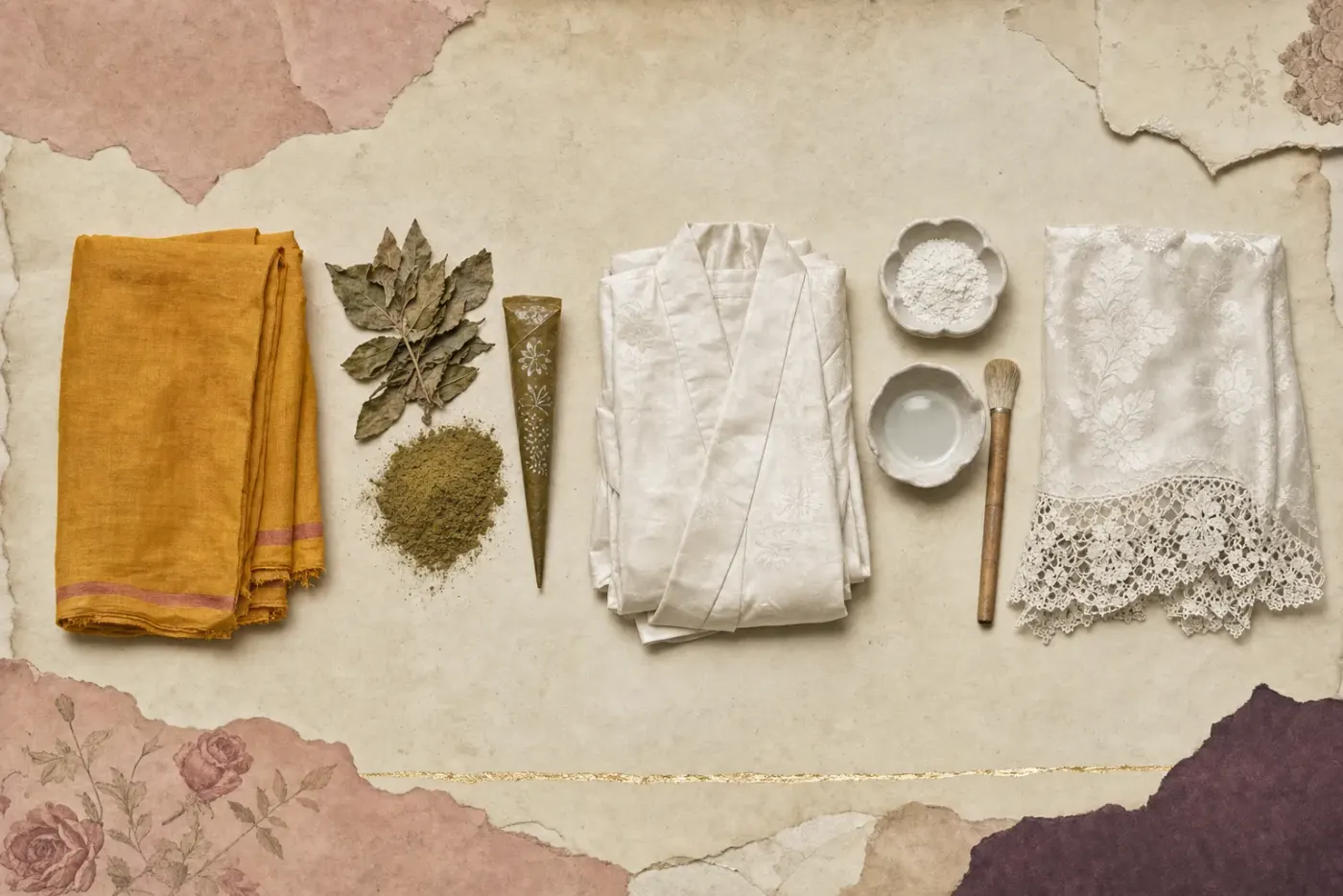
Four are set out here, chosen because each is comparatively well documented and because no two of them work the same way. One turns on a garment. One turns on a dye and the fortnight it takes to fade. One turns on a colour. One turns on a picture.
Rome: One Garment
The Roman bride’s costume is unusually well attested, and it is dominated by a single item: the flammeum, a veil of a strong yellow-orange. Karen Hersch’s study of the Roman wedding shows the veil standing in for the whole ceremony in Latin sources, to the point that naming it was enough to tell a reader that a wedding was meant.[1]
Beneath it the hair was dressed in the seni crines, parted into six locks, an arrangement otherwise associated with the Vestal Virgins. What the colour of the veil signified is not settled. The ancient explanations are late, they disagree with one another, and Hersch declines to choose between them, which is the correct response to a tidy answer that does not exist.[1]
Henna, and What Is Actually Known
Henna is the dried, powdered leaf of Lawsonia inermis, mixed to a paste that stains keratin orange-brown and darkens over a day or two before growing out. Bridal use is documented across North Africa, the eastern Mediterranean, the Arabian peninsula and South Asia, and across religious communities within those regions: the night of the henna is a Jewish, Muslim, Hindu and Zoroastrian occasion in different places rather than one occasion that spread from a single source.[2][3]
The figure of five thousand years of unbroken use, repeated almost everywhere, is an inference from the plant’s range and from stained nails on some Egyptian mummies. It is not a documented sequence of practice. The secure record is shorter and patchier than the round number implies.[2]
The regulatory position is narrower than the practice. In the United States, 21 CFR 73.2190 — the section as it stood when it was consulted on 22 September 2026 — lists henna as a colour additive exempt from certification for colouring hair, excluding the eyelashes, eyebrows and the area of the eye, and requires a label warning; it lists no other permitted use.[4] The Food and Drug Administration states the corollary in its own words elsewhere: henna is approved as a hair dye, and not for application to the skin.[5] Separately, dark-staining pastes marketed as black henna commonly contain p-phenylenediamine, a hair-dye intermediate, and the resulting pattern of sensitisation is the subject of Catherine Cartwright-Jones’s doctoral work.[2]
A veil, a dye, a colour and a picture. Four traditions, four logics, and nothing whatever gained by calling them the same thing.
Japan: The White Face and the White Robe
The Japanese bridal ensemble called shiromuku is white throughout, from the outer robe and the kimono beneath it to the sash and the sandals, and it is worn with one of two head coverings: the hooded wataboshi or the flat tsunokakushi. Web Japan, which is the source of that description, also gives the conventional account of the ensemble’s origin, tracing the all-white bridal robe to warrior households of the Muromachi period; the account is offered without evidence, and it is reported here as Web Japan’s rather than as settled.[6] Explanations of the name tsunokakushi, which means horn-hiding, circulate widely and none of them is well evidenced.
The face was whitened with oshiroi, a powder made historically with white lead and later with zinc oxide and titanium dioxide. The Edo-period handbook Miyako fūzoku kewaiden, published in 1813, advises applying and removing it repeatedly until the skin reads as porcelain, which is a description of a finish rather than of skin.[7]
Europe: The Dress That Became the Tradition
European bridal veiling has no demonstrated line back to Rome, although the Roman veil is sometimes offered as one. What can be dated is the dress. Victoria married Albert on 10 February 1840 in Spitalfields silk with a Honiton lace flounce and veil, both chosen to support British trades, and the image travelled through the illustrated press.[8]
She did not originate it. White had been associated with wedding clothes for centuries among those who could afford to keep a garment that showed every mark, and white was the conventional colour of court dress. What her wedding supplied was a widely reproduced picture of a fashion already under way, which is the usual mechanism and a more useful one to understand than invention.[8]
Sources
- [1]The Roman Wedding: Ritual and Meaning in Antiquity Cambridge University Press, 2010.
- [2]The Geographies of the Black Henna Meme Organism and the Epidemic of Para-phenylenediamine Sensitization: A Qualitative History PhD dissertation, Department of Geography, Kent State University, 2015.View source (opens in a new tab) Accessed 2026-09-22.
- [3]The henna plant: transcending time, religion and culture Natural History Museum, London, 2026.View source (opens in a new tab) Accessed 2026-09-22.
- [4]21 CFR 73.2190: Henna Electronic Code of Federal Regulations, Title 21, Part 73, Subpart C, 2026.View source (opens in a new tab) Accessed 2026-09-22.
- [5]Hair Dyes United States Food and Drug Administration, Office of Cosmetics and Colors, 2026.View source (opens in a new tab) Accessed 2026-09-22.
- [6]Wedding Kimonos 2026.View source (opens in a new tab) Accessed 2026-09-22.
- [7]The Fair Face of Japanese Beauty Nippon.com, Nippon Communications Foundation, 2013.View source (opens in a new tab) Accessed 2026-09-22.
- [8]1840 – Queen Victoria’s Wedding Dress Fashion History Timeline, History of Art Department, Fashion Institute of Technology, 2020.View source (opens in a new tab) Accessed 2026-09-22.
Filed under