The Pale Face: Pallor, Status and Two Thousand Years of Lead
A pale face was a claim about work, and for two thousand years the claim was most often made with lead.
In short
From Athens to Edo to Elizabethan London the material that produced a fashionable pale face was lead carbonate, and analysis of Edo-period burials found children with a median of 1,241 micrograms of lead per gram of dry bone.
- 8min read
- 6chapters
- 18sources

Vivien
Your guide through time
Listen to this essay
12 min listenVivien reads our essays aloud, word for word — every date and every name in its place — so you can listen the way you would be walked through a gallery.
An AI voice, designed for History of Makeup
For most of recorded history, in a striking number of unconnected places, a pale face was a claim about work. Skin not darkened by the sun belonged to someone who did not labour outdoors, and cosmetics that produced that skin were a way of asserting a position rather than describing one.
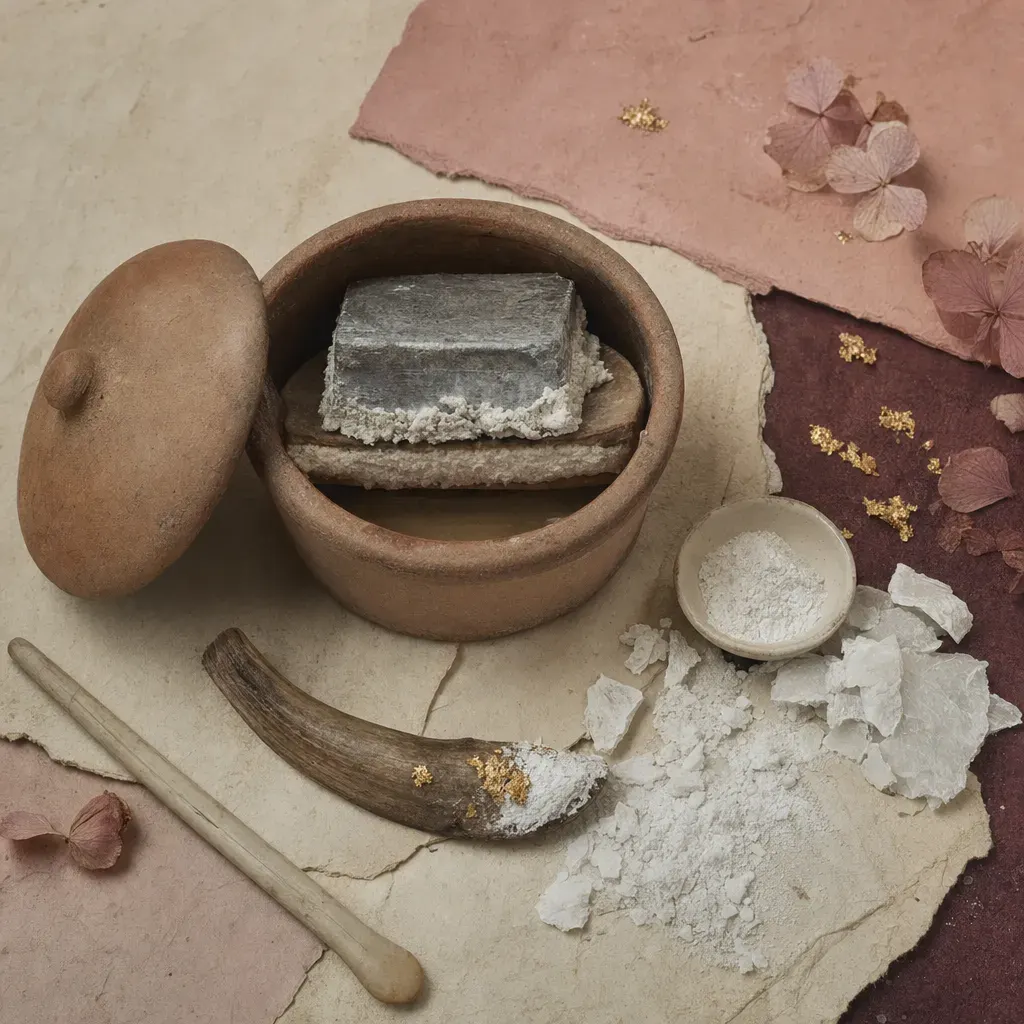
The claim was usually made with lead. The white that produced it was a lead carbonate, made by corroding metallic lead in the vapour of vinegar and collecting the crust that formed — a piece of lead the size of a brick set above vinegar in a closed vessel, left, and then scraped.[1] The same material was put on the face in classical Athens,[2] in Edo Japan,[3] and in Elizabethan and Jacobean England.[4] It covered well, it adhered, and it could be made almost anywhere.
That it was a poison when swallowed was recorded by the same writers who explained how to make it.[5] That it was dangerous on the face took very much longer to say, and longer still to act on.
Psimythion
The Greek word is psimythion. The earliest good description of its use is also a reprimand: in Xenophon's Oeconomicus, written in the first half of the fourth century BCE, Ischomachus tells his wife he has found her wearing white lead to look whiter than she is and alkanet to redden her cheeks, and explains at length that he prefers her own colouring.[6] It is a husband's lecture inside a treatise on household management, which makes it evidence about attitudes as much as about practice — but it fixes the material and the intention beyond argument.
Pliny describes the manufacture of cerussa in the Naturalis Historia, completed around 77 CE, and elsewhere in the same work treats it as a substance that kills if swallowed, for which he supplies remedies. What he does not do is show any alarm about putting it on the face.[7] That is the distinction the whole history turns on. The toxicity was not a secret; the cosmetic use simply was not what anyone thought the toxicity was about.
Analytical work on surviving Greek material has since complicated the picture further: what was sold as psimythion was not always one compound, and its preparation involved more stages than the vinegar-and-lead summary suggests.[8]
The Bones at Kokura
The strongest physical evidence for what lead-based face powder did to the people around it does not come from Europe. In 2011 a team led by the anatomist Tamiji Nakashima published an analysis of skeletal remains from samurai family burials at Kokura, in what is now Kitakyushu, dating to the Edo period.[9]
Lead in the rib bones of children aged three and under had a median value of 1,241 micrograms per gram of dry bone, far above the adults buried alongside them. Women's bones carried more lead than men's. The authors concluded that the likeliest route was the lead-based white face powder, oshiroi, worn by the mothers and reaching infants through skin contact and breast milk.[9]
The comparison worth making is the one inside the cemetery. Bone lead is a measure of accumulated exposure, and it is reported in micrograms per gram of dry bone; the thresholds used in paediatric medicine today are blood lead levels in micrograms per decilitre, which is a different quantity and not convertible by inspection. Setting the two side by side would manufacture a relationship the numbers do not carry. What the burials show without any conversion is that the youngest children held far more lead than the adults around them — the reverse of what a shared environmental source would produce, since lead accumulates over a lifetime.
The finding is worth stating precisely. It establishes exposure, and a probable source for it. It does not license the freer claims about individual deaths that the study is often recruited to support.
The whiteness was the point. That it was made of lead was, for about two thousand years, treated as a detail.
Ceruse, and Two Deaths That Are Not Evidence
Venetian ceruse was the premium European grade of the same material, and the sixteenth and seventeenth centuries used it heavily.[10] Two famous deaths are routinely attached to it, and neither holds up.
Elizabeth I is said to have died of ceruse poisoning in 1603. A number of contemporary accounts of her final illness survive, and they have been collected and examined together as a body of evidence; cosmetics are not among the causes they give.[11] The image of a ruined queen under inches of white paint was assembled afterwards, out of her portraits and out of writing produced after her lifetime, and repeated until it acquired the weight of a diagnosis.
Maria Gunning, Countess of Coventry, died in 1760 at twenty-seven, and her death is offered as the textbook case of lead cosmetics killing a celebrated beauty. The standard biographical reference gives tuberculosis as the cause of death, while also recording the long-standing view that persistent use of white lead had damaged her health.[12] Those are two different statements. Collapsing them is how a plausible contributing factor turns into a cause.
Enamelling
Victorian Britain produced a commercial version of the same ambition, called enamelling: a layered white finish applied in a salon and intended to last for days. Its best-known practitioner was Sarah Rachel Leverson, who traded in Bond Street as Madame Rachel under the slogan Beautiful For Ever, selling enamelling alongside preparations with names like Royal Arabian Cream.[13]
She was convicted of fraud at the Old Bailey in 1868, convicted again a decade later, and died in prison in 1880.[13] The prosecutions concerned obtaining money and jewellery by deception rather than anything in the preparations themselves, which is informative in its own right. No British statute regulated what a cosmetic could contain. What existed was poison law, and it worked on sale rather than on formulation: the Arsenic Act 1851 controlled the sale of arsenic, requiring it to be coloured and the sale recorded,[14] and the Pharmacy Act 1868 (31 and 32 Vict. c. 121) restricted the sale of scheduled poisons to registered pharmaceutical chemists.[15] Neither reached the composition of a face preparation, and neither was what Madame Rachel was tried under.
Rice, Pearl, Zinc — and the Arsenic Story
Not every white was lead. Rice starch and talc powders were widely sold. So was pearl powder, or blanc de perle, a trade term covering several quite different products, including bismuth oxychloride and bismuth subnitrate — and, confusingly, some lead ones. The bismuth whites had a documented failure mode of their own: contemporaries recorded faces discolouring in the sulphurous air of coal gas and coal fires.[16]
Zinc oxide gave the nineteenth century a white with no lead in it at all. Guyton de Morveau proposed it as a substitute for white lead in 1782, and Winsor and Newton brought it to the artists' trade as Chinese White in 1834. It is neither as opaque nor as heavy as lead white and it takes much longer to dry, which is why it did not simply sweep lead out of the trade it was offered as a replacement for.[17]
Arsenic belongs here with a qualification. Arsenic complexion wafers were advertised and sold by mail order, and arsenic was taken for the complexion by some people.[18] The popular version — in which Victorian women routinely ate arsenic to look pale — is an exaggeration built on the advertising rather than on evidence of use.[18] That a product was sold is evidence that it was sold.
Naming the Instrument
Regulation of lead arrived late and in pieces, and it is worth naming instruments rather than saying lead was banned. The International Labour Organization's White Lead (Painting) Convention, adopted on 19 November 1921 and in force from 31 August 1923, prohibited white lead in the interior painting of buildings. It was a workplace measure aimed at painters, and it did not concern cosmetics at all.[19]
In the European Union, lead and its compounds appear among the substances prohibited in cosmetic products under Regulation (EC) No 1223/2009.[20] The United States has no equivalent instrument. There is no positive list of permitted cosmetic ingredients, no rule naming lead as forbidden, and the Food and Drug Administration acts instead through the adulteration provisions of the Federal Food, Drug, and Cosmetic Act. What the agency has published is a draft guidance, issued in December 2016, recommending a maximum of 10 parts per million of lead as an impurity in lip products and externally applied cosmetics — a recommendation to industry, not a binding limit, and explicitly about lead arriving as a contaminant rather than as an added ingredient.[21] The one lead compound that did hold a positive listing in American cosmetics law, lead acetate in hair dyes at 21 CFR 73.2396, had that listing repealed by a final rule of 29 October 2018.[22]
What replaced lead was mineral rather than organic. Titanium dioxide and zinc oxide now do the covering, and both also carry a second legal status as sunscreen actives, which brings different evidence requirements than a colourant. In the European Union they are listed as permitted ultraviolet filters in Annex VI to Regulation (EC) No 1223/2009.[20] In the United States, section 505G of the Federal Food, Drug, and Cosmetic Act, added by the CARES Act in March 2020, made the over-the-counter sunscreen monograph a deemed final order; titanium dioxide and zinc oxide are the two active ingredients the agency has proposed to classify as generally recognised as safe and effective, in the proposed rule of 26 February 2019 and again in the proposed order of September 2021, and both remain proposals rather than final determinations.[23]
Sources
- [1]Lead whiteView source (opens in a new tab) Accessed 2026-09-22.
- [2, 8]On metal and 'spoiled' wine: analysing psimythion (synthetic cerussite) pellets (5th–3rd centuries BCE) and hypothesising gas-metal reactions over a fermenting liquid within a Greek pot Archaeological and Anthropological Sciences 12.10, article 243, 2020.View source (opens in a new tab) Accessed 2026-09-22.
- [3, 9]Severe lead contamination among children of samurai families in Edo period Japan Journal of Archaeological Science 38(1), 23-28, 2011.View source (opens in a new tab) Accessed 2026-09-22.
- [4, 10]Fashions in Makeup: From Ancient to Modern Times Peter Owen, 1972.
- [5, 7]Naturalis Historia, Books XXXIII–XXXV 77.
- [6]Oeconomicus, book 10 Athens, fourth century BCE.View source (opens in a new tab) Accessed 2026-09-22.
- [11]The Death of Elizabeth I: Remembering and Reconstructing the Virgin Queen Palgrave Macmillan, 2010.
- [12]Gunning, Maria Royal Irish Academy and Cambridge University Press, 2026.View source (opens in a new tab) Accessed 2026-09-22.
- [13]Beautiful For Ever: Madame Rachel of Bond Street - Cosmetician, Con-Artist and Blackmailer Long Barn Books, 2010.
- [14, 18]The Arsenic Century: How Victorian Britain was Poisoned at Home, Work, and Play Oxford University Press, 2010.
- [15]Pharmacy Act 1868 (31 and 32 Vict. c. 121) legislation.gov.uk, The National Archives, 1868.View source (opens in a new tab) Accessed 2026-09-22.
- [16]Pearl Powders Cosmetics and Skin, 2009.View source (opens in a new tab) Accessed 2026-09-22.
- [17]Pigments through the Ages: Zinc whiteView source (opens in a new tab) Accessed 2026-09-22.
- [19]White Lead (Painting) Convention, 1921 (No. 13) International Labour Organization, NORMLEX, 1921.View source (opens in a new tab) Accessed 2026-09-22.
- [20]Regulation (EC) No 1223/2009 of the European Parliament and of the Council of 30 November 2009 on cosmetic products Official Journal of the European Union, 2009.View source (opens in a new tab) Accessed 2026-09-22.
- [21]Lead in Cosmetic Lip Products and Externally Applied Cosmetics: Recommended Maximum Level; Draft Guidance for Industry 2016.View source (opens in a new tab) Accessed 2026-09-22.
- [22]Listing of Color Additives Subject to Certification; Lead Acetate; Final Rule (83 FR 53297) 2018.View source (opens in a new tab) Accessed 2026-09-22.
- [23]Over-the-Counter Monograph M020: Sunscreen Drug Products for Over-the-Counter Human Use; Proposed Order (86 FR 53024) 2021.View source (opens in a new tab) Accessed 2026-09-22.
Filed under