The Stage Face: Making Up to Be Read From the Back Row
An actor's make-up is the one kind designed to be read at a distance. In kabuki and in the gaslit Victorian theatre it became a craft with its own rules, tools and rites.
In short
In kabuki, applying make-up is called kao o suru, "doing the face", and its bold kumadori lines are said to have been begun by Ichikawa Danjuro I; in Berlin in 1873 the opera singer Ludwig Leichner began selling greasepaint in numbered sticks.
- 4min read
- 5chapters
- 8sources
Vivien
Your guide through time
Listen to this essay
5 min listenVivien reads our essays aloud, word for word — every date and every name in its place — so you can listen the way you would be walked through a gallery.
An AI voice, designed for History of Makeup
Kabuki make-up exists to be read. Its fixed types tell the audience a character's personality and rank the moment he appears. The actor first covers his whole face in a single colour: white for a good person or a character of high status, a colour close to tea-brown for townspeople or villains, red for a villain's retainer. On that ground he paints the brows, the eyes, the lips, the rouge and the beard.[1]
The Japanese phrase for it is kao o suru: "doing the face".[1]
Taking the Kuma
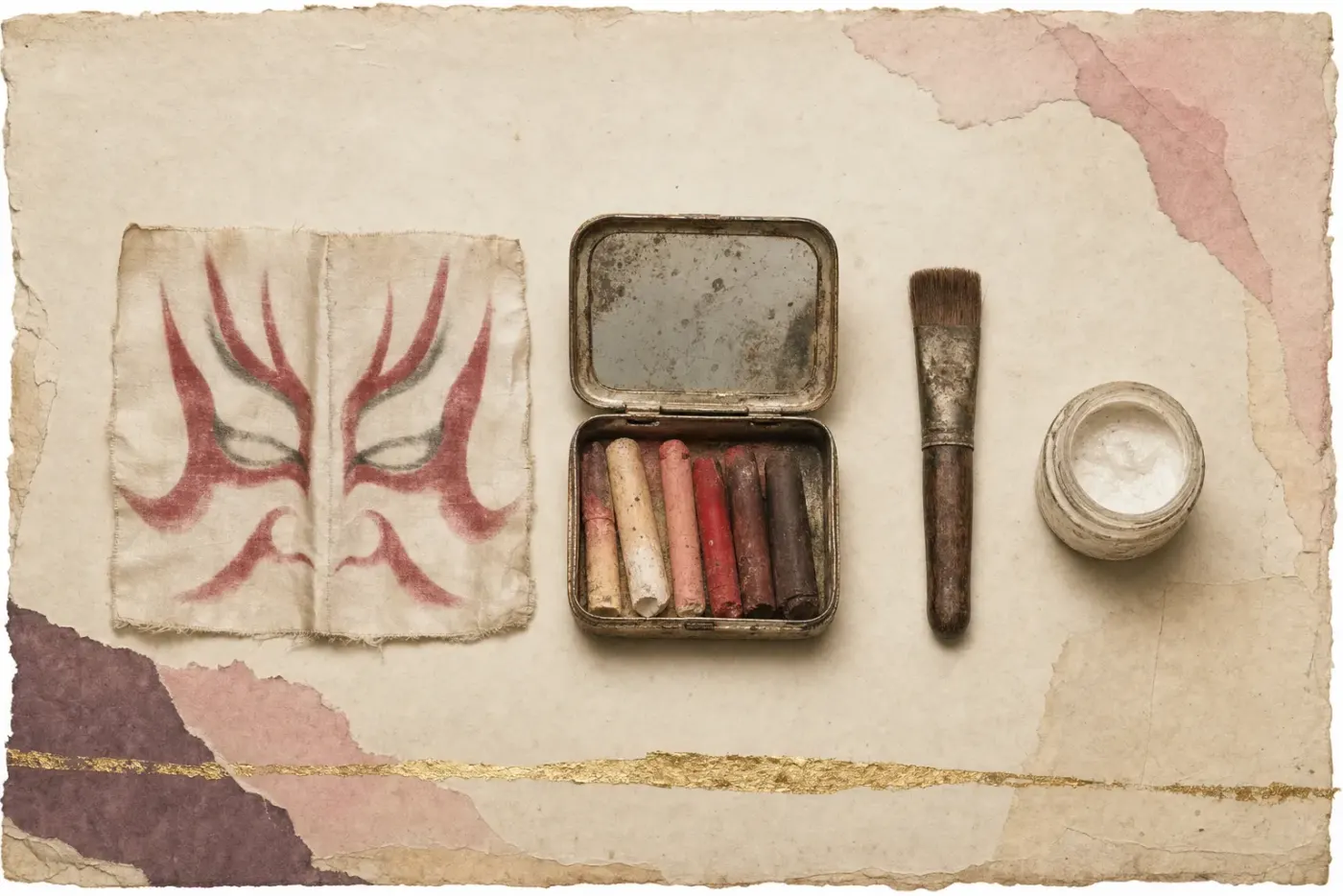
The most striking kabuki make-up is kumadori. After the base, the actor draws lines on his face with a brush and smudges one side with his fingers, and the act is spoken of not as painting but as "taking" the kuma. Kuma means the boundary between light and shadow, and the lines exaggerate the blood vessels and muscles beneath the skin. The style is said to have been begun by Ichikawa Danjuro I, creator of the bold aragoto manner.[2]
The colours are a vocabulary. Crimson expresses justice, courage or hot-blooded youth; indigo, villainy on a grand scale or a vengeful ghost; light brown, ogres and spirits.[2] The shapes are named too: mukimiguma, for youthful, righteous heroes, after the shapes of shellfish out of their shells; nihonguma, two sweeping lines for calm and majestic adults, with blue on the chin for a beard and black ink at the corners of the eyes and inside the lips.[3]
The Face on Silk
Kabuki also kept its faces. The Birmingham Museum of Art holds an early twentieth-century oshiguma, which it titles a facial impression of the make-up worn by the kabuki actor Kikumasa VI: ink and colour on silk, fifty-five centimetres high, mounted as a hanging scroll.[4]
It is the rare case in which make-up leaves the face and survives as a picture of itself. The painted face that would have been wiped away became an object that could be mounted and hung on a wall.
Stage make-up is the only kind meant to be read from the back of the house.
Gaslight and Greasepaint
In the West, it was the lighting that changed the ritual. By the 1840s most theatres were lit by gas, and the brighter light washed colour out of the face. The old method, as one writer described it in 1882, was violet powder with the hare's foot and rouge, and under hot lights the actor's sweat made the colours run.[5]
Actors improvised; one, Herman Vezin, mixed colour into melted tallow in Philadelphia in 1857. The idea was commercialised by Ludwig Leichner, an opera singer with an interest in chemistry, who set up a make-up business in Berlin in 1873. His greasepaints were numbered from No. 1, the lightest, and sold as thick sticks for the base and thinner liners for shadows, lines and brows, and by the 1890s, under electric light, greasepaint was an essential part of an actor's kit.[5]
The Actor's Tin
The Victoria and Albert Museum's theatre collection keeps the dressing-room ritual in its equipment. A tin owned by the actor George Howe still holds the remnants of his greasepaint sticks, under a lid mirrored on the inside.[6] A painted plywood make-up box, also with a mirrored lid, has a removable tray of Leichner greasepaints.[7]
A red tin of Leichner removing cream No. 251 records the other half of the ritual.[8] Stage make-up is put on to be seen by hundreds and taken off to be seen by no one, every night, by the same hands, in front of the same small mirror.
What Is Not Known
How far the stage face shaped the everyday one. The traffic is often assumed and seldom shown. Burckhardt, writing about the painted and masked performers of the Italian religious plays, could only suggest that it was possible they had encouraged cosmetics in daily life.[9] The same caution applies to kabuki and to greasepaint. The two worlds borrowed from each other, but the borrowing is easier to assert than to document.
Sources
- [1, 2]Stock Characters and Makeup, Kumadori Makeup, Kabuki for Beginners Japan Arts Council, Cultural Digital Library.View source (opens in a new tab) Accessed 2026-09-25.
- [3]Types of Kumadori Makeup, Kumadori Makeup, Kabuki for Beginners Japan Arts Council, Cultural Digital Library.View source (opens in a new tab) Accessed 2026-09-25.
- [4]Oshiguma: Facial Impression of Makeup Worn by the Kabuki Actor Kikumasa VIView source (opens in a new tab) Accessed 2026-09-25.
- [5]Greasepaint Cosmetics and Skin, 2010.View source (opens in a new tab) Accessed 2026-09-25.
- [6]Tin for make-up containing remnants of greasepaint sticks, owned by the actor George Howe, museum number S.259-1989View source (opens in a new tab) Accessed 2026-09-25.
- [7]Make-up box containing theatrical make-up, museum number S.342-1987View source (opens in a new tab) Accessed 2026-09-25.
- [8]Tin of Leichner removing cream No. 251, museum number S.599&A-1990View source (opens in a new tab) Accessed 2026-09-25.
- [9]The Civilisation of the Renaissance in Italy Project Gutenberg eBook #2074.View source (opens in a new tab) Accessed 2026-09-25.
Filed under