The Dressing Case: A Toilette Packed for Travel
A Victorian dressing case packed a whole toilette into one box, in an order so exact that a servant usually did the packing.
In short
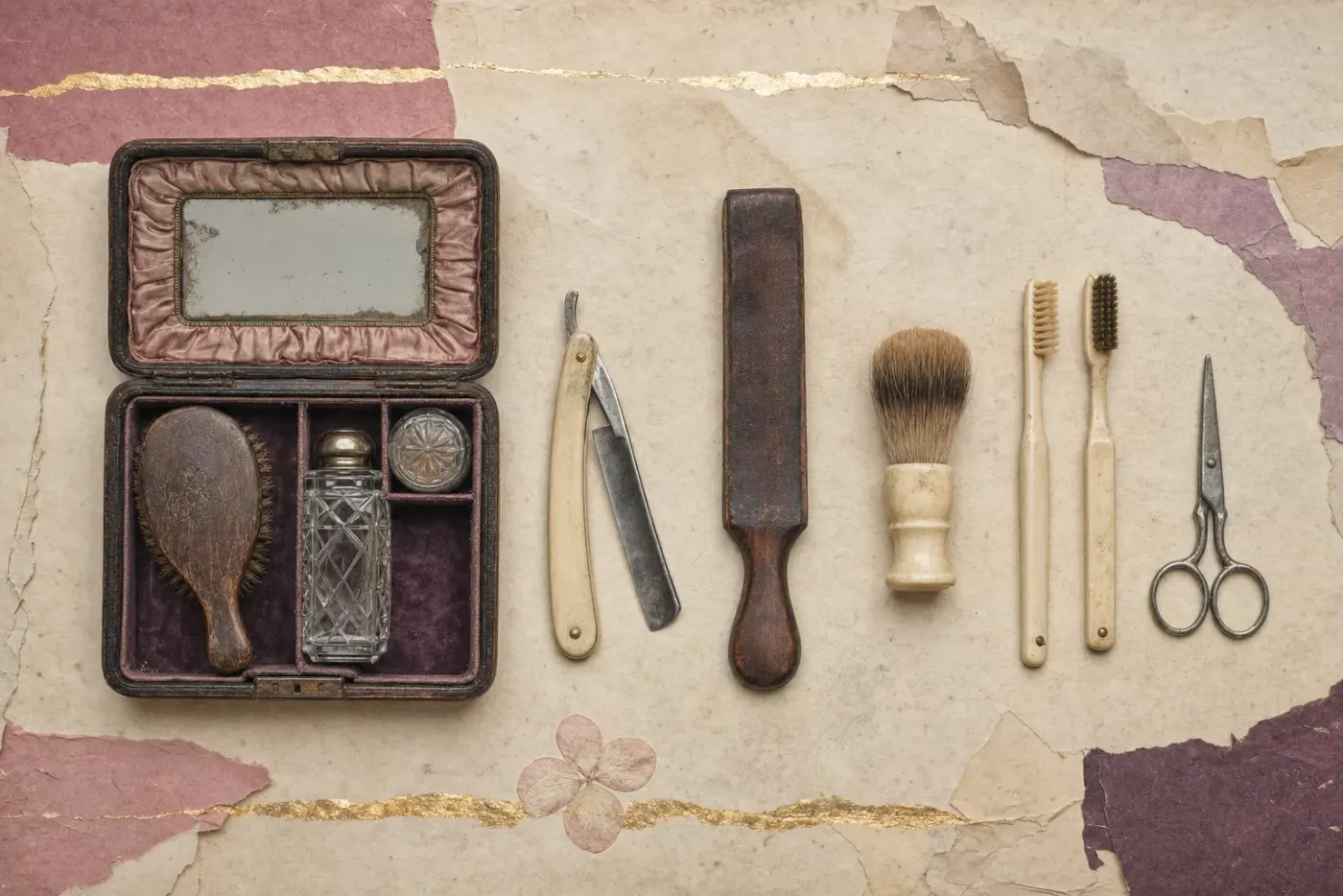
A man's dressing case by Wilson, Walker and Co. of Leeds, thought to have been made for the Great Exhibition of 1851, fits seventeen pieces, from razors and brushes to a mirror and a scent bottle, into one tooled leather case.
- 3min read
- 4chapters
- 3sources

Vivien
Your guide through time
Listen to this essay
4 min listenVivien reads our essays aloud, word for word — every date and every name in its place — so you can listen the way you would be walked through a gallery.
An AI voice, designed for History of Makeup
A dressing case is a toilette made portable: a box fitted with compartments, each cut to the shape of one object, so that the whole business of shaving, brushing and scenting could travel. The Victoria and Albert Museum notes that dressing cases were in use at least from the eighteenth century and were particularly popular in the nineteenth, when the basic contents would include at least one razor with a leather strop, scissors, a toothbrush, a mirror and a hairbrush.[1]
They are small monuments to a particular idea of the self: that a person's grooming could be complete, orderly and carried anywhere.
Seventeen Pieces
One case in the museum's collection is thought to have been made by Wilson, Walker and Co. of Leeds for the Great Exhibition of 1851. It is a luxury product with tooled decoration outside, lined with watered silk, and some compartments with metal foil to keep the contents from tarnishing.[2]
The museum counts seventeen pieces: three wooden brushes for clothes, shoes and hair; two cut-throat razors and a strop to sharpen them; four ivory-handled brushes for shaving, nails and teeth; a mirror; a glass scent bottle; a fitting holding scissors, a button hook, a corkscrew and tweezers; a glass pot, possibly for tooth powder; and two keys.[2]
Packing as a Skill
The arrangement, the museum observes, is ingenious and tricky: the pieces have to go in in the right order as well as in the right place, and many of the men who owned such cases would have been used to a servant packing them and keeping every piece clean.[3]
That is the dressing case's quiet revelation. A toilette that looks self-sufficient was, in practice, a job for two people. The object advertises its owner's independence on the road and depends on someone else to keep it in order.
A toilette that looks self-sufficient was, in practice, a job for two people.
His and Hers
The Leeds case is a man's, and its contents are a man's toilette: shaving first, then hair, teeth and nails, with a single bottle of scent. A lady's version could be far larger. A black leather dressing case made by Parkins and Gotto in 1892, lined in ribbed and watered deep blue silk, is part of a lady's dressing bag that the museum catalogues in fifty-nine parts.[4]
Two centuries earlier the same equipment stood still. The Calverley toilet service, made in London in 1683 to 1684, is a silver mirror frame with boxes, dishes and vessels made to stay on a dressing table, and the museum's label notes that around 1700 such a set was a customary wedding gift for a wealthy bride from her husband.[5] The dressing case put that table in a box.
What Is Not Known
How often cases like these travelled, and how much of what they held was cosmetic in the narrow sense. The fittings that survive in the Leeds case are for grooming, razors, brushes and scissors, with scent the only obvious cosmetic.[6] What else an owner packed, in bottles now empty, the fittings do not record, and the record of the fifty-nine-part lady's bag read for this article does not list its contents.[7]
Sources
- [1, 2, 3, 6]Man's dressing case, Wilson, Walker and Co., Leeds, about 1850, museum number AP.621:1 to 21View source (opens in a new tab) Accessed 2026-09-25.
- [4, 7]Dressing case, Parkins and Gotto, 1892, museum number T.1-1984View source (opens in a new tab) Accessed 2026-09-25.
- [5]The Calverley Toilet Service (mirror frame, boxes and dishes), by William Fowle, London, 1683–84 2026.View source (opens in a new tab) Accessed 2026-09-22.
Filed under