The Toilette: Dressing as a Performance with an Audience
For roughly a century and a half, the most private hour of the European day was conducted in front of guests.
In short
The toilette is named after a piece of cloth: the French toilette, a diminutive of toile, was the linen laid over a dressing table before the pots were set out, and the word moved from the cloth to the table and then to the hour spent at it.
- 8min read
- 5chapters
- 8sources

Vivien
Your guide through time
Listen to this essay
7 min listenVivien reads our essays aloud, word for word — every date and every name in its place — so you can listen the way you would be walked through a gallery.
An AI voice, designed for History of Makeup
The word begins as a piece of linen. French toilette is a diminutive of toile, cloth, and it named the covering spread over a dressing table to protect it while the pots and brushes were in use. The name then moved outward: to the table, to the objects on it, and finally to the hour a person spent there.[1]
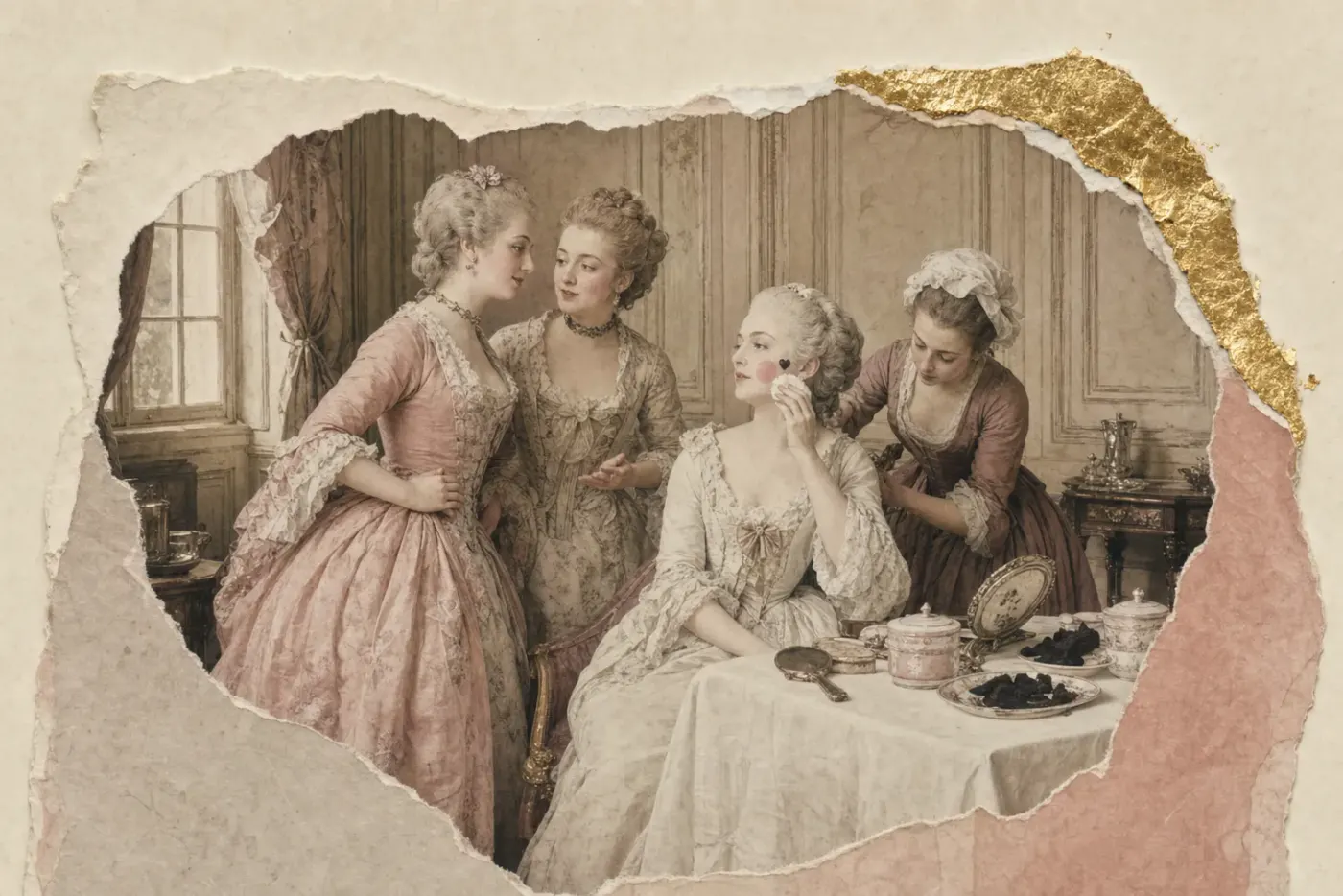
That hour is the subject here. At its most elaborate, at the French court, it was not private at all. It was a reception, with a seated hostess, a mirror, a maid, and visitors who had come to watch and to be seen watching.[2] The English version survives chiefly through the satire aimed at it, and is taken up below.
The Table and Its Furniture
The Victoria and Albert Museum holds one of the best-preserved English toilet services, made by the London silversmith William Fowle and hallmarked 1683 to 1684. It runs to a mirror frame, two tazzas, two large and two small round lidded boxes, two rectangular lidded boxes, two large lidded vessels, two small lidded vases and a pincushion.[3]
The circumstances of its purchase are documented, and they complicate the object rather than confirming it. Sir Walter Calverley bought the service in 1707, more than twenty years after it was hallmarked, for £119 — which the museum’s label notes was little more than the cost of the silver by weight. His diary records the outlay in the same breath as his marriage to Julia Blackett on 17 January 1706–7, and puts the figure at 116 pounds odd money.[3]
The museum’s label supplies the social frame without any need to extrapolate one: in about 1700 a silver toilet set was a customary wedding gift for a wealthy bride from her husband.[3] What the record will not support is the tidier reading, that such a set was bought new and at conspicuous expense to announce a woman’s standing. This one was more than twenty years old and cost little more than its own metal.
Who Was Watching
Guests were received at the dressing table, business was done, gossip was exchanged, and the face was assembled in full view. François Boucher’s portrait of the Marquise de Pompadour at her toilette shows her with a rouge brush in hand, and the art historian Melissa Hyde reads the picture as a claim to rank rather than an admission of vanity: rouge at the French court was a badge, worn openly, and not a secret.[4]
The English version reaches us as satire. William Hogarth’s fourth Marriage A-la-Mode canvas, painted about 1743 and issued as an engraving in 1745, is titled The Toilette by the National Gallery.[5] A hostile picture is still evidence of what there was to be hostile about. It is not a neutral record of how the hour was spent, and the scene it shows should be read as a charge rather than as a description.
The face was not assembled in secret and then revealed. It was assembled in front of the people who had come to see it done.
What Went On the Face
The materials were few and the order was fixed. A white base first, which at the expensive end meant ceruse — which the Bowes Museum describes as a concoction of lead oxide, hydroxide and carbonate — whose opacity nothing else matched. Then rouge, applied with Spanish wool, which the same source describes as a pad of hair saturated with the colour, and placed as a distinct patch of colour rather than blended along the bone.[6]
Then mouches: patches of black silk or taffeta, cut into shapes and stuck to the face, a standing feature of European cosmetic practice in this period and of the verse written against it.[7]
How much rouge, and where, was read as precisely as a uniform. At the French court it was worn heavily and openly, and contemporaries treated it as a marker of rank rather than as a deception. Away from court the same quantity read as excess, which is the usual fate of a court fashion.[8]
The Act of Parliament That Never Was
One story about this period is repeated more often than anything true about it. An Act of Parliament of 1770, it is said, allowed a man to have his marriage annulled if his wife had won him by means of cosmetics, false hair or high heels, the offence to be tried as witchcraft.
No such Act exists. Alison Daniell traced the claim through the eighteenth-century press and found it circulating as a satirical squib rather than as law, with no corresponding bill, statute or parliamentary record behind it. She also notes the legal impossibility: the Witchcraft Act of 1735 had already made accusing a person of witchcraft the offence.[9]
It survives because it is a good story about a real attitude. The charge that a painted face is a fraud practised on the men looking at it runs through the whole period, in sermons, in verse and in print. It simply never became law.[9]
How the Performance Ended
The public toilette did not outlive the century that made it. Morag Martin’s study of the French trade between 1750 and 1830 traces the collapse of the visibly painted face after the Revolution: white lead and heavy rouge belonged to a court that no longer existed, and the industry survived by selling to a middle class that wanted its purchases to look like no purchase at all.[10]
The word outlived the ritual. It narrowed to the act of washing and dressing, then to the room, and then in American usage to the fixture in the room, which is why the most ceremonial hour in European domestic life is now commemorated chiefly by the plumbing.[11]
Sources
- [1, 11]toilet, n. Oxford English Dictionary, Oxford University Press, 2026.View source (opens in a new tab) Accessed 2026-09-22.
- [2, 4]The “Makeup” of the Marquise: Boucher’s Portrait of Pompadour at Her Toilette The Art Bulletin, vol. 82, no. 3, pp. 453–475, 2000.
- [3]The Calverley Toilet Service (mirror frame, boxes and dishes), by William Fowle, London, 1683–84 2026.View source (opens in a new tab) Accessed 2026-09-22.
- [5]William Hogarth, Marriage A-la-Mode: 4, The Toilette (NG116) 2026.View source (opens in a new tab) Accessed 2026-09-22.
- [6]English Rose: Putting Your Best Face Forward — Cosmetics in 18th Century Society Portraits 2026.View source (opens in a new tab) Accessed 2026-09-22.
- [7]The Artificial Face: A History of Cosmetics David & Charles, 1973.
- [8, 10]Selling Beauty: Cosmetics, Commerce, and French Society, 1750–1830 Johns Hopkins University Press, 2009.
- [9]Of False Hair, Spanish Wool, and Witchcraft: The Act of Parliament That Never Was Journal for Eighteenth-Century Studies, vol. 45, no. 4, pp. 447–462, 2022.View source (opens in a new tab) Accessed 2026-09-22.
Filed under