The Powder Compact: A Mirror, a Puff and a Catch
The compact was engineered against spilled powder. What it changed was where a face could be repaired.
In short
Antoine Vericel's vanity-box patent, granted in June 1921, describes a case adapted to be carried in handbags and satchels, with two powder wells, two puffs and a movable mirror: the compact was engineered against spillage long before it was sold as a fashion object.
- 7min read
- 5chapters
- 9sources

Vivien
Your guide through time
Listen to this essay
6 min listenVivien reads our essays aloud, word for word — every date and every name in its place — so you can listen the way you would be walked through a gallery.
An AI voice, designed for History of Makeup
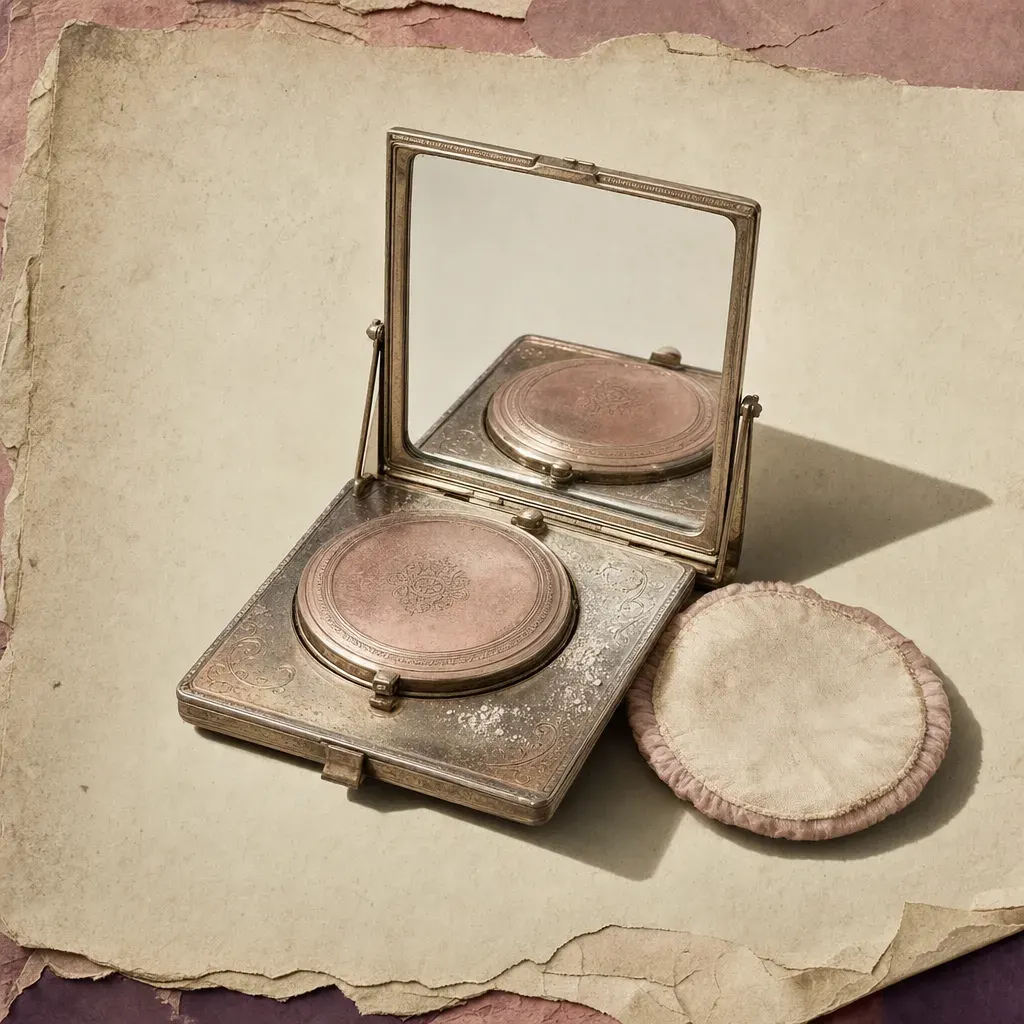
A powder compact is a shallow hinged case. Inside are a well of powder, a puff, a mirror set into the lid and a catch strong enough to survive a handbag. Each of those elements was patented separately, and the patents are unusually candid about the problem being solved.
Joseph Weismantel of Newark, New Jersey filed in October 1911 for a powder box whose cover held the puff. His stated aim was that the puff could be loaded before the box was opened, so that the powder is not wasted or spread around as is sometimes the case.[1] The patent was granted in June 1913. The compact begins as a solution to mess.
The Problem Was Spillage
Less than eight years later the same problem produces a more complete object. Antoine Vericel of New York filed in July 1919 and was granted a patent in June 1921 for a vanity-box: two hinged circular covers, two powder receptacles, two puffs, a compartment for a lipstick, and a mirror that could be raised into position and secured when the case was shut.[2]
The specification names the use case exactly. The device is for toilet cases adapted to be carried in handbags, satchels, or the like, and both receptacles lie in a horizontal plane so that the powder is not displaced when the puff is lifted out.[2] Read in sequence, the patents describe an object being fitted to a place: not a dressing table, where a bowl and a large puff had served for generations, but a bag carried through a day spent outside the house.
Pressing the Powder
Loose powder in a small case leaks whatever the engineering, and the durable answer was to compress it. Pressed powder set into a shallow metal cup, called a godet, could be carried without a sifter and without a seal. Patents for inserting godets into compacts appear from 1917, and compressed-powder products are datable through the same years: a Dubarry Powdrette in 1917, La Dorine in 1919, Jonteel in 1921, a Colgate compact powder in 1923, Roger & Gallet in 1926.[3]
The vocabulary settles alongside the product. The early metal cases were known in English as vanities, and by 1925 the word compact had transferred from the powder to the container that held it.[3]
Pressed powder became the durable format, but it did not sweep the board at once. Franz Vincent's vanity-box specification of 1925 sets out to carry white powder in the loose condition rather than in a compact, as a great many users prefer, which is a patentee's own report of a market that had not finished changing its mind.[4]
The Mirror Was Half the Point
A patent granted in August 1925 makes the priority explicit. Franz Vincent of Bridgeport, Connecticut, filing in December 1923, mounted the mirror in a holder independent of the powder cover, so that, in his words, a maximum sized mirror may be used and it may be exposed for use if desired without opening the powder compartment.[5]
That is a design for looking. The powder becomes optional to the transaction. A case that can be opened in company to check a face, with no powder applied at all, is doing something other than carrying powder.
The mirror could be opened without opening the powder. The object was for looking at least as much as for powdering.
A Status Good
Once the object was carried it was seen, and once it was seen it was made in gold, lacquer, enamel, tortoiseshell and leather. The Metropolitan Museum's Costume Institute holds a French vanity case of 1925 in tortoiseshell and silk.[6] It also holds an American one of the 1920s made by the cosmetics house Richard Hudnut, in leather and brass, accessioned in parts lettered a to z.[7] A perfumer selling a fitted case under its own name, in twenty-six pieces, is a category arriving rather than a one-off commission.
The vocabulary is less settled than the objects. The same department catalogues a silver European case of 1900 to 1910, about fifteen centimetres long, under the object name minaudière.[8] That is a curatorial term applied long after the object was made, and a term the Paris jewellery trade later took up as a brand name. The record shows that the form had precedents. It is not evidence that the word did, and a museum object name is not a date of coinage.
What It Made Ordinary
The compact did not persuade anyone to wear powder. Face powder was long established and widely used before the case existed. What the case changed was the location of the act. Powder had been applied in private, and among respectable women its use was as often denied as displayed.[9] A sealed, mirrored, one-handed object made repair possible at a table, on a train, in a theatre foyer.
In the Australian print culture Liz Conor examines, the woman attending to her own appearance in public becomes, by the late 1920s, a standing subject for comment and caricature.[10] Being worth caricaturing is a reliable sign that a practice has become ordinary. The compact is the piece of hardware that made it so.
Sources
- [1]US Patent 1,063,484 - Powder-box United States Patent Office, 1913.View source (opens in a new tab) Accessed 2026-09-22.
- [2]US Patent 1,381,036 - Vanity-box United States Patent Office, 1921.View source (opens in a new tab) Accessed 2026-09-22.
- [3]Compressed Face Powders Cosmetics and Skin.View source (opens in a new tab) Accessed 2026-09-22.
- [4, 5]US Patent 1,549,396 - Vanity box United States Patent Office, 1925.View source (opens in a new tab) Accessed 2026-09-22.
- [6]Vanity Case, accession number C.I.41.153.7 The Costume Institute, The Metropolitan Museum of Art.View source (opens in a new tab) Accessed 2026-09-22.
- [7]Vanity Case by Richard Hudnut, accession number 1995.238a-z The Costume Institute, The Metropolitan Museum of Art.View source (opens in a new tab) Accessed 2026-09-22.
- [8]Minaudiere, accession number 1985.378.8 The Costume Institute, The Metropolitan Museum of Art.View source (opens in a new tab) Accessed 2026-09-22.
- [9]Hope in a Jar: The Making of America’s Beauty Culture Metropolitan Books, 1998.
- [10]The Spectacular Modern Woman: Feminine Visibility in the 1920s Indiana University Press, 2004.
Filed under