The Ideal Face and What It Cost
A period that theorised beauty, wrote its recipes down, and pursued a complexion that was quietly poisoning the people who achieved it.
HOM · Era1400 – 1700Art & Ideal Beauty
All of The Renaissance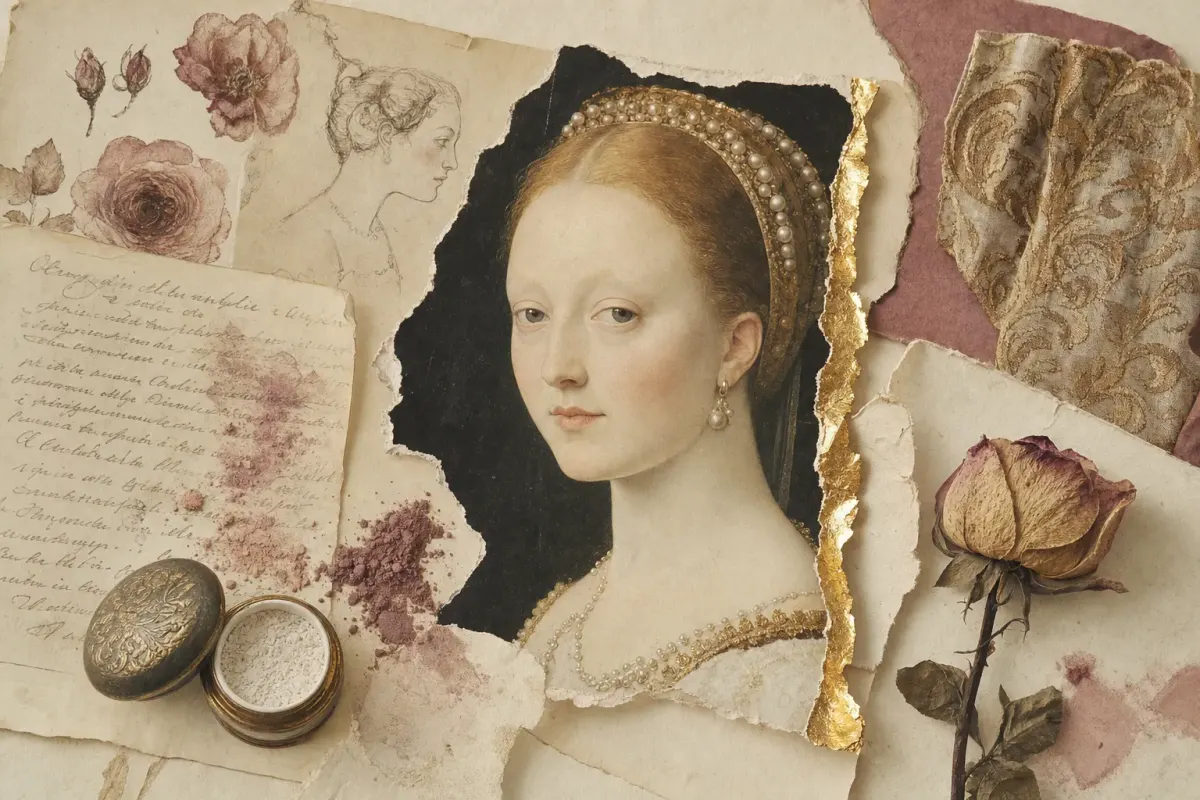
In short
The Renaissance turned cosmetics into a written technical literature: recipe collections such as Caterina Sforza’s Experimenti circulated as serious knowledge, even as the period’s most prized complexion product, lead-based Venetian ceruse, damaged the skin it was applied to.
- 9min read
- 5chapters
- 4sources
Vivien
Your guide through time
Listen to this essay
7 min listenVivien reads our essays aloud, word for word — every date and every name in its place — so you can listen the way you would be walked through a gallery.
An AI voice, designed for History of Makeup
The Renaissance did something no previous period had managed: it wrote beauty down, systematically, as a subject with methods.
Recipes for the complexion, the hair and the hands stopped being household lore passed between women and became collected, copied, exchanged and occasionally printed — documents with authors, circulating among people who took them seriously. Beauty acquired a technical literature. That literature is why we know so much more about this period's cosmetics than about the thousand years preceding it, and it is also why we can see, in the sources themselves, exactly what the period's signature product was doing to the people who wore it.
Recipes as Knowledge
The clearest example is Caterina Sforza, Countess of Forlì, whose recipe collection — known as the Experimenti — gathers several hundred formulations for cosmetics, medicines and alchemical preparations, with no dividing line between the categories.[1]
That absence of a dividing line is the point. A preparation to whiten the skin sits beside a remedy for fever and a procedure for working metals, because all three were the same kind of thing: tested practical knowledge, worth writing down and worth keeping. Recipe collections of this sort were assembled, exchanged and added to across courtly and merchant Europe, and they represent a substantial body of women's technical work that later centuries filed away as domestic trivia.[1]
By the sixteenth century such material was reaching print, and cosmetic instruction became something a reader could buy rather than inherit. The commercial beauty literature that runs through the Victorian manual to the modern magazine starts here.
The Ideal, and Where We Get It From
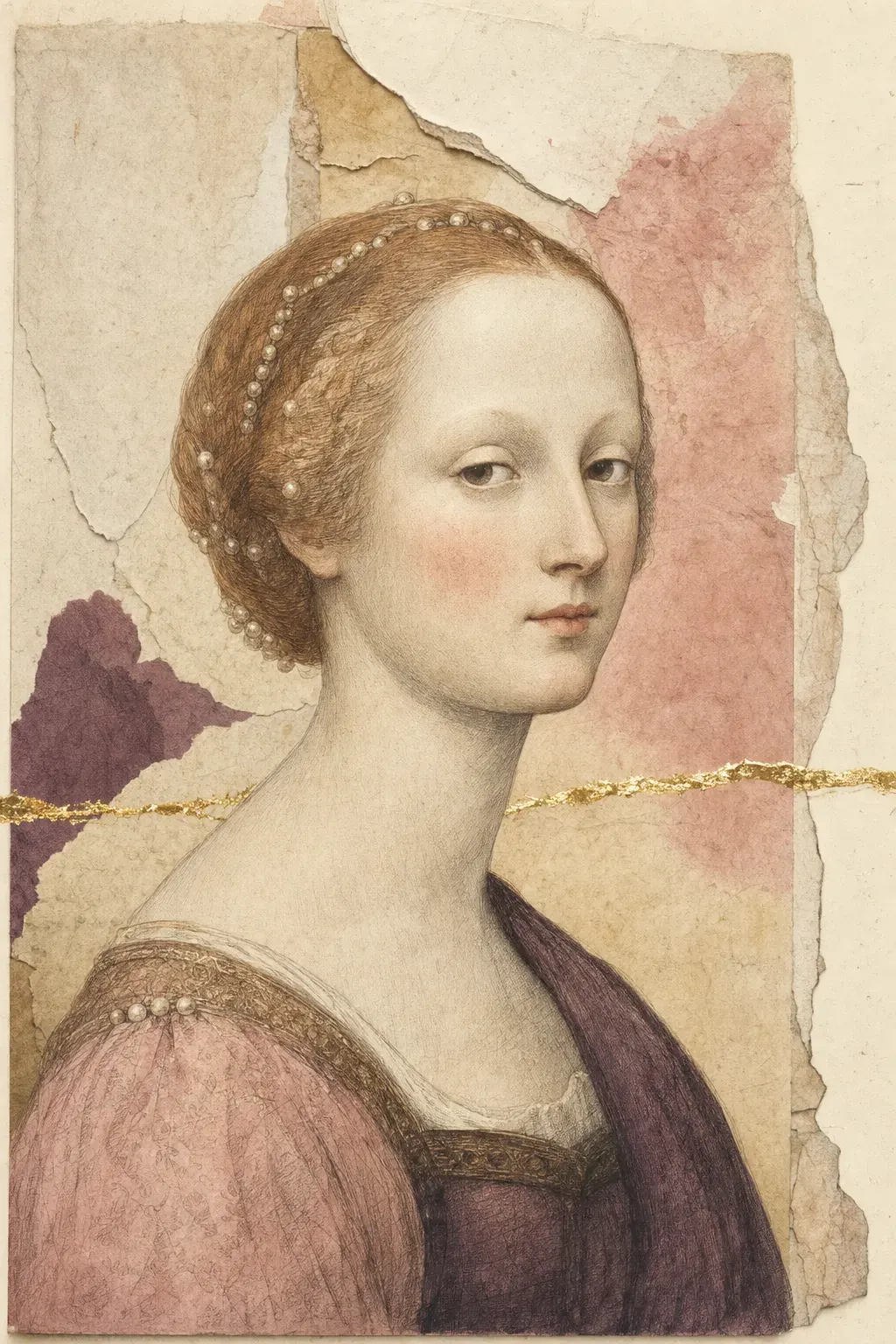
The Renaissance face is familiar from a thousand gallery walls: a high, bare forehead; pale, almost luminous skin; a delicate flush; fair hair; a small mouth; barely-there brows. The hairline was plucked, as it had been in the medieval centuries, and the effect is unmistakable once you know to look for it.[2]
But the evidence needs handling carefully. Portraits are idealised paintings made to a commission, by artists working to conventions of colour and proportion, for patrons who were paying. A Renaissance portrait is reliable evidence of what was considered beautiful. It is much weaker evidence of what any particular face actually looked like on a particular morning, and reading it as documentary is the single most common error in writing about this period.[2]
What the paintings do establish is the distance between the ideal and the ordinary — and it is that distance which creates the demand the recipe books were answering.
Thus the vse of this ceruse, besides the rotting of the teeth, and the vnsauourie breath which it causeth, being ministred in paintings, doth turne faire creatures into infernall Furies.
Venetian Ceruse
The product that delivered the complexion was lead white — the same basic material Pliny had described making in the first century, refined and rebranded. Venetian ceruse was the luxury grade: whiter, finer, more opaque, and expensive enough to function as a status good in its own right.[4]
It worked. Nothing else available gave that flat, even, light-reflecting surface, which is precisely why it persisted for centuries against mounting evidence of harm. Lead applied to the skin over years causes damage that is visible without any laboratory: greying and coarsening of the complexion, hair loss at the front of the scalp, decay of the teeth. The effect is cumulative and it is self-reinforcing — the damage the ceruse caused was best concealed by more ceruse.[4]
Alternatives existed and were known. Preparations built on talc, chalk, starch and ground eggshell gave a whiteness that was safe and, crucially, not as good — thinner, patchier, quicker to wear off. The market chose performance over safety with full information, which is a choice it has gone on making in every century since.
This pattern is worth naming, because it recurs throughout this archive. A cosmetic that degrades the surface it improves generates its own demand. The Renaissance did not invent it, but it is the period where the mechanism becomes fully legible in the sources.
What Elizabeth I Did and Did Not Die Of
The most repeated anecdote in Renaissance beauty is that Elizabeth I wore ceruse so heavily, for so long, that it killed her — often with a thick "Mask of Youth" and a precise date of death attached.
The queen's painted appearance in her later years is genuinely attested, and the portrait convention of her final decades is a real and deliberate thing. The poisoning narrative is a different matter: it is a later reconstruction, assembled largely in the nineteenth and twentieth centuries from her portraits and from what was by then known about lead, rather than a claim made by anyone who saw her.[5]
The honest position is that she certainly used lead-based cosmetics, that such use certainly damages health, and that the specific causal story about her death is not something the contemporary record supports. The general fact does not need the anecdote, and an archive that keeps the anecdote loses the right to be trusted on the fact.
What the Renaissance Established
Beauty became a documented body of knowledge, with authors, editions and readers. That is the change that makes everything after it possible: an industry needs formulations, and formulations need to be written down before they can be manufactured.
The period also fixed the association between pallor and rank so firmly that it governed European cosmetics for the next three hundred years, and it demonstrated the mechanism by which a harmful cosmetic creates the demand for itself.
What comes next is a reaction. The eighteenth century pushes the painted face to its most theatrical extreme, and the nineteenth recoils from it entirely — into a morality of visible restraint that the 1920s then breaks in a single decade.
Sources
- [1]Daughters of Alchemy: Women and Scientific Culture in Early Modern Italy Harvard University Press, 2015.
- [2]Italian Renaissance portraiture, European Paintings collectionView source (opens in a new tab) Accessed 2026-09-22.
- [3]A Discourse against Painting and Tincturing of Women London; text from the EEBO-TCP transcription A14007, 1616.View source (opens in a new tab) Accessed 2026-09-25.
- [4, 5]Fashions in Makeup: From Ancient to Modern Times Peter Owen, 1972.
Continue in The Renaissance
Art & Ideal Beauty
Browse all 19 articles