The Rosewater Sprinkler: Scent Poured Over a Room
A long-necked flask for scattering rose-water travelled from Mughal courts into an English earl's hands, Chinese kilns and the Great Exhibition.
In short
Rosewater sprinklers have been used in the Indian subcontinent from the Mughal period to the present, and the Victoria and Albert Museum holds one said to have been taken from the treasury of Tipu Sultan in 1799 and another sent from Lucknow to the Great Exhibition of 1851.
- 3min read
- 4chapters
- 6sources

Vivien
Your guide through time
Listen to this essay
4 min listenVivien reads our essays aloud, word for word — every date and every name in its place — so you can listen the way you would be walked through a gallery.
An AI voice, designed for History of Makeup
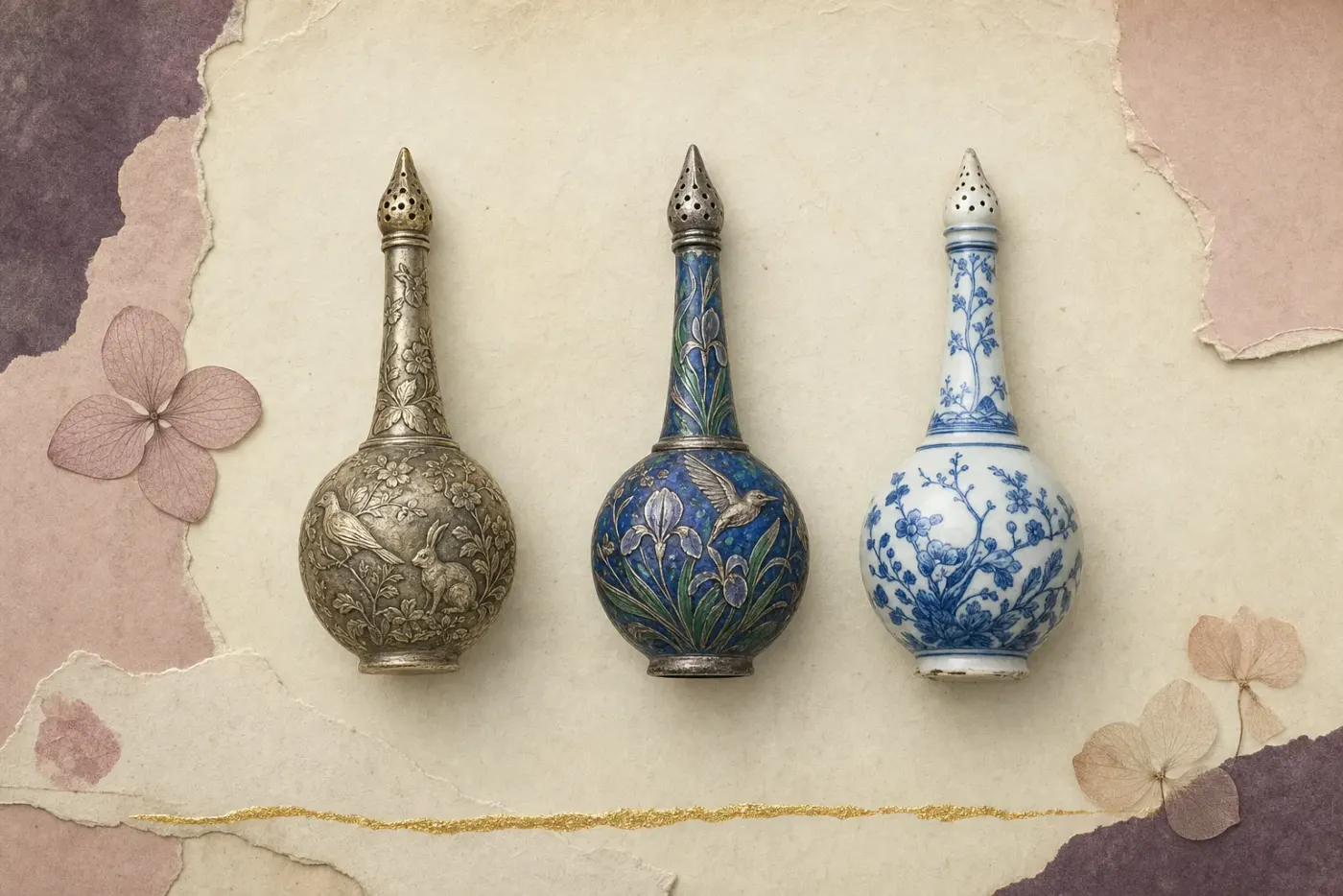
A rosewater sprinkler is a bottle built to scatter rather than to pour: a round body, a long tapering neck, and a pierced rose or bud at the tip. The Victoria and Albert Museum notes that such sprinklers have been used in the Indian subcontinent from the Mughal period to the present day.[1]
Rose-water was a perfume and a courtesy at once, and the sprinkler is the object in which the two meet: scent applied not to one face at a mirror but to a whole room.
A Court Custom
The emperor Jahangir records the custom as a festival. In the ninth year of his reign, in the summer of 1614, he notes the assembly of Gulab-pashi, the sprinkling of rose-water, known from former times as ab-pashi, water-sprinkling. In the tenth year the servants of the court amused themselves at the festival by sprinkling rose-water over each other, and in the eleventh the rites of the day were duly performed.[2]
The same memoir records the discovery of rose oil at his court, credited to the mother of his wife Nur Jahan, who collected the scum that formed on dishes of hot rose-water.[2] A court that kept an annual festival of rose-water was a court in which the vessels for it were worth making in gold.
Gold, Silver and Porcelain
Among the finest surviving examples, the museum records, is a seventeenth-century pair of enamelled gold set with precious stones, looted from the Mughal treasury in Delhi in 1738 by the Iranian ruler Nadir Shah and sent to Russia as ambassadorial gifts; they are now in the Hermitage.[3] A gilt silver Mughal sprinkler in the museum's own collection, worked with flowers, birds and animals, carries on its foot the engraved arms of an English earl, and the heraldic opinion in its record dates the engraving to between 1675 and 1685.[4] Within a few decades of being made, a Mughal courtesy was in an English earl's possession.
The form was made far beyond India. A sprinkler in blue-and-white porcelain was fired at Jingdezhen in China in the Kangxi period, late in the seventeenth century,[5] and a partly gilt silver gulab pash of the late eighteenth century, probably from Lucknow, is in the Metropolitan Museum's collection of Islamic art.[6]
Scent applied not to one face at a mirror but to a whole room.
Plunder and Exhibition
Two sprinklers in the Victoria and Albert Museum carry the history of empire in their records. One, of partly gilt silver, was said when the museum bought it in 1878, for three pounds, to have been taken from the treasury of Tipu Sultan after his defeat at Seringapatam in 1799; the museum notes that it may have been seized in the plundering after the British victory or allotted to a soldier as a reward.[7]
The other, of silver enamelled in the vivid translucent blues and greens of Lucknow, with birds and irises, was one of a small group of Lucknow enamels sent to the Great Exhibition of 1851, probably made for it, and bought for ten pounds.[8] Between them the two objects show a vessel of welcome becoming, within a lifetime, first a trophy and then an exhibit.
What Is Not Known
How often any of these sprinklers was used, on which occasions, and by whom. A vessel of gilt silver or enamelled gold was a treasury object as much as a tool, and the records cited here describe makers, materials and owners rather than the gatherings the sprinklers were carried into.[9]
Sources
- [1, 3, 8]Rosewater sprinkler, Lucknow, about 1850, museum number 130-1852View source (opens in a new tab) Accessed 2026-09-25.
- [2]The Tūzuk-i-Jahāngīrī, or Memoirs of Jahāngīr, volume 1 Royal Asiatic Society, London; Project Gutenberg eBook #53674, 1909.View source (opens in a new tab) Accessed 2026-09-25.
- [4, 9]Rosewater sprinkler, Mughal, probably late seventeenth century, museum number IS.46-1988View source (opens in a new tab) Accessed 2026-09-25.
- [5]Rosewater Sprinkler, China, Kangxi period, accession number 79.2.270 Department of Asian Art, The Metropolitan Museum of Art.View source (opens in a new tab) Accessed 2026-09-25.
- [6]Rosewater Sprinkler (Gulab Pash), accession number 2018.230 Department of Islamic Art, The Metropolitan Museum of Art.View source (opens in a new tab) Accessed 2026-09-25.
- [7]Rosewater sprinkler, Deccan, before 1799, museum number 324-1878View source (opens in a new tab) Accessed 2026-09-25.
Filed under