The Ideal Exported: How a Court Face Became a European One
A standard of appearance travelled across Europe before any product did, carried by the people with a reason to copy a court.
In short
The late seventeenth-century French court face — pale, high-browed and distinctly reddened — spread across Europe through dynastic and diplomatic contact and through print, well before any commercial apparatus existed to distribute cosmetics internationally.
- 12min read
- 6chapters
- 4sources
Vivien
Your guide through time
Listen to this essay
5 min listenVivien reads our essays aloud, word for word — every date and every name in its place — so you can listen the way you would be walked through a gallery.
An AI voice, designed for History of Makeup
Every other export in this history needs a mechanism. A material needs a trade route; a product needs a distributor; a technique needs somebody to demonstrate it. An ideal needs none of those. It travels on the strength of people wanting to resemble other people, and it moves faster than any of the things required to achieve it.[1]
By the late seventeenth century a recognisable court face — pale, high-browed and conspicuously reddened at the cheek — had become the reference standard across a large part of Europe, without anything resembling an industry behind it.[1]
The Look Itself
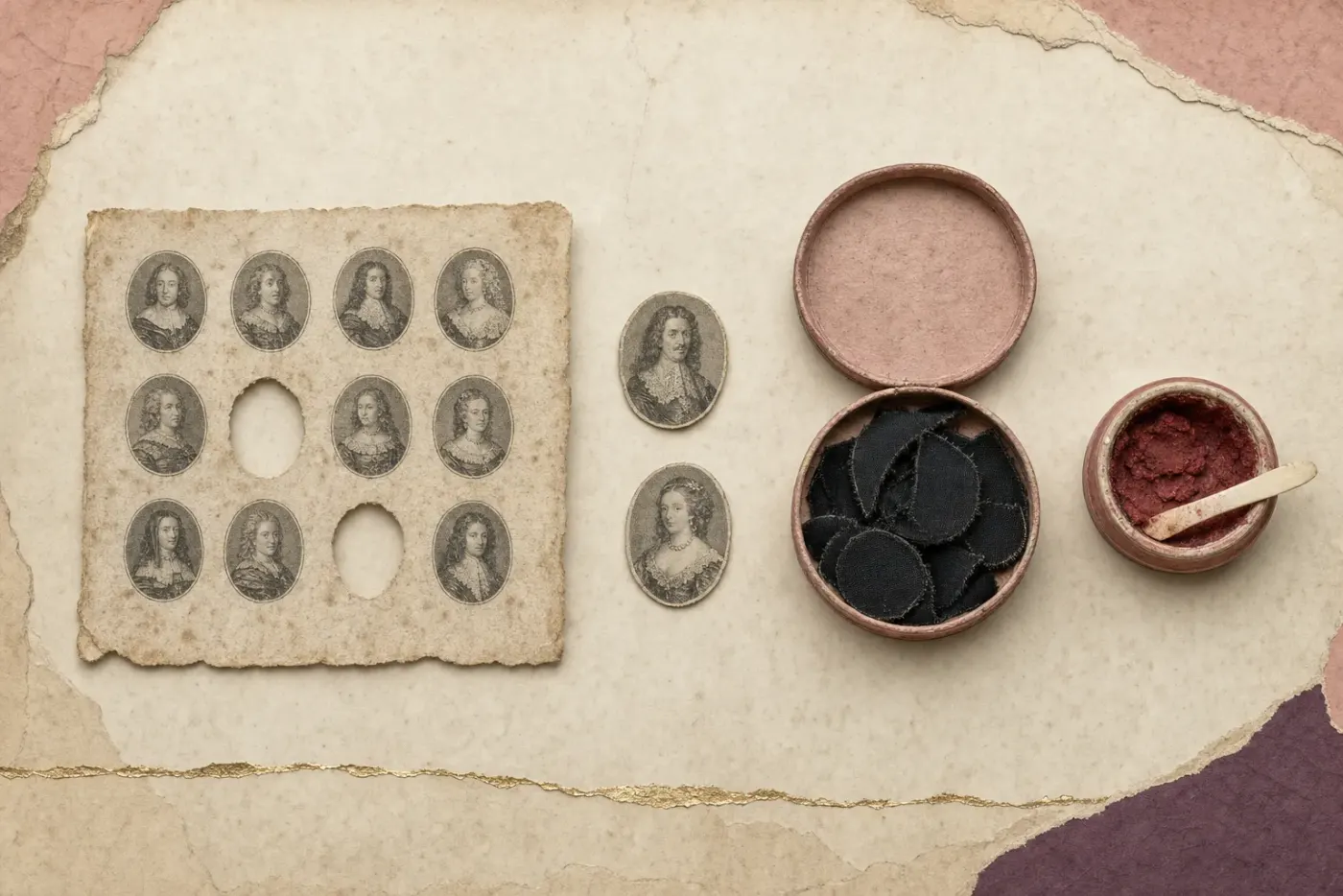
Its components are specific and they are not subtle. A white base, a strong and deliberately artificial red on the cheek, a high clear forehead, and — later in the period — the patch, applied as a dark point against the white.[2]
The red is the part that most distinguishes this face from the ones before and after it. It is not an imitation of a natural flush; it is a declared application, placed and bounded, and the fact that it announces itself is the point rather than a failure of technique.[3]
Why a Court Face Travels
Courts were connected to one another far more densely than they were to the countries around them. Dynastic marriage, resident embassies, exiles, tutors, musicians and painters moved continuously between them, and every one of those movements carried an eye for what the destination court was doing.[4]
A visitor who returns looking like the place they visited is the most efficient transmission mechanism available in a period without mass media. The ideal arrives as a person, which is also why it arrives first among the small group who travel.[4]
An ideal moves faster than any of the things required to achieve it.
Print Did the Rest
Engraved images of court figures circulated far beyond the people who could ever see one, and they did the work that a fashion magazine would do two centuries later: they fixed a look in a reproducible form and carried it to places nobody at that court had visited.[5]
Print also flattens. An engraving reduces a face to line and contrast, which makes a strongly marked cosmetic convention — white ground, dark patch, defined red — far easier to transmit than a subtle one. The medium favoured exactly the kind of face the period was already wearing.[6]
Arriving Without the Materials
The ideal outran its supply chain, which is the most interesting consequence. A household in a provincial town could know precisely what the admired face looked like and have no access to the grade of ceruse, the imported reds or the skilled preparation that produced it.[7]
What follows is substitution: local materials pressed into service, cheaper whites, whatever red was available. The ideal is uniform and the practice is not, and almost all the variation in early modern cosmetics is a variation in what could be got rather than in what was wanted.[8]
This is the inverse of how the period is usually described. Regional differences in early modern appearance are routinely read as differences in taste, when the far likelier explanation is a difference in what a local market carried — and supply leaves almost no record, while taste leaves portraits.[8]
What It Set Up
An ideal this visible and this artificial was unusually easy to attack, and the reaction came. The eighteenth century turned court paint into a political and moral target, and the argument it opened runs directly into the Victorian rule covered elsewhere on this site.[9]
The connection is worth naming plainly. The more declared the face, the sharper the eventual objection to declaring anything — and the naturalness that later periods demanded is a reaction to this specific face rather than a timeless preference.[10]
What Is Not Known
How far down the social scale any of this reached is not recoverable. The evidence is portraits, court writing and satire, all of which describe the same narrow group from different angles, and none of which records what was happening in a farmhouse.[11]
The date is also a marker rather than an event. Nothing happened in 1688 to export a cosmetic ideal; the year stands for a period in which the court face is clearly established as the European reference, and the process was gradual at both ends.[12]
Sources
- [1, 2, 4, 5, 8, 10, 11]Fashions in Makeup: From Ancient to Modern Times Peter Owen, 1972.
- [3, 7, 12]Beauty and Cosmetics 1550–1950 Shire Publications, 2012.
- [6]Italian Renaissance portraiture, European Paintings collectionView source (opens in a new tab) Accessed 2026-09-22.
- [9]The Artificial Face: A History of Cosmetics David & Charles, 1973.
Filed under