Venetian Ceruse: The Most Expensive Way to Damage a Face
The luxury complexion of early modern Europe was a lead compound, and its worst property was also its best selling point.
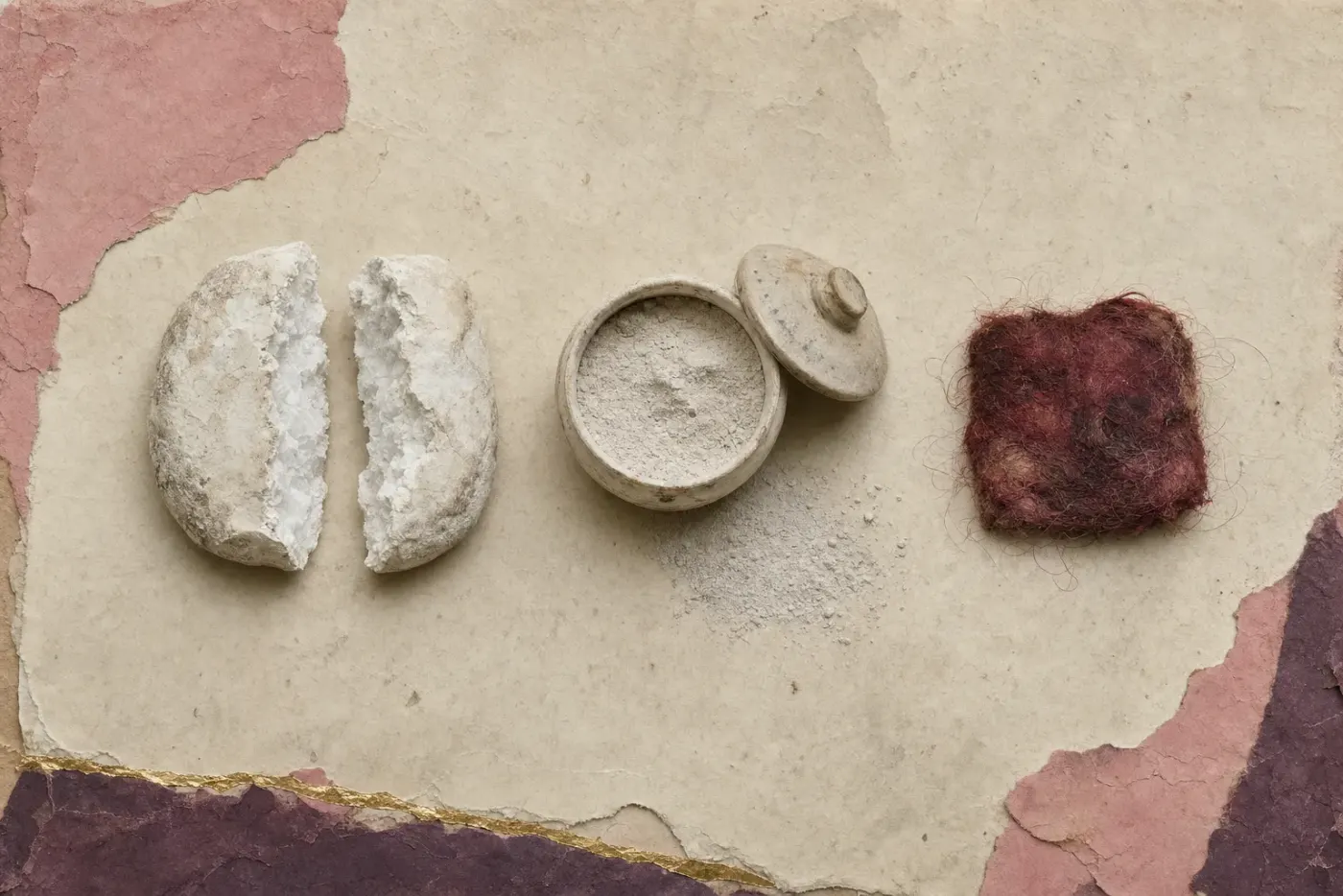
In short
Ceruse, the prestige face white of early modern Europe, was a concoction of lead oxide, hydroxide and carbonate, and the damage it did to the skin created the demand for more of it.
- 12min read
- 6chapters
- 5sources

Vivien
Your guide through time
Listen to this essay
5 min listenVivien reads our essays aloud, word for word — every date and every name in its place — so you can listen the way you would be walked through a gallery.
An AI voice, designed for History of Makeup
Of all the materials in this history, lead white has the longest and worst record. It was the finest white pigment available to Europe for two thousand years, it covers better than anything else within reach of the period, and it is poisonous.[1]
Its cosmetic use is not a Renaissance invention — pellets of Greek psimythion survive from burials of the fifth to third centuries BCE, and the material was in cosmetic use long before Venice attached its name to a grade of it.[2] What the sixteenth century added was prestige, and a market organised around it.
What Ceruse Actually Was
Ceruse is not a single compound. It is described as a concoction of lead oxide, lead hydroxide and lead carbonate, which is what a corrosion process yields rather than what a chemist would specify.[3]
The manufacturing route explains the variability. Lead exposed to acetic acid vapour and carbon dioxide over time produces a white crust that is scraped, washed and ground; the proportions depend on the vessel, the temperature, the duration and the operator. Two batches of ceruse are not the same material, which matters for anyone attempting to reason about its effects from a formula.[4]
Why It Was Worth the Money
The commercial case for a poisonous cosmetic is easy to state and uncomfortable to read. Lead white covers more completely than any alternative available, it holds an even surface, and it produces exactly the unbroken pallor the period admired in a way that chalk, starch or bismuth preparations did not.[5]
It also signalled expense. A material with a known grade, a known origin and a known price is a way of wearing money on the face, and the Venetian designation functioned as much as a claim about quality and cost as a description of where the material came from.[6]
That is worth holding onto, because it explains why cheaper whites did not simply replace it. Chalk and starch were available everywhere and cost almost nothing, which is precisely what made them useless for the purpose: a face that anyone could afford to whiten said nothing about the person wearing it.[6]
A cosmetic that spoils the surface it improves manufactures its own demand.
The Mechanism of the Trap
The damage is what sustains the market. Lead compounds applied to skin over time produce discolouration, irritation and deterioration of the surface — and a deteriorating surface requires heavier covering, which requires more of the material that caused it.[7]
This is the clearest instance on the site of a pattern that recurs in every century: a preparation whose harm generates its own repeat purchase. The Victorian complexion trade would run the same mechanism three hundred years later with different chemistry and identical economics.[8]
What Went On Top
Ceruse was a base rather than a whole face. Colour went over it, and the documented method for applying red is Spanish wool — described as a pad of hair saturated with the colour, rubbed onto the cheek.[9]
That detail is worth keeping accurate, because it is frequently garbled into a claim about dyed wool, which is not what the source describes. The distinction between a pad carrying a colour and a fibre that has been dyed is small on the page and total in the workshop.[9]
How Long It Lasted
Far longer than the Renaissance. Lead white remained the dominant white pigment until zinc white and later titanium white displaced it, and the cosmetic use persisted for as long as the material was the best available.[10]
Displacement was a matter of chemistry rather than of conscience: the substitutes arrived, and they were adequate. A hazard tends to be abandoned when something better exists, not when it becomes known — which is the least flattering and most consistent finding in the whole history of cosmetic materials.[11]
What Is Not Known
How much harm cosmetic ceruse did, as against the much larger lead exposure from plumbing, vessels, paint, glaze and adulterated food, cannot be separated retrospectively. Claims that a named individual died of her face paint should be treated as claims rather than findings.[12]
Nor is the sixteenth-century dating precise. Lead cosmetic whites run continuously from antiquity, and 1550 is a marker for the point at which a prestige grade and a luxury market are clearly attested rather than for any beginning.[13]
Sources
- [1, 4, 5, 10]Lead whiteView source (opens in a new tab) Accessed 2026-09-22.
- [2, 13]On metal and 'spoiled' wine: analysing psimythion (synthetic cerussite) pellets (5th–3rd centuries BCE) and hypothesising gas-metal reactions over a fermenting liquid within a Greek pot Archaeological and Anthropological Sciences 12.10, article 243, 2020.View source (opens in a new tab) Accessed 2026-09-22.
- [3, 9]English Rose: Putting Your Best Face Forward — Cosmetics in 18th Century Society Portraits 2026.View source (opens in a new tab) Accessed 2026-09-22.
- [6, 7, 11, 12]Fashions in Makeup: From Ancient to Modern Times Peter Owen, 1972.
- [8]The Artificial Face: A History of Cosmetics David & Charles, 1973.
Filed under