The Plucked Hairline: A Feature Made by Removal
The most demanding cosmetic practice of the later Middle Ages added nothing to the face. It took things away.
In short
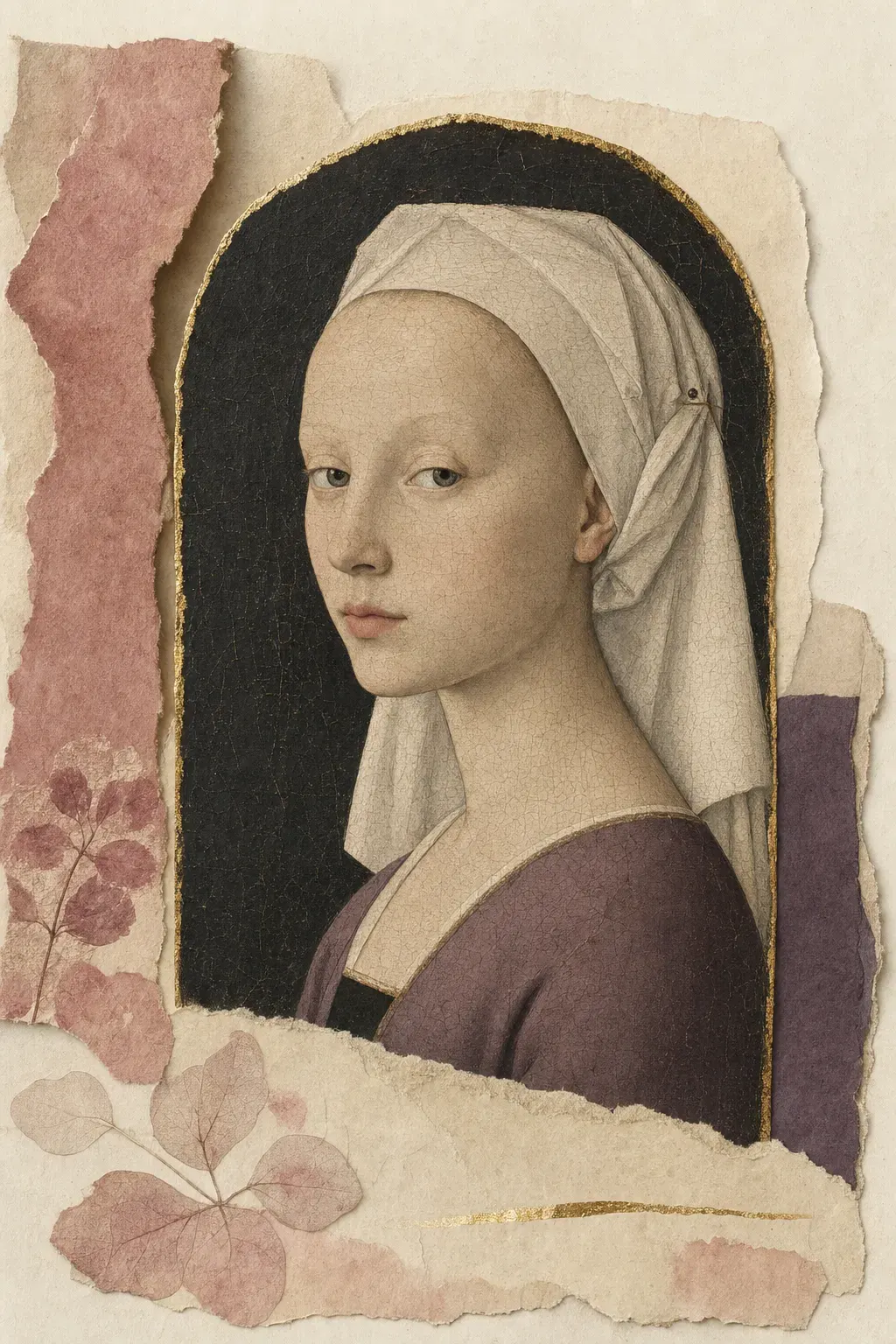
From the later medieval centuries into the sixteenth, the admired forehead was high and the brows nearly absent, both achieved by plucking — a cosmetic practice of subtraction rather than application, and one visible mainly through painted portraiture.
- 11min read
- 6chapters
- 4sources
Vivien
Your guide through time
Listen to this essay
5 min listenVivien reads our essays aloud, word for word — every date and every name in its place — so you can listen the way you would be walked through a gallery.
An AI voice, designed for History of Makeup
Almost every cosmetic practice on this site works by addition: a pigment, a powder, a wax, a dye. The later medieval ideal worked the other way. The admired face had a high, broad, unbroken forehead and brows so fine as to be nearly invisible, and both were produced by pulling hair out.[1]
A cosmetic of subtraction is unusual and it has an unusual property: it cannot be washed off. Paint is a decision that lasts an evening. A plucked hairline is a decision that lasts weeks, and it commits the wearer in a way a pot of rouge does not.[1]
It is also, for the same reason, a practice that leaves no material trace. There is no residue to analyse and no container to excavate, which is why this look is reconstructed almost entirely from pictures — and why the reconstruction is weaker than its confident retelling implies.[1]
What Was Actually Done
The hairline was raised by plucking it back, and the brows thinned or removed — work done with tweezers, with thread, or with depilatory preparations of the kind the medical compendia describe.[2]
Those compendia are the useful corroboration here. A treatise that gives instructions for removing hair is evidence that hair was being removed, and it is better evidence than a painting because it is describing a procedure rather than presenting a result.[3]
Why a Forehead
Explanations are offered freely and supported thinly. The commonest — that a high forehead signalled intellect, or piety, or a deliberate contrast with the animal — are modern readings rather than recorded medieval ones.[4]
What can be said with more confidence is structural. Headdresses of the period covered the hair almost entirely, which leaves the forehead as one of the few visible areas available for modification at all. A face with most of its surface concealed will concentrate its fashion on what remains.[4]
The relationship runs in both directions, which is what makes it convincing. A raised hairline makes a headdress sit further back and reveals more of the forehead it was already framing; the two conventions reinforce each other, and neither has to be explained by a symbolic meaning nobody recorded.[4]
Paint is a decision that lasts an evening. A plucked hairline is a decision that lasts weeks.
The Evidence Is Painted
Nearly everything anyone knows about this look comes from images, and images of this kind are idealisation rather than documentation.[5]
A portrait shows what a sitter wished to be seen as, filtered through a painter’s conventions and a patron’s instructions. When every surviving face in a genre has the same hairline, the safest reading is that the convention was strong — not that every woman had plucked.[5]
The surviving images are also a very narrow sample of the people alive at the time. Portraits were commissioned by those who could pay for them, which means the visual record of this look is drawn almost entirely from the group most able to maintain it. Reading prevalence off a set of portraits is reading it off the wealthiest few per cent, and then generalising.[5]
Who Could Afford It
The practice is expensive in the one currency the period could least spare: time, repeatedly. Hair regrows, so the look requires continual maintenance, and continual maintenance implies leisure and usually implies someone else’s hands.[6]
That places it firmly at court and among the wealthy, and it is a reasonable inference that a look demanding weekly attention was never general. The fashion is real; its reach was narrow.[7]
It Ends, and Then Returns
The high forehead persisted into the sixteenth century and then gave way. The brow, however, has never settled: it has been removed, redrawn, thinned, thickened and removed again in almost every century since, which makes it the most repeatedly revised feature on the face.[8]
The thin downward brow of the 1920s is the same instruction arriving four hundred years later with a different justification attached.[8]
What Is Not Known
How common the practice was is not recoverable. Removal leaves no residue for analysis, unlike a pigment, and the written record describes methods without reporting prevalence.[9]
Nor is it possible to separate, in any given portrait, a plucked hairline from a painter’s convention applied to an unplucked one. Both would look identical on the panel.[10]
The date range is loose for the same reason. Fashions in this period are dated by the images that show them, so the chronology is really a chronology of surviving pictures rather than of practice.[9]
Sources
- [1, 2, 7, 8, 9]Fashions in Makeup: From Ancient to Modern Times Peter Owen, 1972.
- [3]The Trotula: A Medieval Compendium of Women’s Medicine University of Pennsylvania Press, 2001.
- [4, 6]The Artificial Face: A History of Cosmetics David & Charles, 1973.
- [5, 10]Italian Renaissance portraiture, European Paintings collectionView source (opens in a new tab) Accessed 2026-09-22.
Filed under