Beni, by the Fraction of a Per Cent: Why a Red Was Worth Its Weight
The flower is generous with a yellow nobody wanted and miserly with the red everybody did.
In short
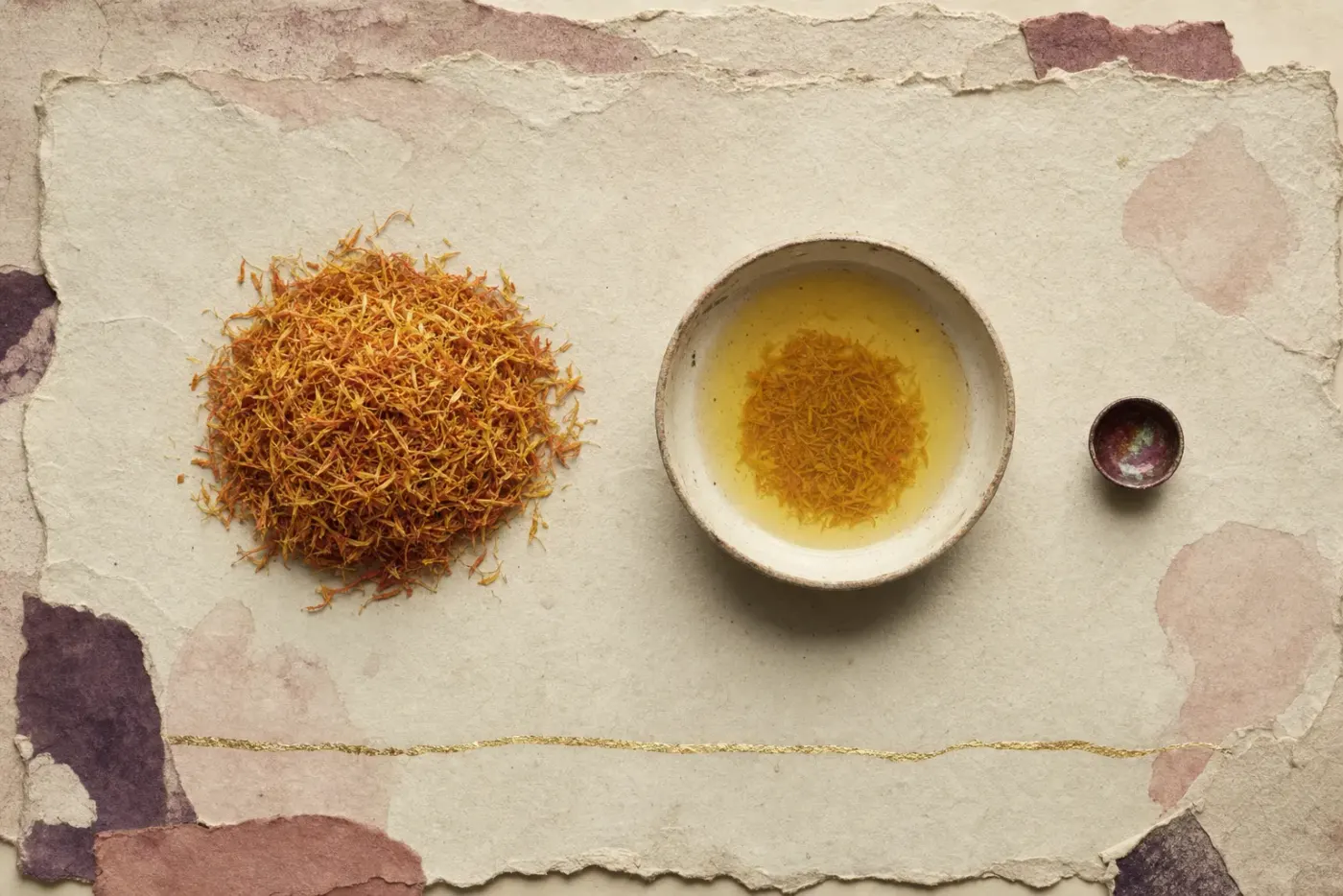
Safflower petals yield water-soluble yellow dyestuffs amounting to about 60 per cent by weight of the dyestuffs they contain, while carthamin, the useful red, is given as 0.4 to 0.6 per cent by weight; the red is recovered from the residue left after the yellow is washed out.
- 13min read
- 6chapters
- 5sources
Vivien
Your guide through time
Listen to this essay
5 min listenVivien reads our essays aloud, word for word — every date and every name in its place — so you can listen the way you would be walked through a gallery.
An AI voice, designed for History of Makeup
Why a cosmetic costs what it costs is usually a question about trade routes or guilds. For beni it is a question about a flower.
Safflower yields two colourants. The water-soluble yellows are abundant, and the red is not, and everything about the price of the finished cosmetic follows from that imbalance.[1]
The Two Figures, Kept Apart
A modern industrial patent states that the water-soluble yellow dyestuffs are as large as about 60 per cent by weight, based on the dyestuffs contained in the petals. It separately states that the content of carthamin, the useful red dyestuff, is as small as 0.4 to 0.6 per cent by weight, and gives no denominator for that second figure.[2]
So the two numbers sit on different bases and cannot be combined. Dividing one by the other would produce a ratio the document does not support, and the honest statement is the one the source makes: a great deal of yellow, and a very small amount of red.[2]
Resisting the arithmetic matters more here than it usually would. A single striking ratio is exactly the kind of figure that gets repeated for decades, and manufacturing one out of two incompatible percentages would put a fabricated number into circulation with a patent number attached to it.[2]
The Red Is What Is Left
The process runs by subtraction. The yellow is water-soluble and the red is not, so washing the petals removes the yellow and the red is recovered from the residue.[3]
Which is why the yellow is not a by-product but an obstacle. Every step of the preparation is work done to get rid of the thing the plant produces most of, and Dunhuang material records the same separation in medieval China alongside safflower’s uses in food, dyeing and ritual offering.[4]
The yellow is not a by-product. It is the thing that has to be washed away first.
What That Did to the Object
It made the cosmetic tiny. Beni was sold painted inside small cups — benizara and benichoko — rather than as a stick or a pot, and the cups were inverted after use.[5]
That is packaging shaped by scarcity. A film dried inside a cup wastes nothing, is picked up with a wet finger or brush in the exact quantity wanted, and cannot be over-dispensed — which is how you sell something whose raw material costs what this one did.[5]
The inverted cup is the same logic applied to storage. Turning it over after use keeps dust off the film and slows the drying, which protects a small quantity of something expensive with no packaging at all.[5]
The Manual That Wrote Down the Economy
The Miyako fuzoku kewaiden of 1813 is the first cosmetic manual written for commoners, and it records the white-powder sequence and a soot-ground economy for beni.[6]
Its bibliographic facts are firm: 1813, by Sayama Hanshichimaru, illustrated by Hayami Shungyosai, in three volumes and seven chapters, covering makeup, skincare, hairstyles and dress.[7] It remained a long-seller until its woodblocks burned in 1923.[6]
A century of continuous sale is itself a finding. Manuals date quickly when they describe fashion, so one that stays in print that long is describing method rather than style — which fits a tradition whose palette did not change and whose technique did.[6]
Why a Manual for Commoners Matters
Because it is written for people who had to make the expensive thing go further, which is why it contains an economy at all. A manual for the wealthy would not need one.[8]
It also means the practice was not confined to the classes whose faces were painted and recorded. A book published for commoners and selling for a century is evidence of a readership, and a readership is evidence of a practice.[8]
What Is Not Known
What proportion of a petal’s weight the red represents is not recoverable from the figures used here, and this article does not supply it. The patent gives two percentages on different bases, and the arithmetic that would join them is not in the document.[9]
The patent is also a modern industrial source and not a record of Japanese practice. It describes the chemistry of the plant, which has not changed, and nothing about how anyone in 1700 actually worked.[9]
Nor does anything here establish what beni cost relative to other goods. The arithmetic of the plant explains why it was expensive; it does not say how expensive, or to whom that put it out of reach.[9]
Sources
- [1, 2, 3, 9]US Patent 5,750,379 — Process for the production of carthamin United States Patent and Trademark Office; assigned to Toyo Ink Manufacturing, 1998.View source (opens in a new tab) Accessed 2026-09-22.
- [4]Cooking, Dyeing, and Worship: The Uses of Safflower in Medieval China as Reflected in Dunhuang Documents Asia Major, 3rd series, 17 (1), 2004.View source (opens in a new tab) Accessed 2026-09-22.
- [5]Beauty Secrets in Japanese Prints Asian Art Newspaper, 27 October 2020, 2020.View source (opens in a new tab) Accessed 2026-09-22.
- [6, 8]Kaleidoscope of Books No. 29: Make-up Then and Now — Cosmetic Culture from Edo to Showa National Diet Library, Tokyo, 2021.View source (opens in a new tab) Accessed 2026-09-22.
- [7]Descriptions of a common belief in an 1813 Japanese beauty handbook regarding the influence of striped clothing on perceived body shape i-Perception 13(5), 2022.View source (opens in a new tab) Accessed 2026-09-22.
Filed under