Nur Jahan and the Rose Oil Her Mother Found
The empress is credited with discovering attar of roses. The emperor who recorded the discovery credited her mother.
HOM · Person? – 1645Mughal empress, consort of Jahangir
In short
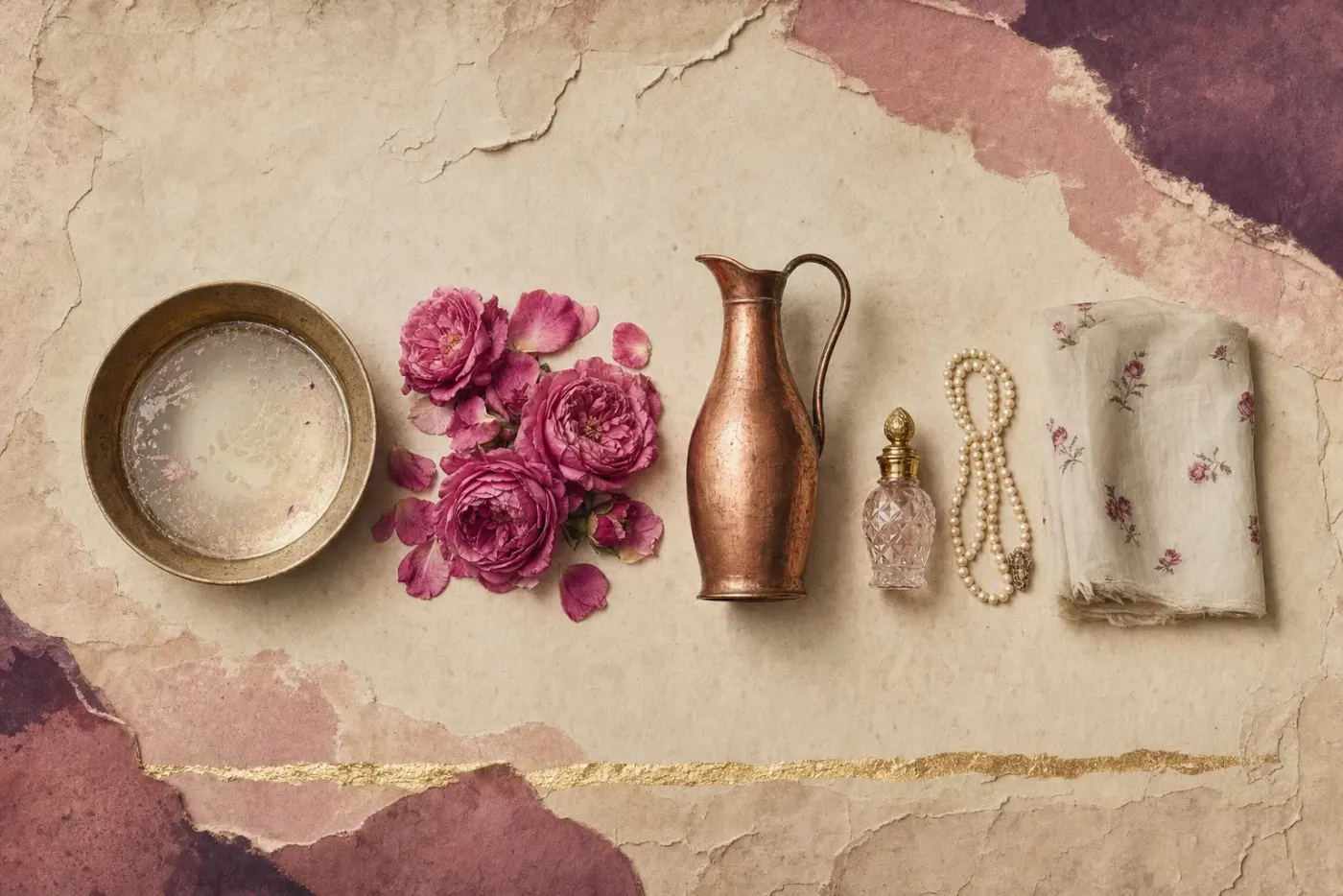
Attar of roses is routinely credited to the Mughal empress Nur Jahan, but her husband Jahangir recorded in his memoirs that it was discovered by her mother, who collected an oily scum from dishes of hot rose-water.
- 3min read
- 4chapters
- 2sources
Vivien
Your guide through time
Listen to this essay
4 min listenVivien reads our essays aloud, word for word — every date and every name in its place — so you can listen the way you would be walked through a gallery.
An AI voice, designed for History of Makeup
Nur Jahan was born Mehr-un-Nisa, in Kandahar, to Persian parents, and married the emperor Jahangir on 25 May 1611. She became the only Mughal woman in whose name coins were struck. Orders were issued under her seal, and she held every privilege of a ruler except the khutbah, the prayer read in the reigning monarch's name.[1]
In the history of beauty she is remembered for something smaller and more fragrant: the discovery of attar of roses, the concentrated rose oil that became one of the most prized perfumes of the subcontinent.
The Emperor's Account
The discovery has the best-placed witness there could be. In his memoirs, in the account of the ninth year of his reign, Jahangir regrets that his father never smelled what he calls the Jahangiri ʿitr, and explains where it came from: This ʿitr is a discovery which was made during my reign through the efforts of the mother of Nur-Jahan Begam.[2]
He describes the method as well. While she was making rose-water, a scum formed on the surface of the dishes into which the hot rose-water was poured, and she collected it little by little. One drop rubbed on the palm, he writes, scents a whole assembly. He rewarded the inventress with a string of pearls, and Salima Sultan Begam, who was present, named the oil ʿitr-i-Jahangiri.[2]
The emperor paid for the discovery in pearls and named its maker. Later tellings moved the credit to her daughter.
How the Credit Moved
Popular accounts routinely give the discovery to Nur Jahan herself. Even those that know the emperor's version tend to split the difference: her mother, Asmat Begum, found the oil, runs one, but the credit of distilling and popularising it goes to her.[3]
The source everyone ultimately draws on is plainer. Jahangir gives the discovery to Nur Jahan's mother, describes how she made it, and records her reward.[4] Stories about luxury drift towards the most famous available name, and at the Mughal court that name was Nur Jahan's.
An Empress's Taste
The attar is not the only invention later writers attached to her. She is credited with a run of textile designs and fashions, among them a flowered muslin, embroidery and lace, and with a design of carpet.[5] Some of these attributions may be accurate and some may be the same drift at work; the sources cited here cannot separate them.
What is documented is her authority, which was real, and a court with the resources to indulge a taste for luxury. That combination is exactly the setting in which inventions made by other people collect around one famous name.
What Is Not Known
When and where the oil was first collected. Jahangir says only that it was discovered during his reign, in an entry written in the ninth year of it, and the naming took place in the lifetime of Salima Sultan Begam, whom he refers to as dead.[6] Whether rose oil had been separated elsewhere before the Mughal court claimed it is a question his memoir does not raise. Nur Jahan died in Lahore in 1645.[7]
Sources
- [1, 3, 5, 7]Was Nur Jahan a scheming temptress or just an independent woman who historians couldn't fathom? Scroll.in, 8 March 2016, 2016.View source (opens in a new tab) Accessed 2026-09-25.
- [2, 4, 6]The Tūzuk-i-Jahāngīrī, or Memoirs of Jahāngīr, volume 1 Royal Asiatic Society, London; Project Gutenberg eBook #53674, 1909.View source (opens in a new tab) Accessed 2026-09-25.
Filed under