The Pharmacopoeia Is Not a Manual: What Li Shizhen Actually Wrote About Pearl
Pearl for the complexion is one of the most repeated claims in beauty writing. The book always cited for it does not say so.
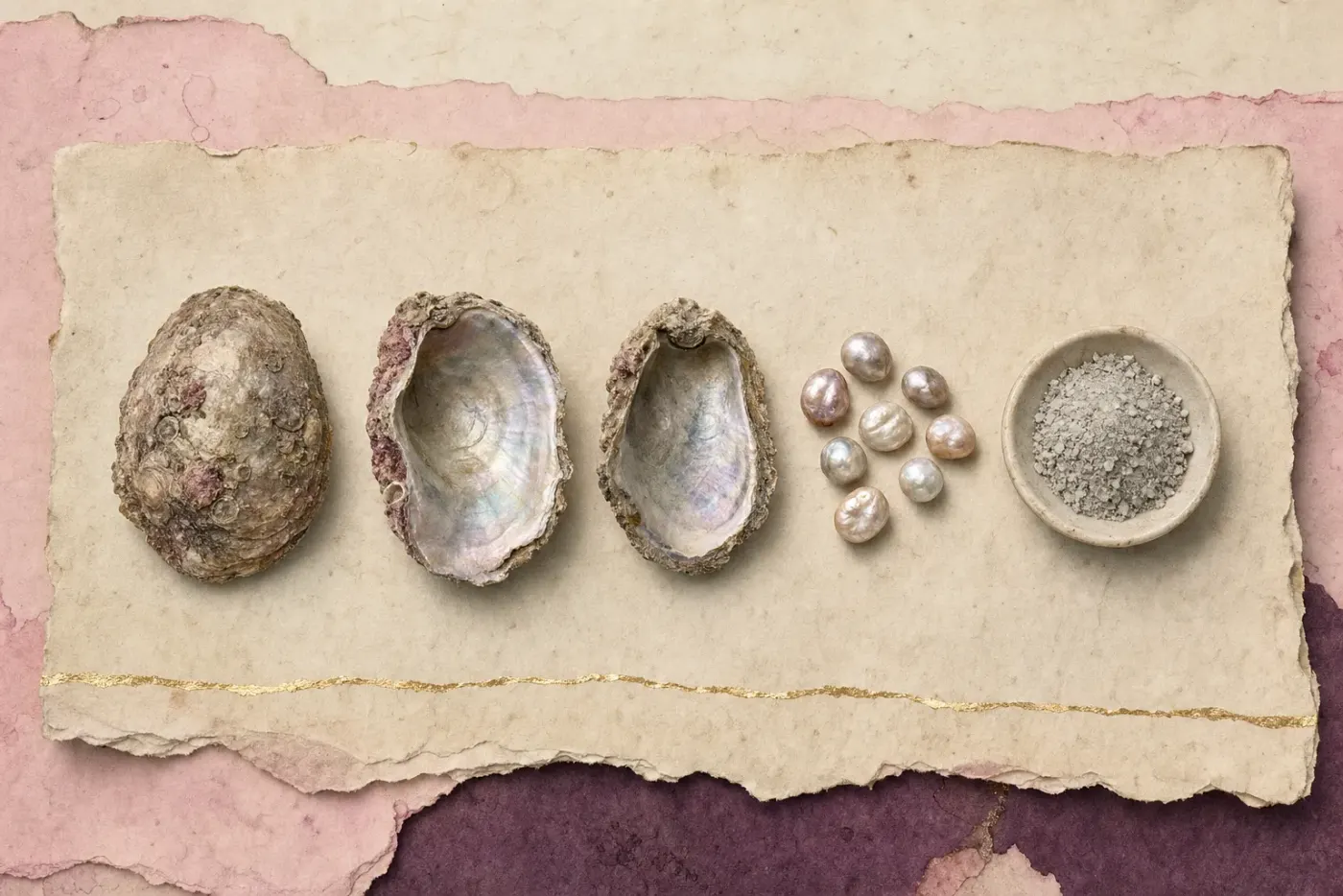
In short
The Bencao gangmu records pearl for settling the heart and calming the mind, clearing heat and extinguishing wind, improving vision and removing nebula, and dispelling poisons and healing wounds — cardiac, ophthalmic and wound indications, with nothing about the condition or appearance of the skin.
- 12min read
- 6chapters
- 1source

Vivien
Your guide through time
Listen to this essay
5 min listenVivien reads our essays aloud, word for word — every date and every name in its place — so you can listen the way you would be walked through a gallery.
An AI voice, designed for History of Makeup
There is a sentence that appears in a great deal of commercial beauty writing: that pearl has been used for the complexion in Chinese medicine for centuries, as recorded in the Bencao gangmu.
The work is real, it was completed by Li Shizhen in 1578 and published in 1596, and it does contain an entry for pearl oyster. That entry records cardiac, ophthalmic and wound indications, and it does not record pearl for the condition or appearance of the skin.[1]
What the Entry Says
Four groups of uses: settling the heart and calming the mind; clearing heat and extinguishing wind; improving vision and removing nebula; and dispelling poisons and healing wounds.[2]
The indications named with them are mental derangement, heart palpitations, ophthalmic nebula, pox and septic lesions — serious conditions, treated internally and on wounds. This is a materia medica doing medicine, not a formulary for appearance.[2]
What Is Being Cited
The record consulted here is one illustrated section of the first edition — six shellfish — rather than the whole work, and it carries the pearl oyster entry. The scope of the claim in this article is exactly the scope of that section.[3]
That is a real limit and it is stated rather than hidden. What can be said is that the pearl entry in the section examined gives no skin indication; what cannot be said from it alone is that no entry anywhere in a work of fifty-two volumes mentions the complexion.[3]
The citation is real, the book is real, and the sentence it is offered to support is not in it.
How the Claim Works
By borrowing authority without transferring content. A named sixteenth-century compendium sounds like a source and functions like one in a reader’s mind, and almost nobody checks a work of this size in a language they do not read.
The move is not unique to pearl. A medical text is invoked, the invocation is accurate about the text’s existence and date, and the specific claim attached to it is supplied from somewhere else entirely — which is a harder kind of error to catch than an outright invention.[4]
It is harder to catch because every checkable part checks out. The author existed, the dates are right, the work contains an entry for the material named, and a reader who verifies those three things has verified everything except the only part that was in question.[4]
Not Evidence of Efficacy Either
Worth saying separately: even where the entry does record a use, that is a record of what a sixteenth-century physician set down, not a demonstration that it works. The Bencao gangmu is evidence of medical belief and practice, and it is not evidence of efficacy.[5]
Both misreadings run in the same direction — treating age as authority. A practice being old is a fact about its history and carries no information at all about whether it does what it was thought to do.[5]
The appeal is obvious enough. Centuries of use sounds like centuries of testing, when it is usually centuries of transmission — and a remedy can be copied from book to book for four hundred years without anyone once checking whether it worked.[5]
What a Materia Medica Is For
It is a reference work organising substances, their properties and their indications, compiled so that a practitioner can find a material and know what it was held to do. Its categories are medical ones.
Cosmetic preparations do appear in medical literature across most traditions — al-Zahrawi gave adornment a section of his compendium, and the Trotula texts carry cosmetic material inside a gynaecological corpus — so the general point is not that such books never treat appearance. It is that this entry, for this material, does not.[6]
What Is Not Known
Whether pearl powder was in fact used cosmetically in Ming China is an open question that this article does not answer either way. It may well have been; the point is that the Bencao gangmu pearl entry is not the evidence for it, and a different source would be needed.[7]
Where the complexion claim entered circulation is also not established here. It is old enough to be repeated without attribution and specific enough to have had an origin, and finding it would be a genuinely useful piece of work.[7]
Sources
- [1, 2, 3, 4, 5, 6, 7]Bencao gangmu (Compendium of Materia Medica) Printed at Nanjing; Wellcome gives 1,892 medicinal substances and 1,109 illustrations, 1596.View source (opens in a new tab) Accessed 2026-09-22.
Filed under