The Written Recipe: When a Formula Became a Possession
The recipe stopped being a line inside somebody else’s medical book and became a thing worth owning in its own right.
In short
Across the fifteenth and sixteenth centuries cosmetic recipes shifted from being chapters inside medical compendia to being items in collections of secrets, exchanged between courts and valued as technical knowledge in their own right.
- 12min read
- 6chapters
- 3sources
Vivien
Your guide through time
Listen to this essay
6 min listenVivien reads our essays aloud, word for word — every date and every name in its place — so you can listen the way you would be walked through a gallery.
An AI voice, designed for History of Makeup
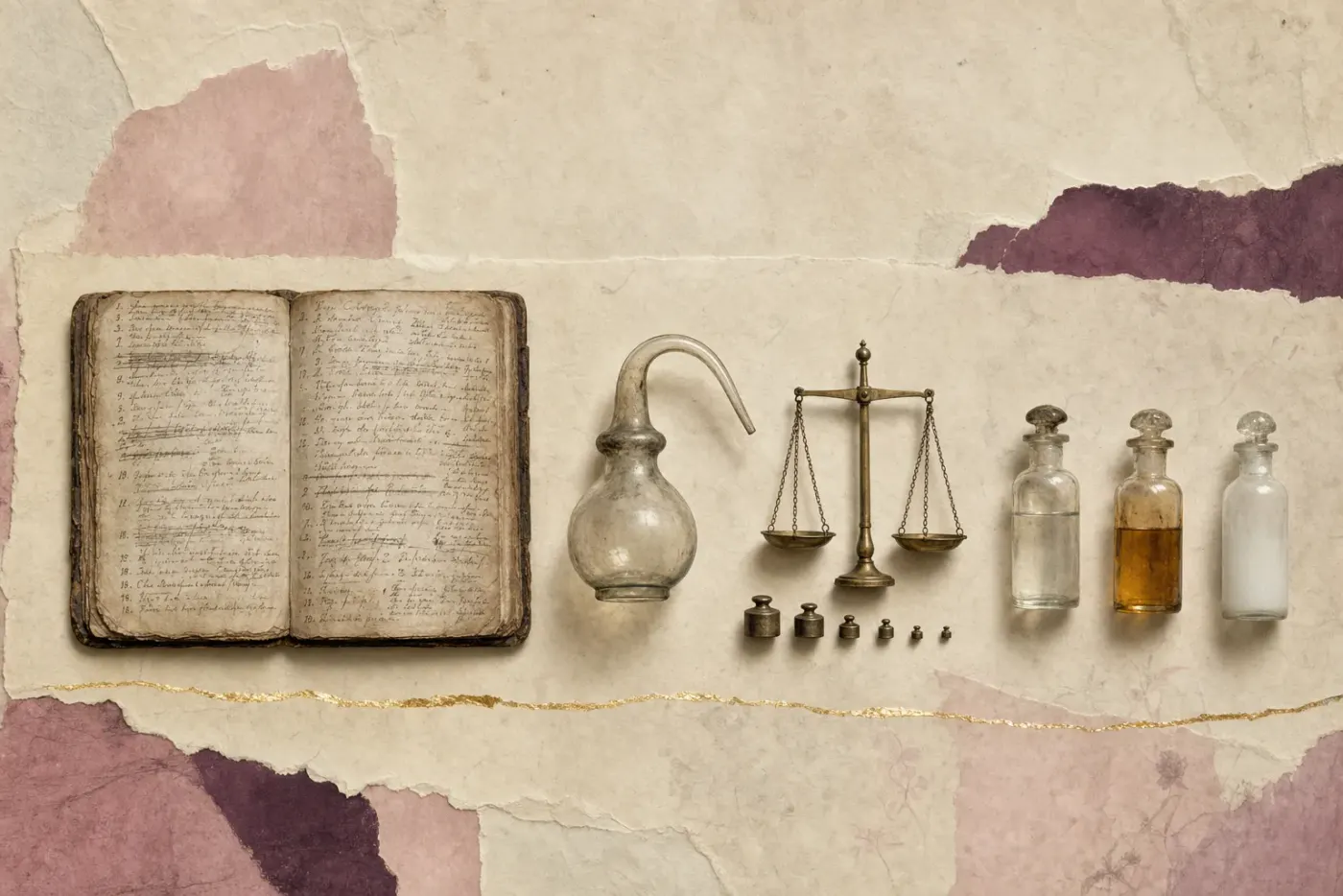
The medieval cosmetic recipe travelled as a passenger. It sat inside a medical compendium, copied because the compendium was wanted, and it had no independent standing — nobody acquired a manuscript in order to get the chapter on depilatories.[1]
By the sixteenth century that had changed. Recipes were being collected deliberately, assembled into books of their own, exchanged as favours between households of standing, and treated as things with a value that could be given away or withheld. The formulation had become a possession, and a possession behaves differently from a passage in a book: it can be traded, hoarded, inherited and shown off.[2]
What a Book of Secrets Was
The genre that carried this is the book of secrets: a compiled collection of practical procedures, gathered from correspondents, from experiment, from other books and from artisans, and organised by what they accomplish rather than by any theory of why they work.[3]
Cosmetics sit in these books beside medicine, metallurgy, dyeing, distillation and what would later be separated out as alchemy. That neighbourhood is the most informative thing about them. A collection that puts a face wash next to a method for treating metal is not making a category error; it is working with a category that has since been dismantled, in which all of these are operations performed on materials to change their properties.[3]
Why Writing It Down Changes It
A recipe held in a household and passed by demonstration is durable but immobile: it survives as long as somebody is there to show it, and it cannot travel further than a person can walk. A recipe on a page has the opposite properties. It can cross a continent, sit unused for a century, and be revived by somebody who never met its author.[4]
Writing also imposes a discipline that demonstration does not. A procedure has to be stated in an order, with its materials named and its quantities fixed, and that act of specification is the beginning of the difference between a craft and a formulation. Much of what later became cosmetic chemistry is downstream of the simple obligation to write the steps in a row.[5]
A possession behaves differently from a passage in a book: it can be traded, hoarded, inherited and shown off.
Who Was Doing the Collecting
Recipe collecting was an activity of households with resources, and a substantial amount of it was done by women — who were, in most such households, the people responsible for the still-room, for medicines, and for the preparations the household consumed.[6]
This matters to the history because it is one of the few domains of early modern technical practice where women’s work is documented in their own compilations rather than described by somebody else. The recipe collection is not a marginal source for that history; in several cases it is the principal one, and it records experiment and correction as well as transcription.[6]
Secrecy Was Part of the Value
The word secret in these titles is doing real work. A procedure that everybody has is worth nothing to give, and the exchange of recipes between households functioned partly as a currency of obligation — a valuable thing handed over, creating a debt.[7]
That economy has a consequence for the historian. A collection is not a neutral record of what was known; it is a record of what somebody thought worth having, and the most closely guarded formulations may be exactly the ones least likely to appear in a book that circulated. Absence from the record is weak evidence of absence from practice.[7]
The Printing Press Cuts Both Ways
Print took these collections out of the household and into the market. Books of secrets were commercially successful, ran through many editions, and put formulations in front of readers who had no connection to the households that assembled them.[8]
It also destroyed the thing that made a recipe valuable to give. Once a procedure is in a printed book that anyone can buy, it stops being a secret and becomes an ingredient in somebody else’s compilation — and the printed collections borrow from one another heavily enough that tracing a formulation to an origin is frequently impossible.[9]
What Is Not Known
Whether any given recipe was ever prepared remains the standing problem with this entire literature, and print makes it worse rather than better. A compiler assembling a saleable book has an incentive to include a great many procedures and no incentive at all to test them.[10]
Attribution is equally unstable. Collections copy from collections, names are attached to compilations for commercial reasons, and a formulation credited to a famous household may have entered the manuscript tradition long before that household existed.[11]
Sources
- [1]The Trotula: A Medieval Compendium of Women’s Medicine University of Pennsylvania Press, 2001.
- [2, 3, 4, 6, 7, 8, 10]Daughters of Alchemy: Women and Scientific Culture in Early Modern Italy Harvard University Press, 2015.
- [5, 9, 11]Fashions in Makeup: From Ancient to Modern Times Peter Owen, 1972.
Filed under