The Birth of the Modern Face
A decade of freedom, bold beauty, and a new ideal — how the 1920s changed makeup forever.
HOM · Era1920 – 1929Rebellion & Modernity
All of The 1920s Era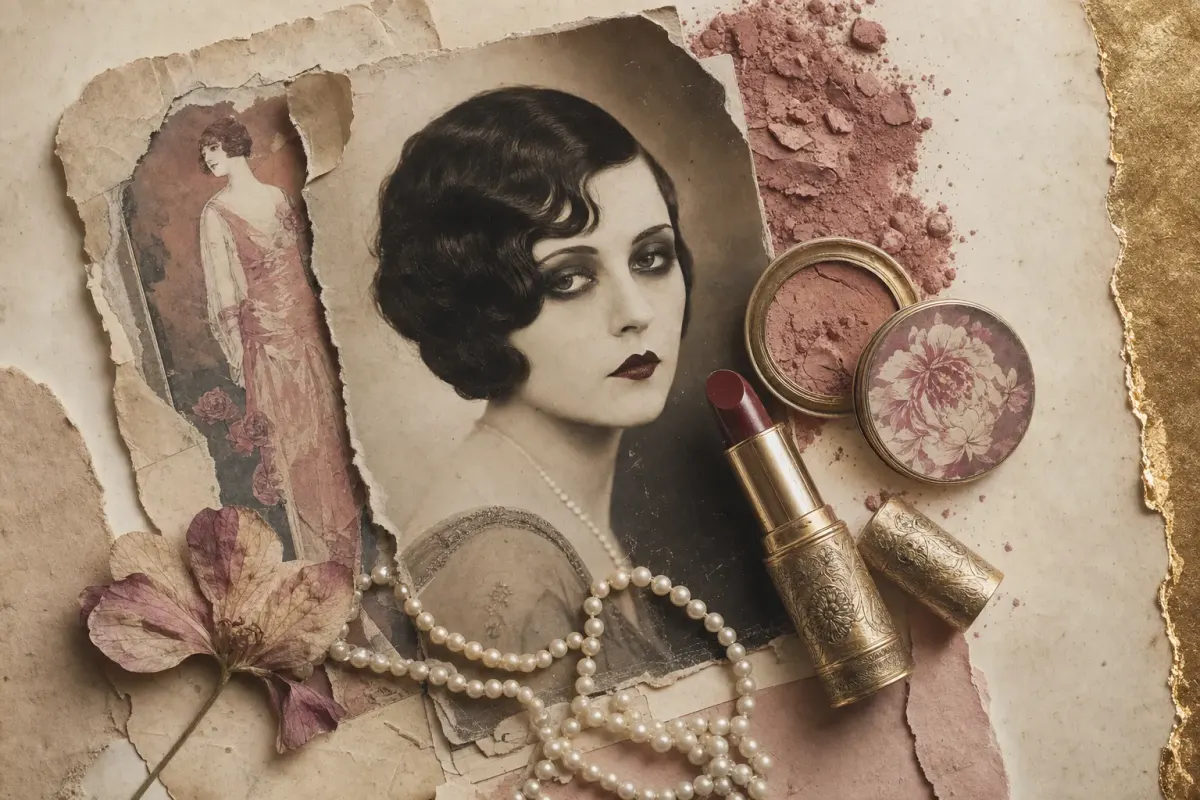
In short
In the 1920s cosmetics moved from the dressing table to the handbag: the swivel lipstick tube, the mirrored compact and a film industry with a face to sell turned makeup from a private correction into a public style.
- 12min read
- 5chapters
- 11sources
Vivien
Your guide through time
Listen to this essay
7 min listenVivien reads our essays aloud, word for word — every date and every name in its place — so you can listen the way you would be walked through a gallery.
An AI voice, designed for History of Makeup
The 1920s were more than a decade — they were a rupture. In the years after the First World War, a generation of women who had worked, voted and buried a great many people declined to return to the drawing room. They cut their hair, shortened their skirts, and did something their mothers would have found genuinely shocking: they painted their faces, and then walked outside.
What makes the decade matter is not that makeup was invented — it is thousands of years older than the Charleston. It is that makeup stopped being a secret. The cosmetics of the nineteenth century were, for respectable women, something to be used invisibly or not admitted to at all.[1] By 1929 a woman could take a metal tube out of her handbag, in a restaurant, and redraw her mouth while someone watched. That shift — from correction to declaration — is the thing the 1920s actually changed.
A New Era Dawns
The social ground moved first. Women had entered wartime workplaces in numbers, and the franchise followed in several countries within a few years of the armistice — 1918 in the United Kingdom for women over thirty, 1920 in the United States.[2] Neither event handed anyone a lipstick. What they did was make a young woman in public, unaccompanied, spending her own wages, an ordinary sight rather than a remarkable one.
Cosmetics followed that visibility, and then accelerated it. A face made up for being looked at only makes sense if you expect to be looked at, and increasingly women did: in offices, in dance halls, in the street, and above all on screen.[3] The modern face was, in a quite literal sense, a face designed for an audience.
The 1920s gave women something extraordinary — permission to be visible.
The Flapper Look
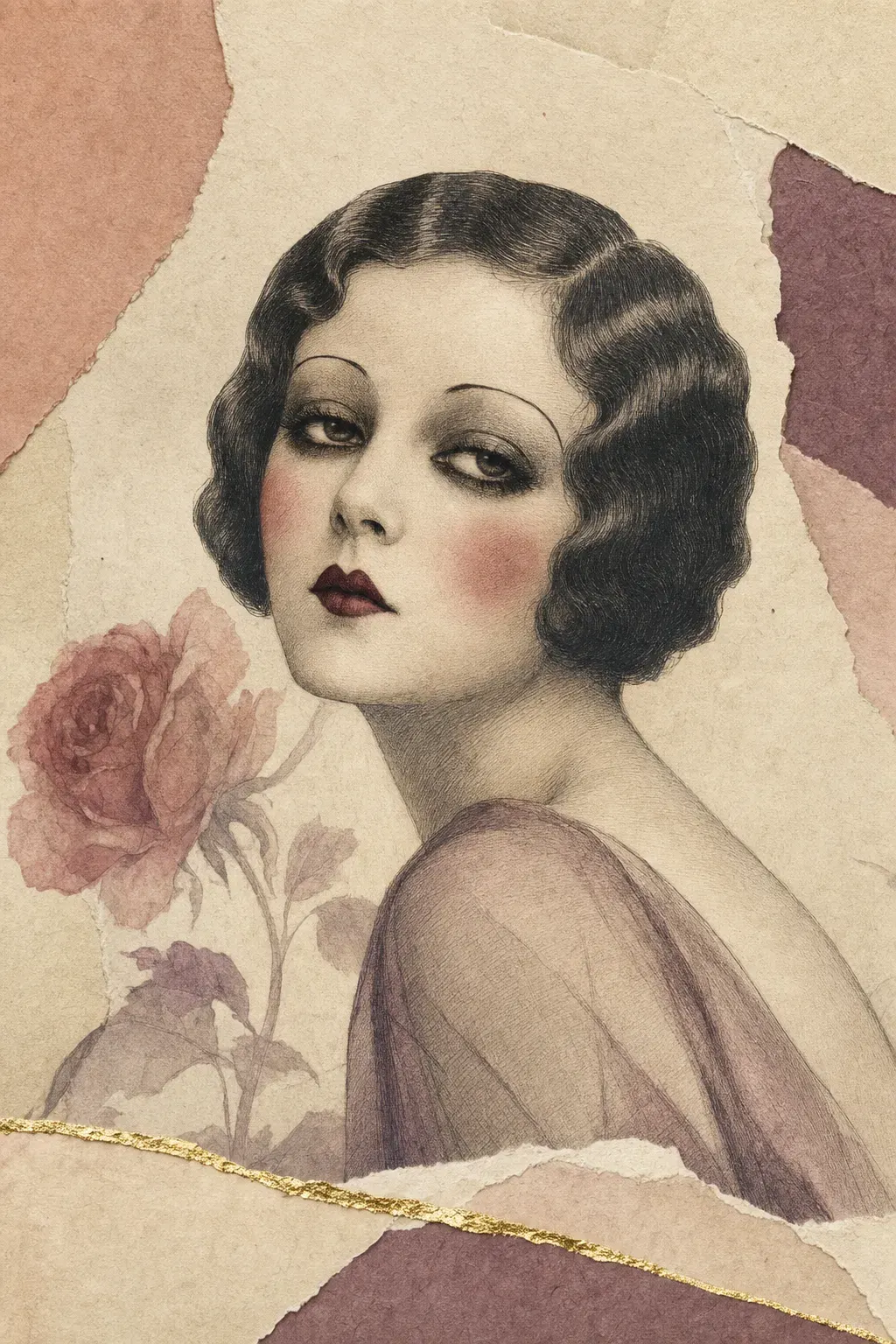
The flapper face was built on contrast, and every element of it was a rejection of what came before. The complexion was pale and matte, powdered to a deliberate flatness. The eyes were the drama: rimmed and smudged with kohl, shadowed in grey, green or brown, and framed by brows plucked to a thin, downward-curving line that gave the face a faintly melancholy cast.[4]
The mouth was the signature. Rather than following the natural lip line, women drew a small, sharply peaked cupid’s bow well inside it, in a deep red, plum or near-brown — a shape associated with screen actresses including Mae Murray and Clara Bow.[5] Rouge went on the apples of the cheeks in a distinct circle, not blended into the bone. Seen in daylight the effect was frankly artificial, and that was the point: this was not a face pretending to be bare.
It was also a face built for the cloche hat, which sat low on a cropped bob and hid the forehead entirely. With the hair and brow concealed, everything expressive had to happen between the eyebrow and the chin.[6]
Iconic Products & Innovations
The decade’s most consequential invention was not a colour. It was a container.
Metal lipstick tubes had existed since the middle of the previous decade — Maurice Levy’s sliding version was produced by Scovill Manufacturing from 1915.[7] But it was the swivel-up mechanism, patented in 1923 by James Bruce Mason Jr., that made lipstick genuinely portable: a sealed metal cylinder that fitted in a handbag, survived being carried, and could be opened and used with one hand.[8] The compact did the other half of the work. A powder case with a mirror in the lid meant a woman no longer needed a dressing table, or privacy, to repair her face.
Alongside the hardware came the industry. Max Factor, who had built his business supplying the film studios, moved towards the general public through the 1920s, bringing the language of professional screen makeup — matched, deliberately composed, thought of as a whole — to the ordinary buyer.[9] Elizabeth Arden and Helena Rubinstein, already rivals, were building salon empires on opposite sides of the same market, and between them did much to make the purchase of cosmetics respectable.[10]
One further influence sat underneath the decade’s taste for dark, elongated eyes: the opening of Tutankhamun’s tomb in 1922 set off a wave of Egyptian motifs across fashion, jewellery, architecture and packaging.[11] Kohl-rimmed eyes were already fashionable; Egyptomania gave them a pedigree.
Makeup as Freedom — and Its Limits
It is tempting to read the painted flapper straightforwardly as liberation, and there is something in it. Applying lipstick in public was a small, deliberate act of self-possession, and it was understood as such by the people who disapproved of it.
But the decade complicates its own story. The same industry that sold autonomy also sold a narrow and exclusionary ideal. Foundation and powder shades were formulated for white skin; the cosmetics marketed most aggressively to Black women in the 1920s were skin bleaches and hair straighteners, some containing caustic agents, and they represented a substantial share of advertising in the Black press of the period.[12] A history of 1920s beauty that stops at the Charleston has described one audience and quietly omitted another.
The suntan belongs in the same cautious category. It is regularly said that Coco Chanel made tanned skin fashionable after returning brown from a Mediterranean cruise in the early 1920s. The shift in taste is real and does belong to this period; the tidy origin story, with its single cruise and single woman, is repeated far more confidently than the evidence supports.[13]
Lasting Legacy
The crash of 1929 ended the decade’s confidence, and the 1930s softened almost every hard line the flapper had drawn: brows lifted, lips returned to their own outline, the complexion warmed.
What survived was structural. The idea that a face is composed — that eyes, lips and complexion are chosen together rather than corrected separately — is a 1920s inheritance, and it is how cosmetics have been sold ever since.[14] So is the assumption that makeup is portable, public and unremarkable. The swivel tube in a handbag is a hundred years old and essentially unchanged.
Most of all, the decade established that a woman could look visibly, unapologetically made up and still be respectable — a line that had to be crossed once, loudly, before it could be forgotten.[15]
Sources
- [1, 12, 15]Hope in a Jar: The Making of America’s Beauty Culture Metropolitan Books, 1998.
- [2]Flapper: A Madcap Story of Sex, Style, Celebrity, and the Women Who Made America Modern Crown, 2006.
- [3]The Spectacular Modern Woman: Feminine Visibility in the 1920s Indiana University Press, 2004.
- [4, 13]Fashions in Makeup: From Ancient to Modern Times Peter Owen, 1972.
- [5]Hollywood Before Glamour: Fashion in American Silent Film Palgrave Macmillan, 2013.
- [6]Introduction to 1920s FashionView source (opens in a new tab) Accessed 2026-09-22.
- [7]Metal lipstick container, Scovill Manufacturing Company 1915.
- [8]US Patent 1,470,994 — Toilet article (swivel-up lipstick holder) United States Patent and Trademark Office, 1923.View source (opens in a new tab) Accessed 2026-09-22.
- [9, 14]Max Factor: The Man Who Changed the Faces of the World Arcade Publishing, 2008.
- [10]War Paint: Madame Helena Rubinstein and Miss Elizabeth Arden — Their Lives, Their Times, Their Rivalry John Wiley & Sons, 2003.
- [11]Tutankhamun and the discovery of the tomb, 1922View source (opens in a new tab) Accessed 2026-09-22.
Continue in The 1920s Era
Rebellion & Modernity
Browse all 23 articles