Coming of Age: The First Application as a Threshold
In several societies the face was altered once, publicly, to announce that a person had crossed a line — into adulthood, into marriage, into motherhood.
In short
Coming-of-age adornment is designed to be noticed rather than to flatter, because its function is informational: the point of a blackened tooth, a court curtsey or a first lipstick is that other people can see the change has happened.
- 7min read
- 5chapters
- 5sources
Vivien
Your guide through time
Listen to this essay
6 min listenVivien reads our essays aloud, word for word — every date and every name in its place — so you can listen the way you would be walked through a gallery.
An AI voice, designed for History of Makeup
A threshold ritual needs a visible mark, and the face is the most visible surface a person has. Where a society wants a change of standing to be legible, it has usually put something on the face, and it has usually made the first application an occasion rather than a private decision.
The materials vary and the ages vary. What repeats is the structure: a first time, carried out in front of witnesses, after which the person is treated differently.
Teeth, Brows and the Married Face
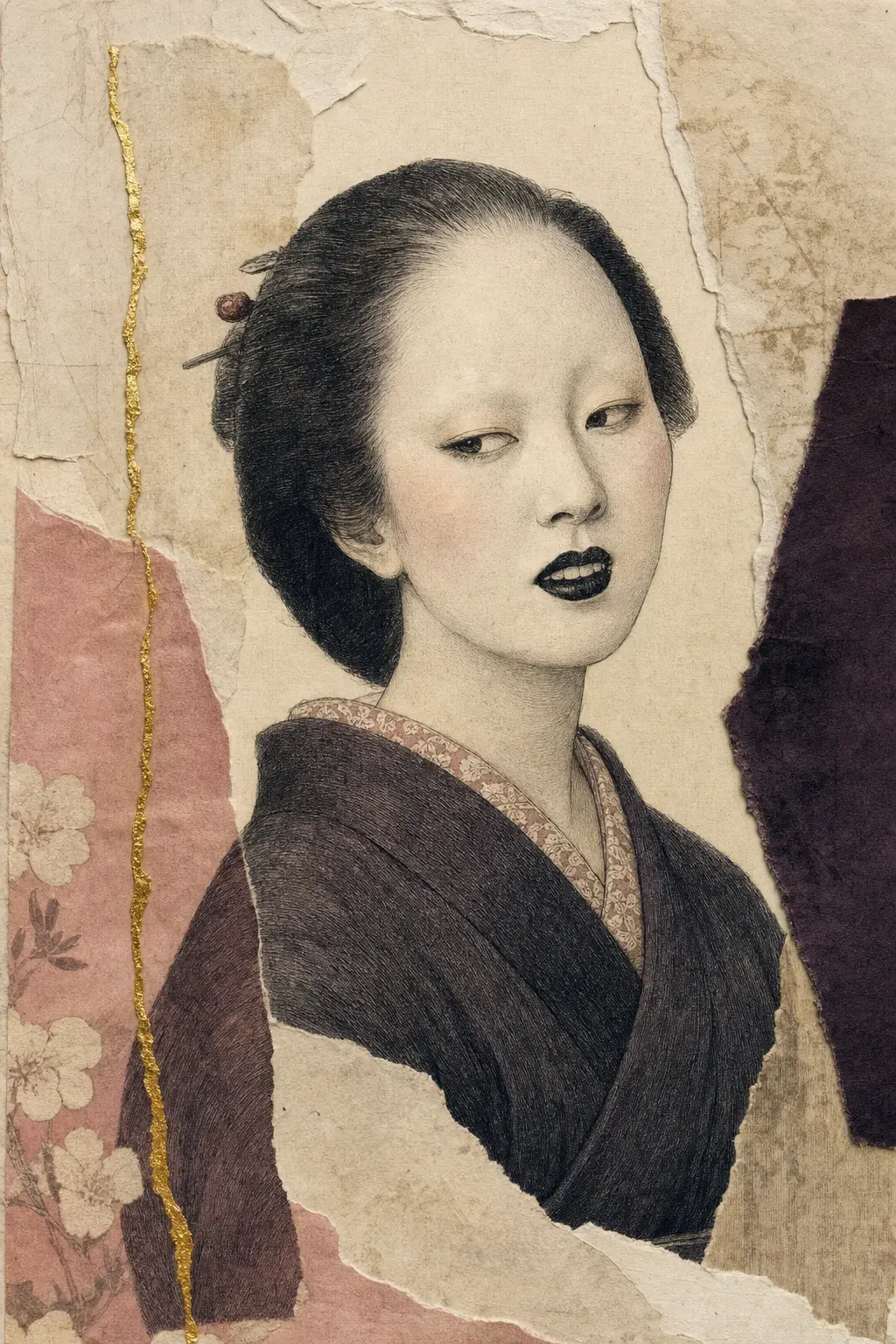
In Japan the threshold was written on the teeth. Ohaguro, the blackening of the teeth, and the removal of the eyebrows were both worn as marks of standing, and the Edo-period version of the custom is specific about which standing: a woman coloured her teeth after marriage and shaved her eyebrows after bearing a child.[1] The face was therefore readable at a distance. A stranger could tell marital and maternal status across a room, without asking and without being told.
The technique was taught in print. Miyako fūzoku kewaiden, a handbook of cosmetics in the capital published in 1813, remained a reference for beauty through the following century.[1]
The rite at which blackening was first applied is a separate question, and a harder one. It is frequently said to have been the Heian coming-of-age ceremony. No source used for this entry says so, and the claim is left out here rather than repeated on the strength of how often it appears elsewhere.
The Meiji Reversal
The practice was ended from above, or at least discouraged from above. In 1870 blackened teeth were banned among the nobility, as part of a broad programme of revising customs that Western observers found objectionable or strange.[2] The source used here does not name the legal instrument, and English-language accounts differ both on what it was and on how far down the social scale the prohibition reached. The entry reports the ban as its source states it and does not supply a statute it cannot cite.
It did not end the practice quickly. Ohaguro persisted outside the aristocracy into the early Shōwa era, which began in 1926, more than half a century after the prohibition.[2] A rite of passage is not abolished by decree. It is abandoned when the passage it marks stops mattering.
The mark is not meant to flatter. It is meant to be noticed, once, by everyone who matters.
Coming of Age Day
Japan kept the threshold and dropped the pigment. The genpuku rite is traced back as far as the Nara period, conventionally dated 710 to 794; its modern descendant is Seijin no Hi, Coming of Age Day, a public holiday falling on the second Monday of January, at which municipalities hold ceremonies for their new adults in formal dress — furisode, hakama or a suit.[3]
The legal threshold has since moved away from the ceremonial one. A revision of the Civil Code in 2022 set the age of adulthood in Japan at eighteen. Most local authorities have gone on holding the ceremony for those turning twenty, because eighteen-year-olds are in their final year of high school and the date falls in the middle of entrance examinations.[3] The adornment survives. What it marks has come loose from it.
The Last Curtsey
The British version was a presentation rather than a mark. Young women of a particular class were presented at court in prescribed dress, and were thereafter out: eligible, visible, adult by social agreement rather than by age.
It ended by announcement rather than by decline. The final presentations took place in 1958, after which they were discontinued; the privately organised Queen Charlotte’s Ball continued in various forms, without the constitutional element that had given it its point.[4] The threshold outlived the institution by some decades and then thinned into a party.
The First Lipstick
The modern equivalent is domestic and unofficial, and it has a literature. Kelly Schrum’s study of American teenage girls between 1920 and 1945 uses diaries, yearbooks and school magazines to show lipstick and powder functioning as a contested threshold: girls arguing for permission, parents setting an age, adults reading the first appearance of colour as a sign that a girl had begun to accept an adult role.[5]
Seventeen launched in September 1944 and found a mass readership within a few years, which is a fair measure of how large a market the threshold had become.[5] A precise circulation figure is usually quoted alongside that launch; it is not repeated here, because it could not be checked against a page of the source. Kathy Peiss’s history of the American industry shows the same pattern from the manufacturers’ side, where an age of first use is read as a date of first purchase.[6]
Sources
- [1, 2]The Fair Face of Japanese Beauty Nippon.com, Nippon Communications Foundation, 2013.View source (opens in a new tab) Accessed 2026-09-22.
- [3]Seijinshiki: Japan’s Coming-of-Age Ceremonies Nippon.com, Nippon Communications Foundation, 2026.View source (opens in a new tab) Accessed 2026-09-22.
- [4]Last Curtsey: The End of the Debutantes Faber and Faber, 2006.
- [5]Some Wore Bobby Sox: The Emergence of Teenage Girls’ Culture, 1920–1945 Palgrave Macmillan, 2004.
- [6]Hope in a Jar: The Making of America’s Beauty Culture Metropolitan Books, 1998.
Filed under