The Swivel Tube: The Container That Changed a Habit
The metal case everyone dates to 1923 had been arriving, piecemeal and in several countries, for thirty years.
In short
James Bruce Mason Jr. was granted United States patent 1,470,994 for a screw-operated lipstick holder in October 1923, but metal lipstick cases had been sold in Britain and France since the early 1890s, and no surviving record identifies who made the first one.
- 13min read
- 6chapters
- 5sources

Vivien
Your guide through time
Listen to this essay
12 min listenVivien reads our essays aloud, word for word — every date and every name in its place — so you can listen the way you would be walked through a gallery.
An AI voice, designed for History of Makeup
A lipstick is a soft stick of wax and oil, and it behaves like one. Left loose in a pocket it warms, bends, collects lint and eventually snaps. For most of its history that was simply what lip colour was: a salve in a pot, a paste in a twist of paper, a crayon in a wrapper — something applied at a mirror, in a room with a door, and then left behind.[1]
A rigid metal case changed the terms of the object. A stick held in a tube that closes and reopens can be carried all day, dropped into a bag with keys and coins, and brought out again at a table without preparation. What follows from that is not a new product so much as a new habit. Reapplying lip colour became something done in company. The case did not cause that shift by itself, but the shift is difficult to picture without it.[2]
What the Tube Had to Hold
The mechanical problem comes before the engineering one, and the lipstick of the years this piece covers was a simple thing. Early twentieth-century sticks were relatively simple mixtures of fats, oils and the pigment carmine: a formulary of the period prints recipes running to little more than carmine, spermaceti and soft white paraffin, or carmine, zinc oxide, ceresine, almond oil and paraffin.[3]
Simple to make, awkward to hold. The base has to be strong enough not to crumble or break and soft enough to release colour when it is drawn across a lip, and both properties move with temperature. That is why a lipstick base is never a single wax. Waxes with a higher melting point give the stick strength; waxes with a lower melting point let it soften in use; a combination of the two is required. Fats and oils supply the plasticity that keeps it from cracking or crumbling. Beeswax, candelilla, carnauba, ozokerite, ceresin, castor oil, lanolin, cocoa butter and liquid paraffin all appear in lipstick bases over the years, in proportions the trade arrived at by trial.[3]
Those proportions decide everything the container has to do. A stick soft enough to mark skin at body temperature is also soft enough to deform in a warm handbag, and a lipstick was expected to hold its shape through a summer without softening. It has to be supported along its length when extended, withdrawn completely when not in use, and closed against knocks and dust. Every mechanism described below is an answer to that one brief, and the answers differed because the brief is genuinely awkward.
The Cases Before 1915
Metal lipstick cases are considerably older than the standard account allows. The British firm Blondeau et Cie — later the Vinolia Company — was selling Vinolia Lypsyl in a metal tube no later than 1892, and a Dorin catalogue of 1893 shows lip rouges in cardboard and nickel cases, already offering more than one mechanism: some are pushed up from the bottom with a finger, others work by a slide.[4]
Stick cosmetics for the mouth were on sale earlier still, though not quite as the object this piece is about. A. Bourjois et Cie was selling greasepaint labelled Batons Extra-Fins from the 1880s at the latest, and a Bourjois catalogue published around 1900 lists stick cosmetics pour les lèvres — Pommade Rosat, Raisin de Théâtre, Rubis Rouge. Their containers suggest they were produced primarily for the theatre, which is a caution rather than a footnote. The trade in stage make-up and the trade in things a woman carried in her bag overlap, and the second grew partly out of the first, but they are not the same trade.[4]
James Bennett's survey, the fullest published account of lipstick containers, declines to name a first. Its conclusion is that exactly when a lip stick was first encased in metal is unknown and is likely to remain so — partly because the line between a lip salve and a lip stick was never firm, partly because a woman with money could simply order a case from a jeweller, which leaves no catalogue behind — and that French-made metal cases were probably in production earlier than the surviving catalogues can show.[4] That is an unsatisfying sentence. It is also the accurate one, and no later claim in this piece is worth more than it.
Levy, Scovill and 1915
The version in general circulation is that Maurice Levy invented the metal lipstick tube in 1915, and that Scovill Manufacturing of Connecticut made it. The first American lipstick sold in a metal case is indeed generally credited to Scovill in 1915 — and the same survey that records the credit adds, in the same breath, that this case is often erroneously credited as being the first metal lipstick case anywhere.[5]
The detail underneath is less tidy, and its provenance matters more than the detail does. The account everything else rests on is a trade-journal retrospective published in 1957, forty-two years after the events it describes, which has Levy as an American investor meeting the French cosmetics manufacturer Anthony Guash in New York in 1915, at a meeting arranged by an official of Scovill, after which the two formed the French Cosmetic Manufacturing Company.[5] That is a business arrangement rather than an act of invention, reported at four decades' distance and then repeated until it hardened.
Nor is 1915 secure even for Scovill. The firm is reported to have produced a metal lipstick container for the Luxor Company of Chicago the year before, and an Oregon newspaper of February 1913 already advertises lip pomade in tiny metal cases suited to a lady's hand bag.[5] Being generally credited with something and having done it first are separate claims, and only one of them here has evidence behind it.
What changed the habit was not a new colour. It was a case that closed.
What Mason Actually Patented
James Bruce Mason Jr., of Nashville, Tennessee, filed an application on 17 July 1922 under serial number 575,479. It was granted on 16 October 1923 as United States patent 1,470,994, under the deliberately unhelpful title Toilet article.[6]
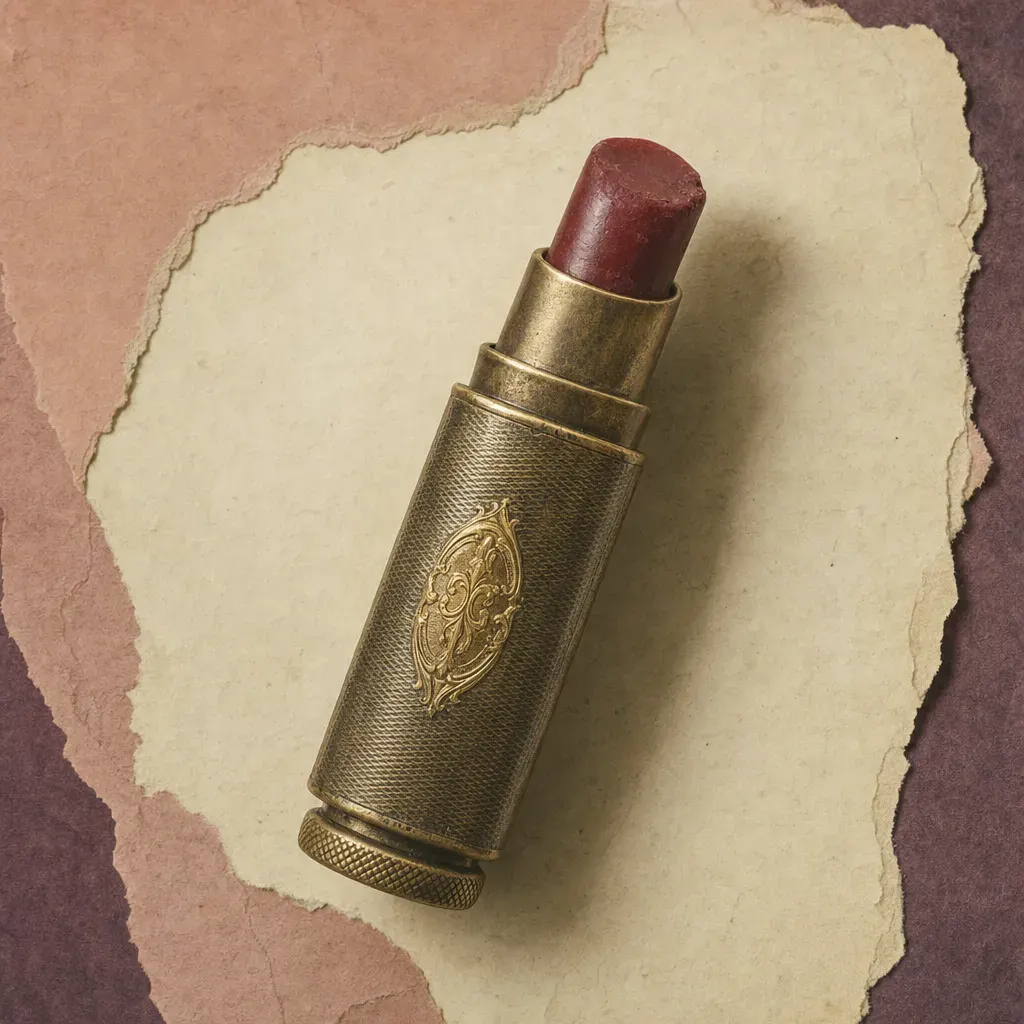
The mechanism is worth reading. A cup carrying the stick travels up and down inside the casing. A threaded rod fixed to that cup engages a rotatable sleeve, which passes through the closed end of the tube and finishes in a knurled head. Turn that head between finger and thumb and the stick rises through the barrel; turn it back and the stick withdraws.[6]
It is routinely called the first swivel lipstick, and on the evidence available that is very nearly right: this is the earliest known patent for a lipstick with a swivel mechanism.[7] What it is not is the direct ancestor of the object in a handbag now. Mason's case was oval in cross-section, like the slide-up types before it, because the stick itself did not have to rotate. In the later swivel cases all or part of the case was twisted instead, which is precisely why those lipsticks had to be round.[7] The design that won is a descendant, not a copy.
What the document does show is a good solution arriving in a field already crowded with sliders, levers and screws. A knurled head at the closed end of a tube can be turned by the hand already holding it, which is an inference from the geometry and not a claim the patent makes; a mechanism needing two hands and a flat surface is a mechanism for a dressing table. The trade reached the same conclusion without Mason's help, and advertised it: in 1930 Jean Patou was selling Lift, an automatic slide-up lipstick that could be opened and closed with one hand.[7]
The Cases That Followed
Metal became the lipstick container of choice after the First World War, when scrap metal was abundant and metal prices were low. The early forms were generally small, often oval in cross-section rather than round, and used some form of sliding mechanism to extend and then withdraw the stick.[8]
Not everything that followed was a question of mechanism. In the late 1920s it became fashionable in Europe to match lipstick to nail polish, and when Northam Warren added lipsticks to its Cutex range in 1935 the company harmonised them with its polishes, releasing four shades — Natural, Coral, Cardinal and Ruby — to match the nail colours it already sold.[8]
By the late 1920s the variety of cases was considerable: oval, round and rectangular, in a range of materials, with sliding, pushing and screwing actions between them, some of them heavily decorated. Mechanisms kept arriving afterwards and kept failing. A 1924 Scovill patent for a double mechanism could freeze when its pins dislodged from their groove; the ball-point lipsticks that appeared just after the Second World War, and Richard Hudnut's Lip Quick of 1959, all failed to gain repeat buyers and were withdrawn.[8]
No document records why the swivel outlasted the rest. The requirement it satisfies is plain enough, though this is an inference rather than a finding: a sealed case that reseals, worked with a thumb, with no loose parts to mislay and nothing protruding to catch on the lining of a bag.
Why a Container Mattered
Liz Conor's study of the 1920s describes the decade in which a young woman in public, unaccompanied and spending her own wages, became an ordinary sight rather than a remarkable one, and in which the face she presented was understood to be on display.[9] Its material is Australian, and whether the same held at the same pace in Britain, France and the United States — where the rest of this entry is set — is not something that source establishes. What it does establish is the shape of the life: a cosmetic that could only be applied at home fitted it badly, and a sealed tube fitted it exactly.
The change that followed is small and consequential. Repairing a mouth stopped being a retreat to a private room and became a gesture made at a table, in a few seconds, in front of whoever happened to be there. Disapproval of that gesture is amply documented in the American press and advice literature of the period, which is the clearest available evidence that it was happening.[10] The tube did not make anyone bolder. It removed the excuse that there was nowhere to do it.
Sources
- [1, 4, 5, 7, 8]Lipsticks Cosmetics and Skin, 2009.View source (opens in a new tab) Accessed 2026-09-22.
- [2, 10]Hope in a Jar: The Making of America’s Beauty Culture Metropolitan Books, 1998.
- [3]Lipstick Formulation Cosmetics and Skin.View source (opens in a new tab) Accessed 2026-09-22.
- [6]US Patent 1,470,994 - Toilet article United States Patent Office, 1923.View source (opens in a new tab) Accessed 2026-09-22.
- [9]The Spectacular Modern Woman: Feminine Visibility in the 1920s Indiana University Press, 2004.
Filed under