Cake Mascara: A Block of Black, a Brush and Water
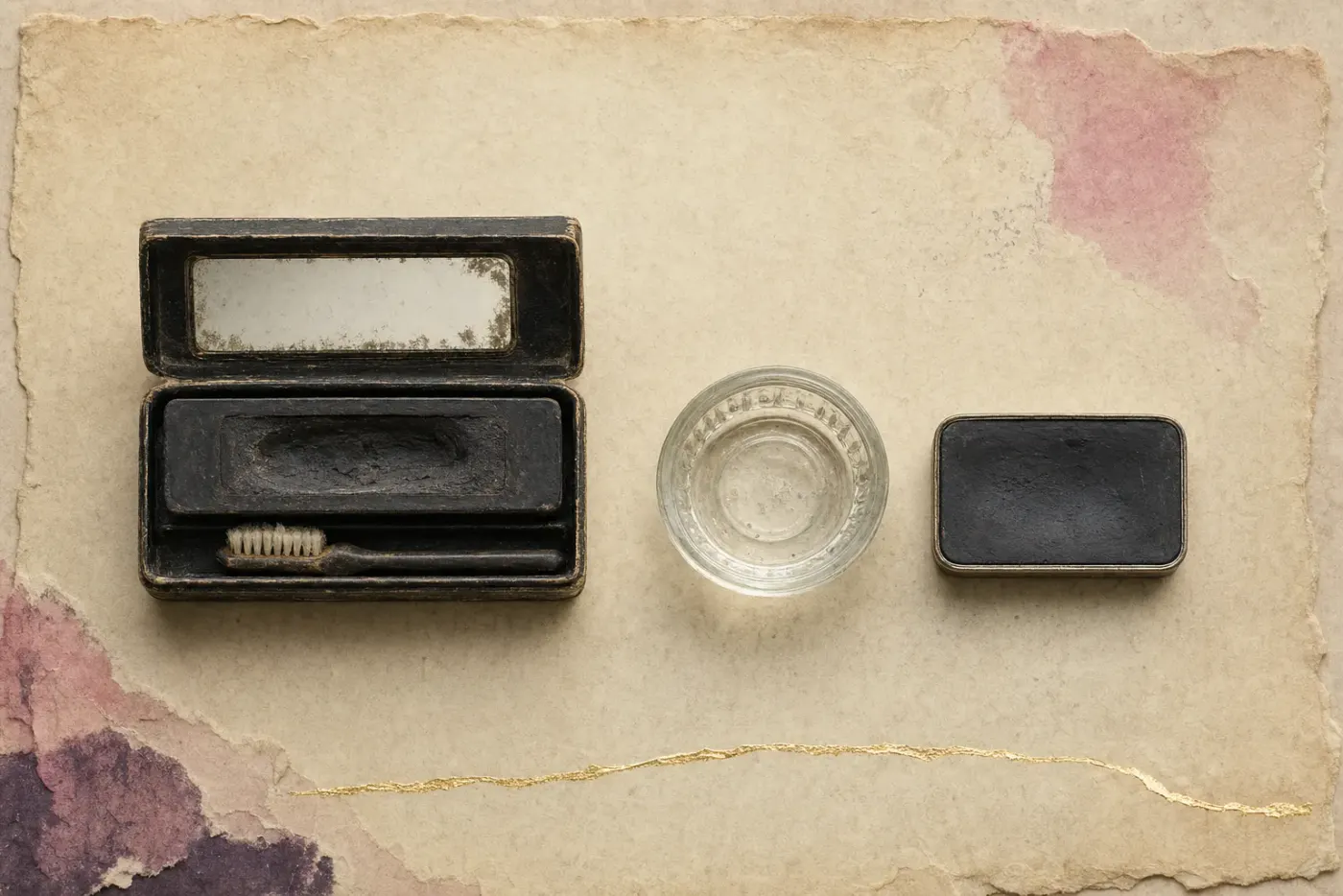
For half a century mascara came as a hard block that had to be wetted and scrubbed with a brush. It was called water black, and sometimes spit black.
In short
Cake mascara, a block of carbon black in soap that was wetted and brushed onto the lashes, was the most popular form of mascara until automatic mascaras began with Helena Rubinstein's Mascara-matic in 1957.
- 4min read
- 5chapters
- 6sources
Vivien
Your guide through time
Listen to this essay
5 min listenVivien reads our essays aloud, word for word — every date and every name in its place — so you can listen the way you would be walked through a gallery.
An AI voice, designed for History of Makeup
In the Victoria and Albert Museum is a small black box of mascara, labelled water black, sealed with a red paper strip and holding a cake and a brush. The lid, printed in gold capitals, carries the whole method: Wet in cold or warm water and use with small brush. It was made by H. Thomas and Co. of London, and it was the stage make-up of the ballerina Tamara Karsavina.[1]
Until the 1960s, that was the most popular kind of mascara there was: a dry cake, a brush and water.[2]
What Was in the Cake
A formula published in 1957 gives the composition plainly: carbon black, fifty per cent, with coconut oil and palm oil sodium soaps at twenty-five per cent each.[3] The pigment was held in soap, and the soap was what let water release it. It was cheap to make and sold at the lower end of the market; mascara, its historian notes, did not achieve the standing of lipstick until after the Second World War.[3]
A wet brush was scrubbed across the cake to pick up the colour and then brushed onto the lashes. Water was not always to hand, and many women spat on the cake instead, which is why the product was also known as spit black; a stage make-up handbook of 1930 warned against licking the brush.[3] The early soaps were alkaline, and the cake stung if it got into the eye.[3]
The Maybelline Legend
The best-known name in cake mascara has an origin story attached to it. The story usually told is that Thomas Lyle Williams watched his sister Mabel repair singed eyebrows with petroleum jelly mixed with ash and coal dust, or in another version rub oil into her lashes. The historian cited here reports both and trusts neither: origin stories, he writes, are notoriously unreliable, and Williams may simply have copied an existing mail-order cosmetic.[4]
The record is plainer than the legend. Williams advertised Lash-Brow-Ine, a scented petroleum-jelly cream with no colour in it at all, in Photoplay in 1916. In 1917 his company brought out a cake eyelash and eyebrow beautifier named Maybelline, in black made with lamp-black and brown made with iron oxides, sold for seventy-five cents in a box with a brush and a mirror inside the lid.[4]
A dry cake, a brush and water: for half a century, that was mascara.
The Dye That Blinded
The eyes were also where an unregulated trade did its worst damage. In the early 1930s an eyelash and brow dye sold as Lash Lure injured the women who used it, cases reported in the Journal of the American Medical Association in 1933 and 1934, and the episode became part of the campaign that produced the Federal Food, Drug, and Cosmetic Act of 1938,[5] which extended federal control to cosmetics.[6]
Lash Lure was a dye, not a cake mascara, and the cake makers had reason to say so. Maybelline began calling its eyelash darkener mascara between 1933 and 1935, a change its historian suggests may have been meant to separate it from the dyes of the Lash Lure scandal.[7] The rule the scandal left behind still stands: in the United States no colour additive is approved for permanently dyeing the lashes or brows, apart from a single professional-only exception listed in 2021.[8]
The End of the Cake
The cake's reign ended with the wand. Its historian dates the change to automatic mascaras, beginning with Helena Rubinstein's Mascara-matic in 1957.[9] A product sold as Modern Mascara had come twenty years earlier, in 1937: a hollow cylinder of cake in a metal tube, with a spiral brush that screwed into the case. It anticipated the wand in form, but its brush still had to be dampened.[9]
The difference sounds small and was not. A cake asked for water, a brush and a steady hand; a wand in a tube asked for nothing but the tube. Every mascara since has been a variation on the second answer.
What Is Not Known
Who made the first mascara, in any sense of the word. Cake preparations for darkening lashes and brows were sold in the nineteenth century as water cosmetique and mascaro, and the name mascara only took over after 1900; the history cited here traces the cake back without naming a first.[10] The Karsavina box is itself undated in its museum record.[11]
Sources
- [1, 11]Mascara (Water Black), H. Thomas and Co., London, museum number S.2261:1, 2-1994View source (opens in a new tab) Accessed 2026-09-25.
- [2, 3, 9, 10]Cake (Block) Mascara Cosmetics and Skin (first posted 29 April 2013, updated 29 August 2025), 2013.View source (opens in a new tab) Accessed 2026-09-25.
- [4, 7]Maybelline Cosmetics and Skin, 2010.View source (opens in a new tab) Accessed 2026-09-25.
- [5]Lash Lure and Paraphenylenediamine: Toxic Beauty Past and Present American Academy of Ophthalmology.View source (opens in a new tab) Accessed 2026-09-22.
- [6]Milestones in U.S. Food and Drug Law United States Food and Drug Administration.View source (opens in a new tab) Accessed 2026-09-22.
- [8]Eye Cosmetic Safety US Food and Drug Administration.View source (opens in a new tab) Accessed 2026-09-22.
Filed under