Colour Typing at the Counter: Selling a System Instead of a Shade
Sorting customers into complexion types solved a retail problem before it solved a cosmetic one.
In short
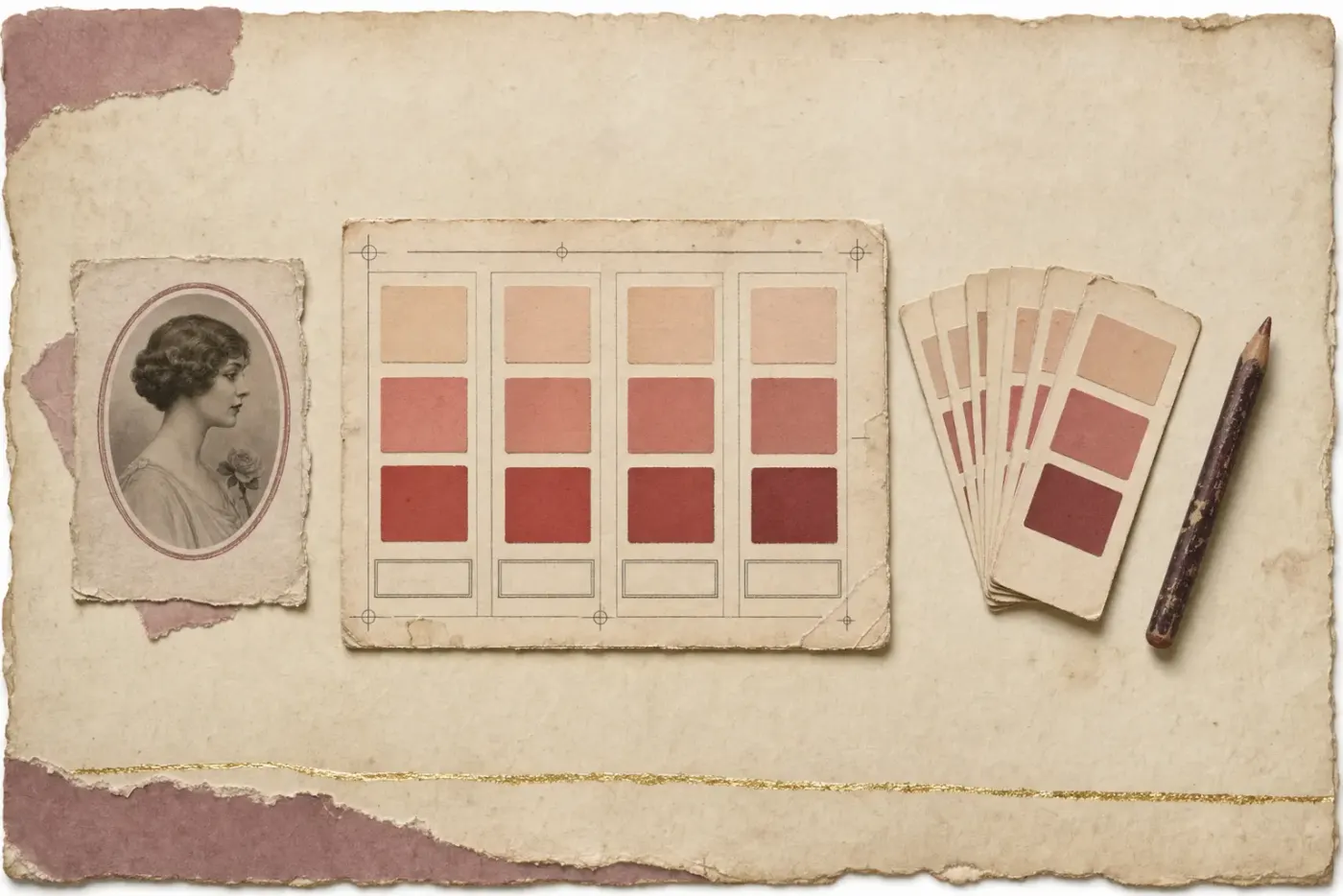
Complexion typing — sorting customers into blondes, brunettes, redheads and brownettes — was used by many cosmetic companies during the 1920s, and grouping individuals into types was neither new nor peculiar to Max Factor, whose Society Make-up of 1927 is its best-remembered expression.
- 11min read
- 6chapters
- 5sources

Vivien
Your guide through time
Listen to this essay
5 min listenVivien reads our essays aloud, word for word — every date and every name in its place — so you can listen the way you would be walked through a gallery.
An AI voice, designed for History of Makeup
A counter selling loose powder in nine shades has a problem that has nothing to do with powder. A customer cannot judge a shade against her own face in a shop, an assistant cannot be expected to have an eye for it, and a wrong answer is returned merchandise and a lost customer. The trade needed a procedure.
The procedure it arrived at was typing: sort the customer into one of a small number of complexion categories and read the recommendation off a chart. It is a retail solution before it is a cosmetic one, and understanding it that way explains almost everything about how it was used.[1]
What the System Was
The categories were few and memorable. Max Factor's Society Make-up, launched in 1927, divided consumers into blondes, brunettes, redheads and brownettes — the last a coinage for the very large group of women who are neither clearly blonde nor clearly brunette, and who had been falling between the other three.[2]
Four buckets is a commercially chosen number. It is small enough for an assistant to learn in an afternoon and for a customer to place herself in without help, and large enough that the answer feels particular to her. That balance is the whole design.[2]
It Was Not One Firm's Idea
The system is so firmly attached to one name that its ordinariness gets lost. Colour typing was used by many cosmetic companies during the 1920s, and grouping individuals into types was neither new nor peculiar to Max Factor.[3]
The attribution problem runs deeper than credit. Basten's biography of Factor credits him with first developing Color Harmony in 1918 — and Bennett, surveying the same ground, records that attribution as unverified.[3] An authorised biography is a good source for what a family remembered and a poor one for a priority claim, and the honest position here is that the date is not established.
Why a System Outsells a Product
A shade is one purchase. A type is a set. Once a customer has been told which category she belongs to, every product in the range has a correct answer for her, and the recommendation extends from powder to rouge to lip colour without a further diagnosis.[4]
It also transfers authority. The assistant is no longer offering an opinion about a face — an awkward thing to do to a stranger — but applying a scheme. That is easier to do, easier to train, and considerably easier for the customer to accept.[4]
A shade is one purchase. A type is a set.
The Counter Was the Product
Typing belongs to a wider change in how cosmetics were sold: the staffed counter, the demonstration, the consultation, the treatment as an argument for a purchase. Helena Rubinstein and Elizabeth Arden had both built businesses on exactly that premise before the decade opened, and the salon model fed the counter model directly.[5]
Worth noting, because it recurs: Rubinstein did not originate the normal, dry and greasy skin classification either. The Institut de Beauté in Paris was already using it.[6] The pattern across this whole period is that systems attributed to a founder were usually circulating first, and the founder's contribution was to sell them harder.
What Typing Left Out
A four-category scheme built around hair colour has an obvious limit, and the limit is the point at which this history stops being a story about retail efficiency. A system organised by blonde, brunette, redhead and brownette describes a narrow range of complexions and silently excludes everyone outside it.[7]
The exclusion was not incidental to the commercial logic; it followed from it. A scheme is built for the customer the seller expects, and for decades the expected customer was assumed to be white. The consequences of that assumption, and how long they lasted, are the subject of a separate piece on this site.[7]
What Is Not Known
When complexion typing began cannot be fixed to a year. The 1927 Society Make-up launch is documented; the 1918 origin claim is not verified; and the practice was in use across the trade, which makes any single first attribution suspect on its face.[8]
There is also no reliable measure of how well it worked. Sales figures for the period are partial and commercially motivated, and the system's persistence is evidence that the trade believed in it rather than evidence that it sold more.[9]
Sources
- [1, 4, 7]Hope in a Jar: The Making of America’s Beauty Culture Metropolitan Books, 1998.
- [2, 3, 8]Max Factor Cosmetics and Skin.View source (opens in a new tab) Accessed 2026-09-22.
- [5]War Paint: Madame Helena Rubinstein and Miss Elizabeth Arden — Their Lives, Their Times, Their Rivalry John Wiley & Sons, 2003.
- [6]Helena RubinsteinView source (opens in a new tab) Accessed 2026-09-22.
- [9]Beauty Imagined: A History of the Global Beauty Industry Oxford University Press, 2010.
Filed under