The Complete Look: When Makeup Became a Single Decision
The decade's real innovation was not any one cosmetic. It was the idea that they were supposed to go together.
In short
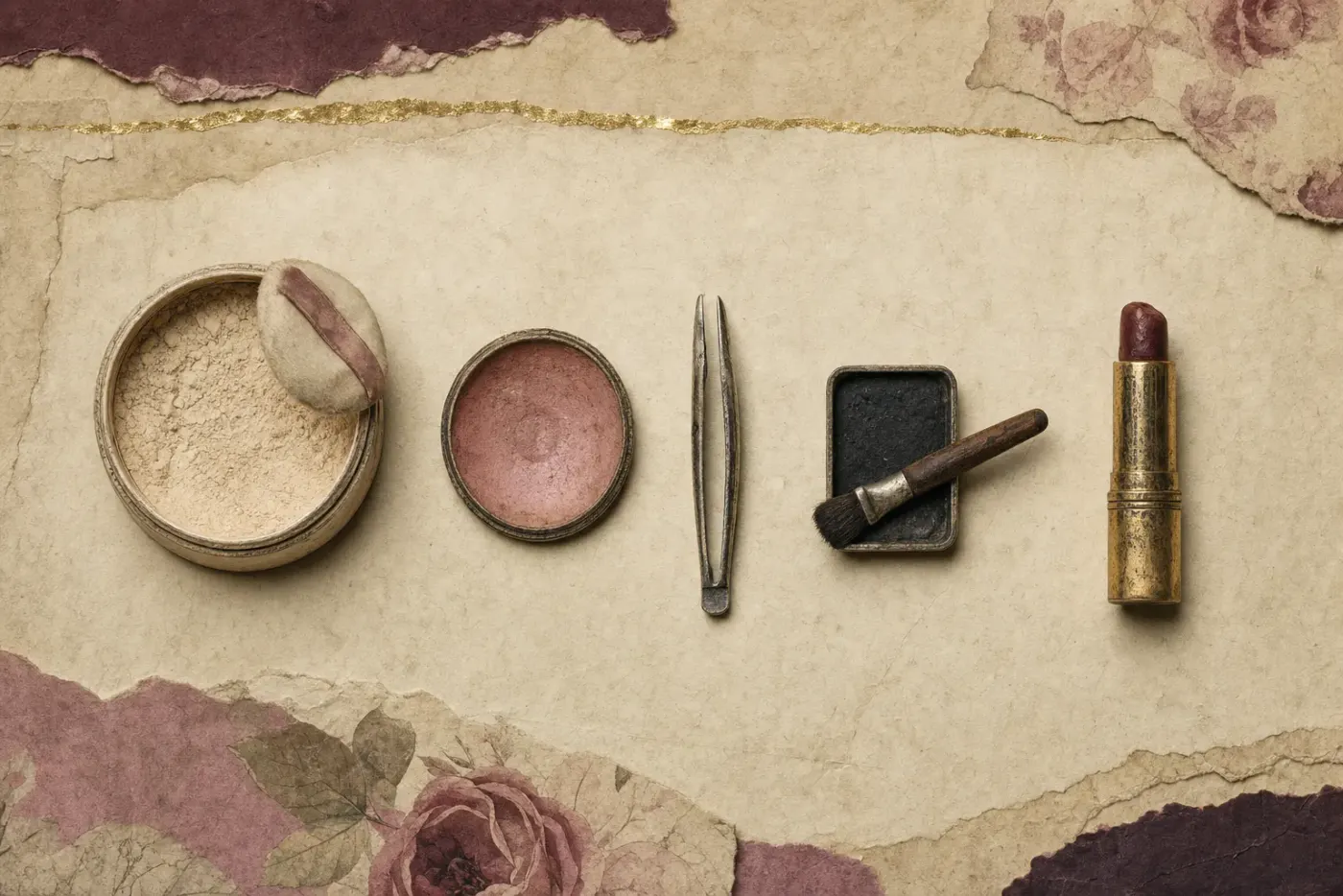
By the late 1920s cosmetics were sold and worn as a coordinated set rather than as separate remedies, a shift that made the range rather than the individual product the unit of both purchase and instruction.
- 11min read
- 6chapters
- 6sources
Vivien
Your guide through time
Listen to this essay
5 min listenVivien reads our essays aloud, word for word — every date and every name in its place — so you can listen the way you would be walked through a gallery.
An AI voice, designed for History of Makeup
Through most of the nineteenth century, cosmetics were bought one at a time and for unrelated reasons. A powder was for shine. A salve was for chapping. A rouge was a separate decision made by a woman who had already decided to take a risk. There was no expectation that these things constituted anything together.[1]
By the end of the 1920s there was. The face had become a composition with named parts — complexion, cheek, brow, eye, mouth — each with a product and a technique attached, and each understood to be wrong if it did not agree with the others.[1]
The Parts, and Their Order
The sequence that settled in this period is recognisably the one still taught: a base first, then colour on the cheek, then the brow shaped, then the eye, then the mouth last. Its logic is practical — the largest area first, the most precise last — and its stability since is remarkable for a fashion industry.[2]
An ordered sequence is also teachable, which matters commercially. A face that has steps can be demonstrated at a counter, printed in a magazine, and reproduced at home, and every step is a place where a product belongs.[3]
The steps have a second effect that is easy to miss. An ordered procedure creates a standard against which a face can be judged incomplete — a woman who has done four of the five has not simply made a different choice, she has left something out. Instruction and obligation arrive in the same sentence, and the commercial value of the first is inseparable from the pressure of the second.[3]
What the Screen Contributed
Film supplied both a reason and a vocabulary. A face built for a camera has to survive lighting that flattens it and stock that distorts its colours, which forces every element into a relationship with every other — a mouth that works with a particular eye under a particular light.[4]
That way of thinking travelled off the set and into the shop, carried by fan magazines and by firms whose studio work was their credential. It is the clearest line from professional technique to ordinary practice in the whole history of the subject.[5]
The face had become a composition with named parts, each understood to be wrong if it did not agree with the others.
The Word Itself
"Make-up" as a term for what a person does to their face belongs to the theatre first and moves outward. Its spread into ordinary use across this period is real, and the claim frequently attached to it — that one manufacturer coined it, or rescued it from disrepute — is the kind of origin story a firm tells about itself.[6]
The useful observation is smaller. A single word covering the whole set is itself evidence of the shift this piece describes: you do not need a collective noun until the things collect.
The Range as the Unit
Once the face is a set, the range becomes the thing being sold. A firm no longer competes on one excellent powder; it competes on whether its powder, rouge and lip colour can be bought together with a guarantee that they will agree.[7]
Complexion typing, covered on this timeline at 1925, is the retail machinery that makes that promise operable — a customer sorted into a category can be sold the whole set at once.[8] The two ideas are the same idea, approached from the shelf and from the counter.
What Was Lost
A coordinated face is also a standardised one. When every element is specified in relation to the others, the room for idiosyncrasy narrows, and a look that had been assembled privately from whatever was to hand becomes a thing one can do correctly or incorrectly.[9]
That is the trade the decade made: a practice that was easier to learn, easier to buy and easier to get wrong.
What Is Not Known
No date can be put on the shift, and the attempt is misleading. It happens unevenly, faster in cities than outside them, faster among the young, and faster in the United States than in most of Europe.[10]
The evidence is also skewed toward the people doing the selling. Advertising, instruction columns and counter material survive in quantity; what women actually did with them is far less recoverable.[11]
Sources
- [1, 3, 9, 11]Hope in a Jar: The Making of America’s Beauty Culture Metropolitan Books, 1998.
- [2, 6]Fashions in Makeup: From Ancient to Modern Times Peter Owen, 1972.
- [4]Hollywood Before Glamour: Fashion in American Silent Film Palgrave Macmillan, 2013.
- [5]Max Factor: The Man Who Changed the Faces of the World Arcade Publishing, 2008.
- [7, 10]Beauty Imagined: A History of the Global Beauty Industry Oxford University Press, 2010.
- [8]Max Factor Cosmetics and Skin.View source (opens in a new tab) Accessed 2026-09-22.
Filed under