The Shade Range: Who Complexion Products Were Made For
Three iron oxides and a white make very nearly every foundation shade on sale. The chemistry was never the constraint.
In short
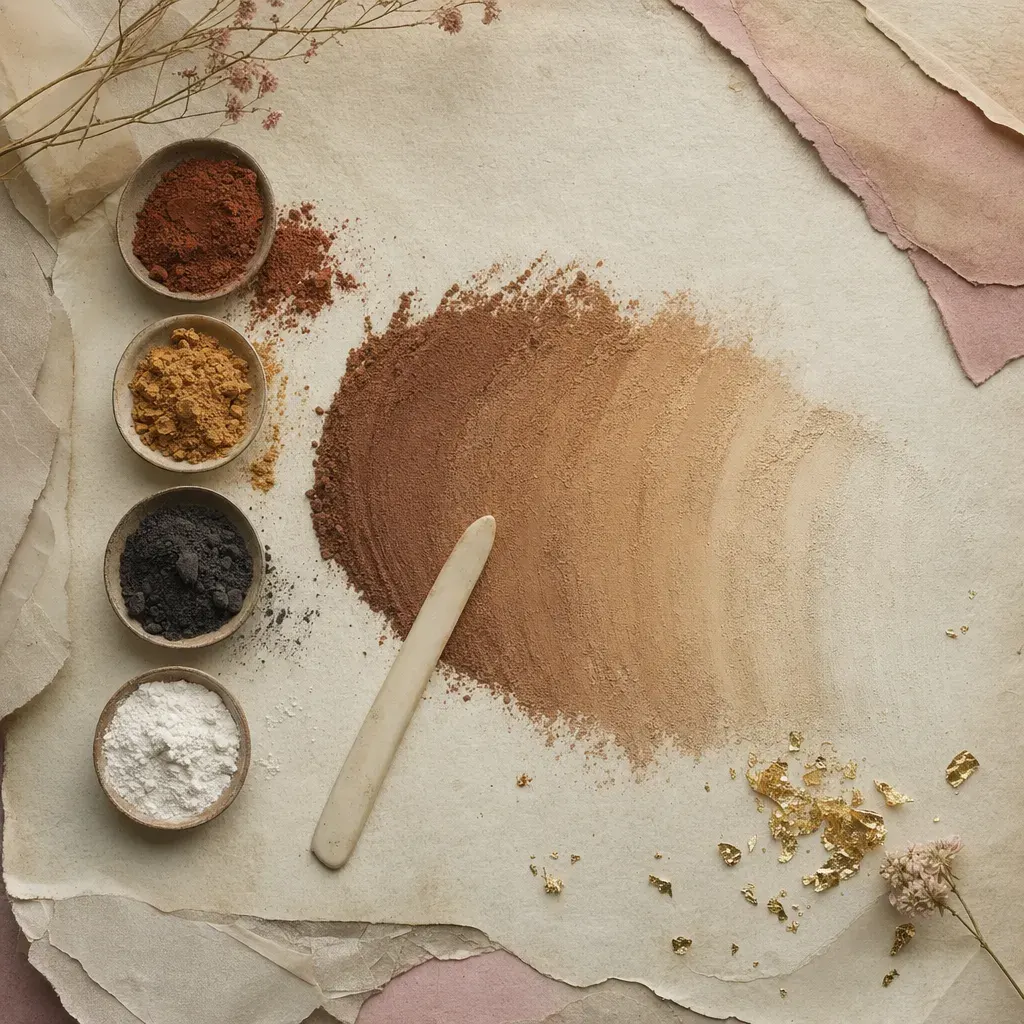
Very nearly every foundation shade on sale is a ratio of the same four pigments — red, yellow and black iron oxide, plus titanium dioxide — which is why the narrowness of most shade ranges was a commercial decision rather than a technical limit.
- 13min read
- 6chapters
- 9sources
Vivien
Your guide through time
Listen to this essay
12 min listenVivien reads our essays aloud, word for word — every date and every name in its place — so you can listen the way you would be walked through a gallery.
An AI voice, designed for History of Makeup
Foundation is a suspension of coloured mineral particles in something that will spread. The colours are almost always the same four: red, yellow and black iron oxide, with titanium dioxide as the white. Very nearly every shade on every counter is a ratio of those, adjusted for how much light the film scatters back off the skin.[1]
That is worth establishing first, because it disposes of the usual explanation. The reason most complexion ranges stopped short of deep skin for the better part of a century was not that the pigments were unavailable, or that the chemistry was unsolved, or that the deeper shades were difficult to make. They are the same pigments, mixed in different proportions. The range was a decision about who the customer was taken to be.
Four Pigments
The iron oxides used in cosmetics are listed in the United States colour additive regulations at 21 CFR 73.2250. As the Code of Federal Regulations stood on 22 September 2026, that section permits them for colouring cosmetics generally, including the area of the eye, exempts them from batch certification, and sets purity limits for arsenic, lead and mercury.[2] They are the same family of rust and ochre colours that have been ground onto faces for tens of thousands of years. What changed in the twentieth century was that they became synthetic, consistent from batch to batch, and specified.
The trade literature describes them as a continuum rather than a set of three: trivalent hydrated iron oxides in all the colours of rust, from dark yellow through brick red, sienna and umber to black, with the white pigment titanium dioxide doing the work of matching skin tones and modifying luminosity. Only in special cases — camouflage products — does anything else appear, and then only small amounts of anhydrous chromium oxide green.[3]
Formulating a shade means choosing proportions of those. The published account of the difficulty is instructive about where the difficulty actually lay, because it is not in the colours. It is in adjusting the vehicle — the water and oil phases and the emulsifier — so that every shade in a range, up to thirty of them in the worst cases, applies the same way. Coated pigments, introduced to cosmetics around thirty years before that article was written, largely solved it: by equalising the surface of different pigments, coatings let a formulator produce different shades while keeping the general vehicle composition constant.[3]
What “Flesh” Was Made to Mean
The narrowness was not confined to cosmetics, and the neighbouring industries make it easier to see. Johnson and Johnson introduced the Band-Aid in 1921 and marketed it as flesh-coloured, meaning one particular flesh. When flesh tones entered underwear they were defined as peach and pink. The Standard Color Card of America, in its 1941 edition, fixed that restricted palette as a reference standard.[4]
Colour photography encoded the same default. Laboratory printing was balanced against a norm reference card — known in the trade as a Shirley card — showing a white woman, and film stocks and printing processes were optimised around it. Lorna Roth’s 2009 study traces the consequences, including the loss of facial detail in images of darker-skinned subjects, and the later commercial pressures that led Kodak to redesign its brown tones.[5]
None of this was a secret formula. It was a default that nobody with the authority to change it had a commercial reason to question.
Overton, 1898
Anthony Overton Jr., who lived from 1865 to 1946 and trained in both law and chemistry, opened the Overton Hygienic Manufacturing Company in Kansas in 1898. It began with baking powder, extracts and toilet preparations. High-Brown face powder followed, made for customers the established powder firms did not market to.[6]
The range is the detail that matters. Surviving boxes and listings record shades sold as nut-brown, olive-tone, brunette and flesh-pink — a range, in other words, with more than one end to it.[6] It is worth being exact about the comparison, because the obvious version of it is wrong. Mainstream powders were not uniformly pale: a Jonteel compressed powder of 1921 was sold in White, Flesh, Outdoor, Brunette, Light, Medium and Dark, which is seven tints from a mass-market firm, and not all of them light.[7] What Overton's range records is therefore not the number of tints that existed in the world. It is who they were addressed to, who was expected to walk up and ask for them, and whose face the word on the box had in mind.
By 1911, operating from South State Street in Chicago, the company was making more than fifty products, from hair creams to eye makeup, and it became one of the largest producers of cosmetics for African American customers in the country.[6] The surviving record does not fix the year High-Brown itself was introduced, and this piece does not supply one.[6]
The pigments could always make the shade. What was missing was a company willing to stock it.
Bamberger's Said Yes
Flori Roberts created her eponymous cosmetics company for women of colour in the 1960s, with her husband Craig Roberts, a doctor who had studied the science of Black skin — which is the fact worth holding on to, because the line was formulated on a physician's understanding of the skin it was made for, not assembled out of whatever the majors already had. She had come to it from acting: a Carnegie Mellon drama degree, and a Broadway run replacing Carol Channing in Lend an Ear, before a career in advertising and public relations. Department stores in metropolitan New York turned the line down. Bamberger's took it, and after a successful debut the brand earned counters at Burdine's in Miami and Foley's in Houston. Marion Boswell, the Black woman who was Roberts' first beauty advisor, later told The New York Times that customers “couldn't believe we had foundations and lipsticks and eyeshadows in colors that were right for them”.[8]
That reaction, reported by the woman who stood at the counter and watched it happen, is the finding of this whole entry. The pigments had been available the entire time.
Eunice W. Johnson reached the same problem from another direction. She launched Fashion Fair Cosmetics in 1973 — she was also the wife of John H. Johnson, founder of Jet and Ebony — and designed makeup specifically for women of darker skin tones who were often unable to find products to match their complexion. The company became one of the first Black-owned international cosmetic lines. It reached its commercial peak in 2003 and later failed, partly because the department stores that carried it were closing, and partly because other brands had at last begun stocking shades for Black women — competition that was, in its way, the argument won.[9]
Neither business was serving a niche. Both were serving a large body of customers the majors had declined to formulate for, which is a different thing, and the distinction is the whole subject of this entry.
Forty Shades
Fenty Beauty launched in 2017 with forty shades of its Pro Filt'r foundation, and the launch is now routinely described as the moment the industry's shade ranges changed. The count by itself explains very little. Make Up For Ever was selling forty shades of its Ultra HD foundation over the same period, and said so publicly, noting that it had had forty since 2015.[10]
What a measurement showed is more useful than the count. In June 2018 The Pudding recorded the published colour values for every shade in a series of foundation ranges, converted them to the CIE Lab model and plotted their lightness. Thirty-one of Make Up For Ever's forty fell inside a single band at the light end of the scale, catering chiefly to light and tanned skin. Fenty's forty, the study found, evenly supported a greater range of skin tones, excelling at both the darkest and the lightest ends.[10]
The same study is worth reading past its headline, because it does not finish where a press release would. Measured against the American bestsellers rather than against Make Up For Ever, Fenty did not cover the deepest band on the scale at all. Maybelline and L'Oréal did — Maybelline having added sixteen mostly darker shades in May 2017, a few months before Fenty launched. Very few brands supported the darkest range, and Fenty was not among them.[10]
Two brands, the same number of shades, entirely different products. The figure on the press release was never the thing worth counting. It is also not the case that nobody had done this before. Overton's High-Brown powder had been sold in four named tones.[11] Flori Roberts had been on department store counters since the 1960s,[12] and Fashion Fair since 1973.[13]
What a Range Measures
The same 2018 analysis looked outside the United States, and the results are a useful corrective to reading a shade count as a straightforward moral index. Five Nigerian brands offered at most eleven shades each, with the distribution skewed noticeably darker than even the Black-founded American brands. Japanese bestsellers carried nothing darker than the middle of the lightness scale. Among nine brands sold in India — seven Indian, two not — most offered fewer than five shades apiece, and only one product in the entire set, a L'Oréal foundation, went darker than that same middle band.[14]
A shade range is a picture of the customer a company believes it has. Narrow ranges in Lagos and narrow ranges in Tokyo are narrow in opposite directions, for the same underlying reason. The chemistry sets no limit in either case; iron oxides and a white will make any of it.[15] What a range records is a commercial judgement, and commercial judgements can be revised — which is why the useful question about a shade range is not how many, but where.
Sources
- [1, 3, 15]Color Foundation and Base Formulas Deciphered Cosmetics & Toiletries, 2013.View source (opens in a new tab) Accessed 2026-09-22.
- [2]21 CFR 73.2250 - Iron oxides Code of Federal Regulations, title 21, part 73, subpart C, 2026.View source (opens in a new tab) Accessed 2026-09-22.
- [4]Redefining Nude Science History Institute.View source (opens in a new tab) Accessed 2026-09-22.
- [5]Looking at Shirley, the Ultimate Norm: Colour Balance, Image Technologies, and Cognitive Equity Canadian Journal of Communication, vol. 34, no. 1, 2009.View source (opens in a new tab) Accessed 2026-09-22.
- [6, 11]Overton's High Brown La Petite Face Powder (object record) Science History Institute Digital Collections.View source (opens in a new tab) Accessed 2026-09-22.
- [7]Compressed Face Powders Cosmetics and Skin.View source (opens in a new tab) Accessed 2026-09-22.
- [8, 12]Flori Roberts Dies Happi (Household and Personal Products Industry), 2020.View source (opens in a new tab) Accessed 2026-09-22.
- [9, 13]New documentary captures legacy of Fashion Fair, one of the first Black-owned makeup lines NBC News, 2022.View source (opens in a new tab) Accessed 2026-09-22.
- [10, 14]The Diversity of Makeup Shades The Pudding, 2018.View source (opens in a new tab) Accessed 2026-09-22.
Filed under