Egyptomania: A Tomb, and the Taste That Preceded It
Carter opened the tomb into a market that was already selling Egypt, and the commercial wave that followed says more about advertising than about Egypt.
In short
Howard Carter located the tomb of Tutankhamun in November 1922, and the cosmetic industry's Egyptian styling that followed was a marketing response layered onto a European taste for Egyptian ornament that dated back to the Napoleonic campaigns.
- 11min read
- 6chapters
- 6sources

Vivien
Your guide through time
Listen to this essay
6 min listenVivien reads our essays aloud, word for word — every date and every name in its place — so you can listen the way you would be walked through a gallery.
An AI voice, designed for History of Makeup
On 4 November 1922 Howard Carter's workmen uncovered a step cut into the floor of the Valley of the Kings. What followed — the sealed doorway, the antechamber, the near-intact burial of Tutankhamun — was the most widely reported archaeological event of the century, and it reached a newspaper-reading public far larger than any previous excavation.[1]
Within months, Egyptian motifs were on cosmetic packaging, in advertising copy and in the names of products. The sequence is real. The causation usually claimed for it is too strong.
The Taste Was Already There
European enthusiasm for Egyptian ornament did not begin in 1922. It runs, in successive waves, from the Napoleonic campaigns and the publication of the Description de l'Égypte onward, through nineteenth-century revival furniture, jewellery, funerary architecture and theatre design.[2]
By the early twentieth century an Egyptian register was an established decorative option rather than a novelty. What 1922 supplied was not the vocabulary but an enormous, sustained, free supply of public attention — and a reason to reach for a vocabulary that was already to hand.[2]
What the Industry Actually Did
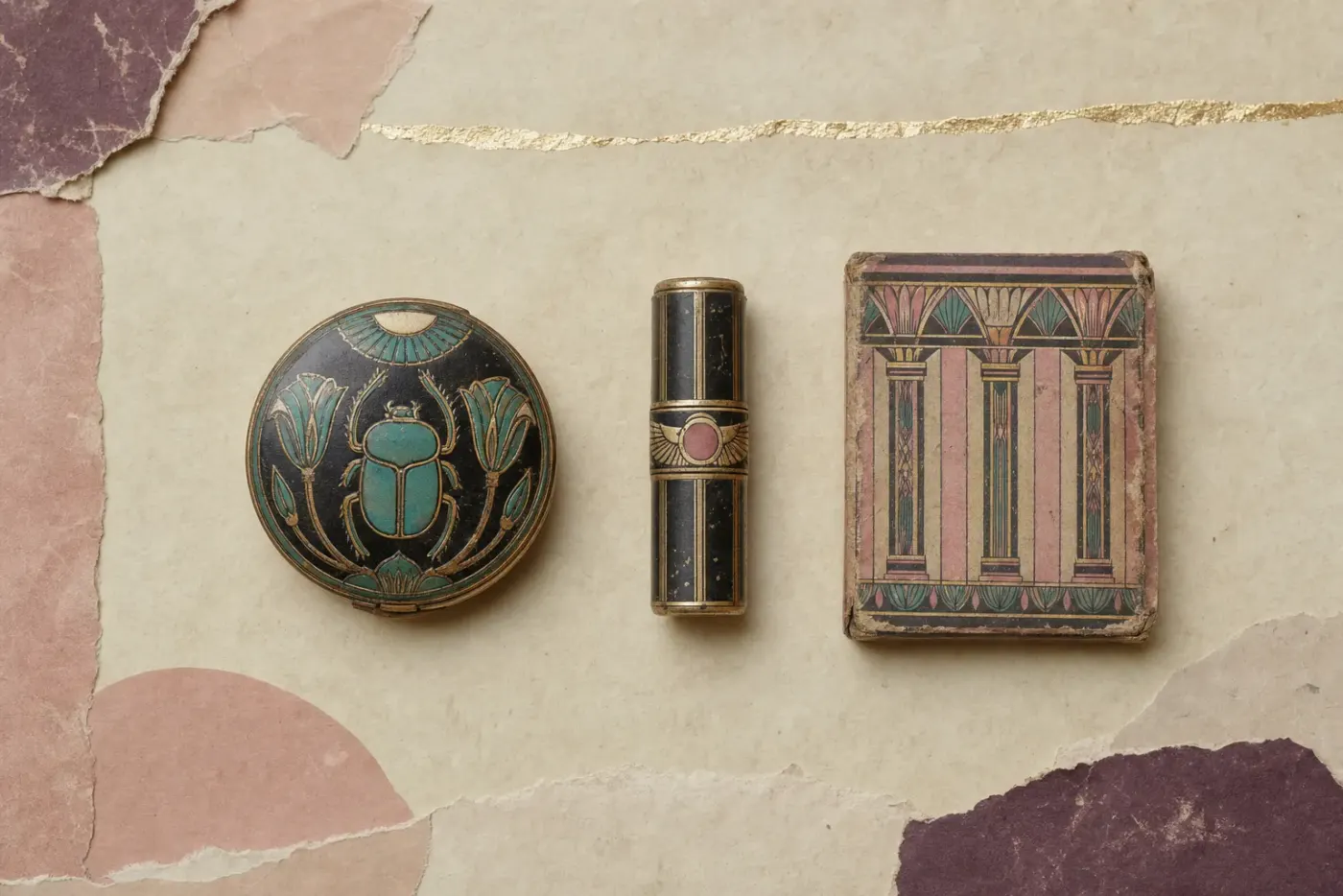
The response was overwhelmingly in packaging, naming and advertising rather than in formulation. Compacts were decorated with scarabs, lotus and winged discs; powders and rouges acquired Egyptian names; copy invoked Cleopatra and the Nile.[3]
Very little of this changed what was inside the container. A rouge sold with a scarab on the lid is the same rouge. That is worth stating plainly, because the Egyptomania episode is frequently narrated as though ancient cosmetic practice had been rediscovered and revived, when what was revived was a decorative style.[4]
The vanity case is the clearest instance. A compact is a small, hard, flat object carried where other people can see it, which makes its lid the most valuable advertising surface the industry had; and a lid is cheap to redesign. The surviving cases of the period show how completely the decoration floats free of the contents — the same pressed powder, the same mirror and puff, behind an enamelled scarab one season and a geometric sunburst the next.[3]
Kohl, and a Word Doing Two Jobs
The one apparent formulation link is the word kohl, which appears on Western eye products of the period. It is not evidence of continuity with Egyptian practice. Egyptian kohl was a family of ground mineral preparations, and analysis of surviving containers shows recipes built variously on lead, manganese, silicon and carbon rather than a single formula.[5]
A 1920s product labelled kohl was typically a carbon-black pigment in a fat or wax base, made to a modern cosmetic formulary. The word was doing advertising work, not chemical description — and it is the same word doing the same work in a good deal of writing about the subject today.[5]
A rouge sold with a scarab on the lid is the same rouge.
The Eye That Followed
There is a real cosmetic consequence, and it is narrower than the story usually allows: the decade's enthusiasm for a darkly shadowed, heavily defined eye was reinforced by the Egyptian register, and the two are visibly entangled in advertising imagery.[6]
Reinforced, not caused. The smudged dark eye was already a screen convention driven by film stock and stage lighting, and it appears in the fashion record before the tomb was opened. Egyptomania gave an existing preference an ancient pedigree, which is a familiar and effective piece of advertising.[7]
The direction of travel is the thing to hold on to. A cosmetic fashion that can be shown to predate the event said to have caused it has not been caused by that event; it has been re-narrated by it. The eye of the mid-1920s is a case where the re-narration was so effective that it is still the version most often repeated.[7]
Cleopatra, Again
Every wave of Egyptian styling produces a new set of confident claims about what Cleopatra wore, and the 1920s wave was no exception. No contemporary source describes her cosmetics. The accounts that circulate are later inference, and the versions attached to twentieth-century products are advertising copy.[8]
This is the reliable test for the whole episode: where a claim of the period names an ancient practice, ask which surviving object or text it rests on. In most cases the answer is a lid.
What Is Not Known
How much of the packaging boom is attributable to the tomb specifically, rather than to the general revival already under way, cannot be separated cleanly. Design registers and catalogues rarely state a motive, and the wave arrives alongside a broader modern-decorative enthusiasm for geometric and exotic ornament.[9]
The defensible statement is that the discovery sharply accelerated an existing taste and gave it a date. That is less than "Tutankhamun created a cosmetic fashion", and it is what the evidence will carry.[10]
Sources
- [1, 10]Tutankhamun and the discovery of the tomb, 1922View source (opens in a new tab) Accessed 2026-09-22.
- [2, 7, 9]Fashions in Makeup: From Ancient to Modern Times Peter Owen, 1972.
- [3]Vanity Case by Richard Hudnut, accession number 1995.238a-z The Costume Institute, The Metropolitan Museum of Art.View source (opens in a new tab) Accessed 2026-09-22.
- [4, 8]Hope in a Jar: The Making of America’s Beauty Culture Metropolitan Books, 1998.
- [5]Recipes of Ancient Egyptian kohls more diverse than previously thought Scientific Reports, volume 12, 2022.View source (opens in a new tab)
- [6]Hollywood Before Glamour: Fashion in American Silent Film Palgrave Macmillan, 2013.
Filed under