The Flapper Face: A Type Invented by Magazines
The flapper was a media figure before she was a person, and the face attributed to her was a commercial specification.
In short
The flapper was substantially a media construction: the word predates the 1920s, the look was assembled and standardised by magazines, advertising and film, and the extent to which ordinary women adopted it varied sharply by class, country and age.
- 12min read
- 6chapters
- 5sources
Vivien
Your guide through time
Listen to this essay
5 min listenVivien reads our essays aloud, word for word — every date and every name in its place — so you can listen the way you would be walked through a gallery.
An AI voice, designed for History of Makeup
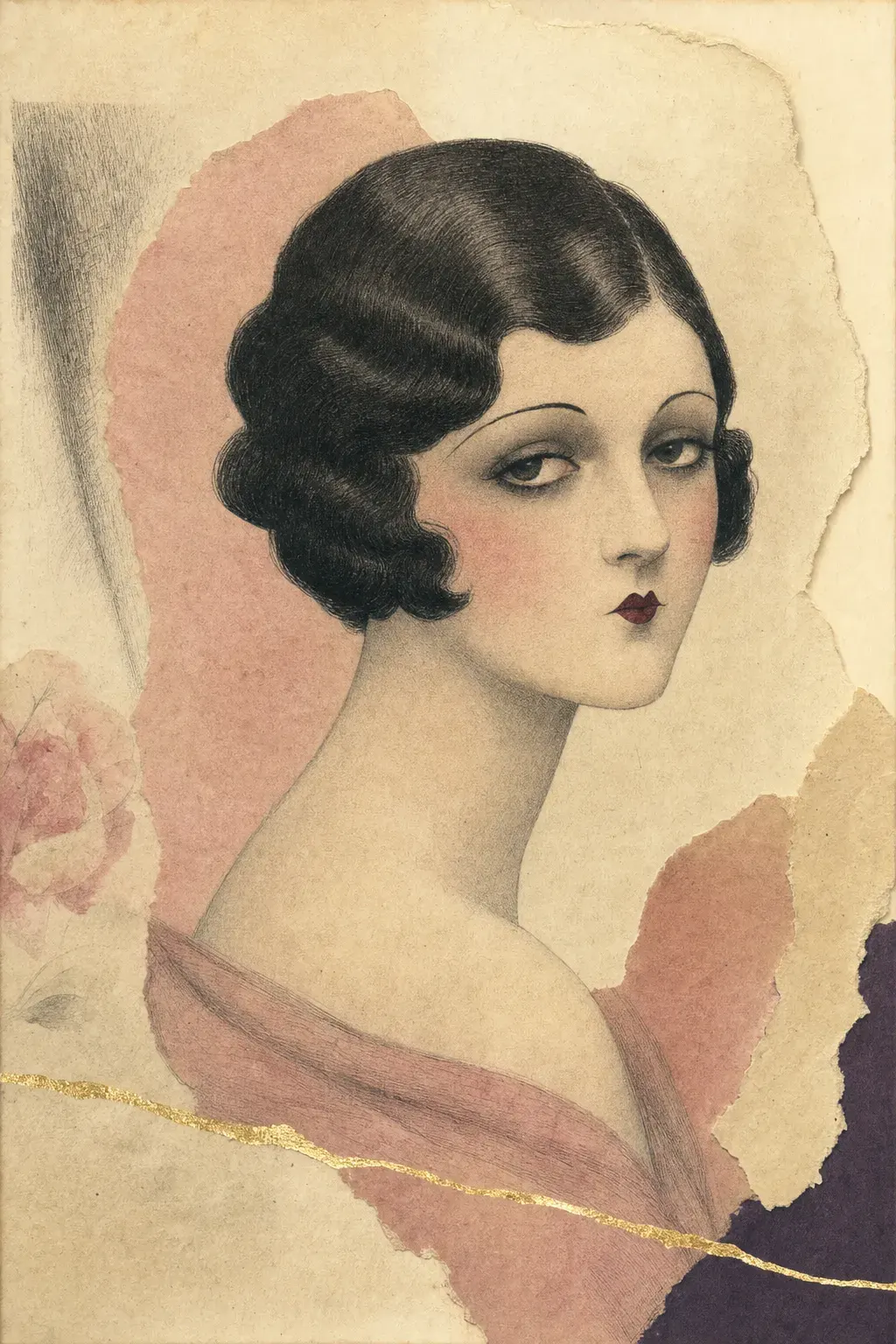
The flapper is the most recognisable face in the history of cosmetics and one of the least reliable. She is a type: dark bobbed hair in waves, pale matte skin, a heavily shadowed eye, thin downward brows, and a small sharply peaked mouth painted well inside its own outline. The type is real in the sense that it can be drawn, recognised and reproduced. It is unreliable as evidence of what women looked like.[1]
What makes it unreliable is its provenance. This face was assembled, circulated and standardised by magazines, advertising and the cinema, and those three had a commercial interest in a look that was specific enough to be copied and named.[1]
The Word Came First
"Flapper" is older than the decade it names. It circulates in British slang well before the war, with meanings that shift between a young girl, an awkward adolescent and a woman of doubtful respectability, and it arrives in the 1920s already carrying a charge.[2]
That prehistory matters because it explains the tone. The flapper was not a neutral description of a demographic; she was a figure people argued about, and much of the writing that established her appearance was hostile. A look first described in order to be disapproved of is a poor guide to how common it was.[2]
The Specification
Taken as a specification rather than as a description, the face is coherent and unusually precise. The complexion is matte and pale, powdered rather than tinted. The brow is plucked thin and drawn in a long downward curve, which reads as languor. The eye is shadowed and smudged rather than lined sharply. The mouth is the signature: drawn inside the natural lip line and peaked high at the centre, producing the small bowed shape that photographs so distinctly.[3]
Every element of that is achievable with products that were on sale, and each one is small, repeatable and teachable — which is precisely what a magazine page or a counter demonstration needs.[4]
Why the Mouth Is Small
The inward-drawn mouth is the element most often explained badly. It is usually attributed to a single actress or a single film. The likelier explanation is technical and boring: orthochromatic film stock, which dominated cinematography for most of the silent period, rendered reds very dark and made a full mouth read as a heavy black mass on screen.[5]
A smaller, more sharply defined mouth photographed better under those conditions, and screen conventions travelled outward into ordinary practice through fan magazines. This is a case where a cosmetic fashion has a genuine cause in the equipment rather than in a personality — and where the personality version is the one that circulates.[5]
A look first described in order to be disapproved of is a poor guide to how common it was.
Who Actually Wore It
Adoption was uneven, and the unevenness is the most useful fact about it. The full specification suited the young, the urban and the unmarried, and it suited women whose work did not penalise them for looking conspicuous. It did not describe most women in most places, and the surviving photographic record of ordinary households looks far less like the magazine page than the magazine page implies.[6]
Class cuts through it in both directions. The look was cheap to approximate — powder, a lipstick and a pair of tweezers — which made it available; but being seen to wear it carried a social cost that fell unevenly.[6]
The Claim That Will Not Die
The flapper did not invent lipstick, and she did not invent wearing it in public. Lip colour in metal cases was on sale in Britain and France in the 1890s, and American suffragists were using lipstick demonstratively before 1920.[7]
What the decade did was normalise the act for a much wider group, and attach it to a face that could be named. Naming is powerful and it is not the same as originating. Any sentence beginning "the flapper introduced" should be checked against a date before it is repeated.[8]
What Is Not Known
There is no reliable figure for how many women wore the full look, in any country, in any year of the decade. The sources that survive best — magazines, advertising, film — are precisely the sources with an interest in overstating it, and household photography is a partial and self-selecting record.[9]
The safe form of the claim is that the look was universally legible and unevenly worn. That is duller than the usual version and it is what the evidence supports.[9]
Sources
- [1, 2, 9]Flapper: A Madcap Story of Sex, Style, Celebrity, and the Women Who Made America Modern Crown, 2006.
- [3]Fashions in Makeup: From Ancient to Modern Times Peter Owen, 1972.
- [4, 6, 8]Hope in a Jar: The Making of America’s Beauty Culture Metropolitan Books, 1998.
- [5]Hollywood Before Glamour: Fashion in American Silent Film Palgrave Macmillan, 2013.
- [7]Lipsticks Cosmetics and Skin.View source (opens in a new tab) Accessed 2026-09-22.
Filed under