Beauty and Protest: Makeup as Argument
Cosmetics have been carried into politics as a weapon, thrown out as a symbol of oppression, and defended as a right.
In short
The most repeated story about cosmetics and protest - that Elizabeth Arden handed red lipstick to suffragists marching in New York in 1912 - has no contemporary evidence behind it, appears no earlier than a 1999 popular history, and reached wide circulation after a 2012 Elizabeth Arden charity campaign.
- 9min read
- 6chapters
- 13sources
Vivien
Your guide through time
Listen to this essay
12 min listenVivien reads our essays aloud, word for word — every date and every name in its place — so you can listen the way you would be walked through a gallery.
An AI voice, designed for History of Makeup
Makeup turns up in political argument more often than its scale would suggest, and it turns up on every side.
It has been worn to prove respectability and worn to refuse it. It has been thrown away in public as a symbol of what women were made to do, and defended, by other women, as something they were finally allowed to choose. The same tube has been a badge and a grievance inside one decade.
It is also the corner of beauty history most contaminated by invented tradition. The most famous story in it - red lipstick at a suffrage march - is the one with the least evidence behind it.
The Suffragettes Dressed to Be Believed
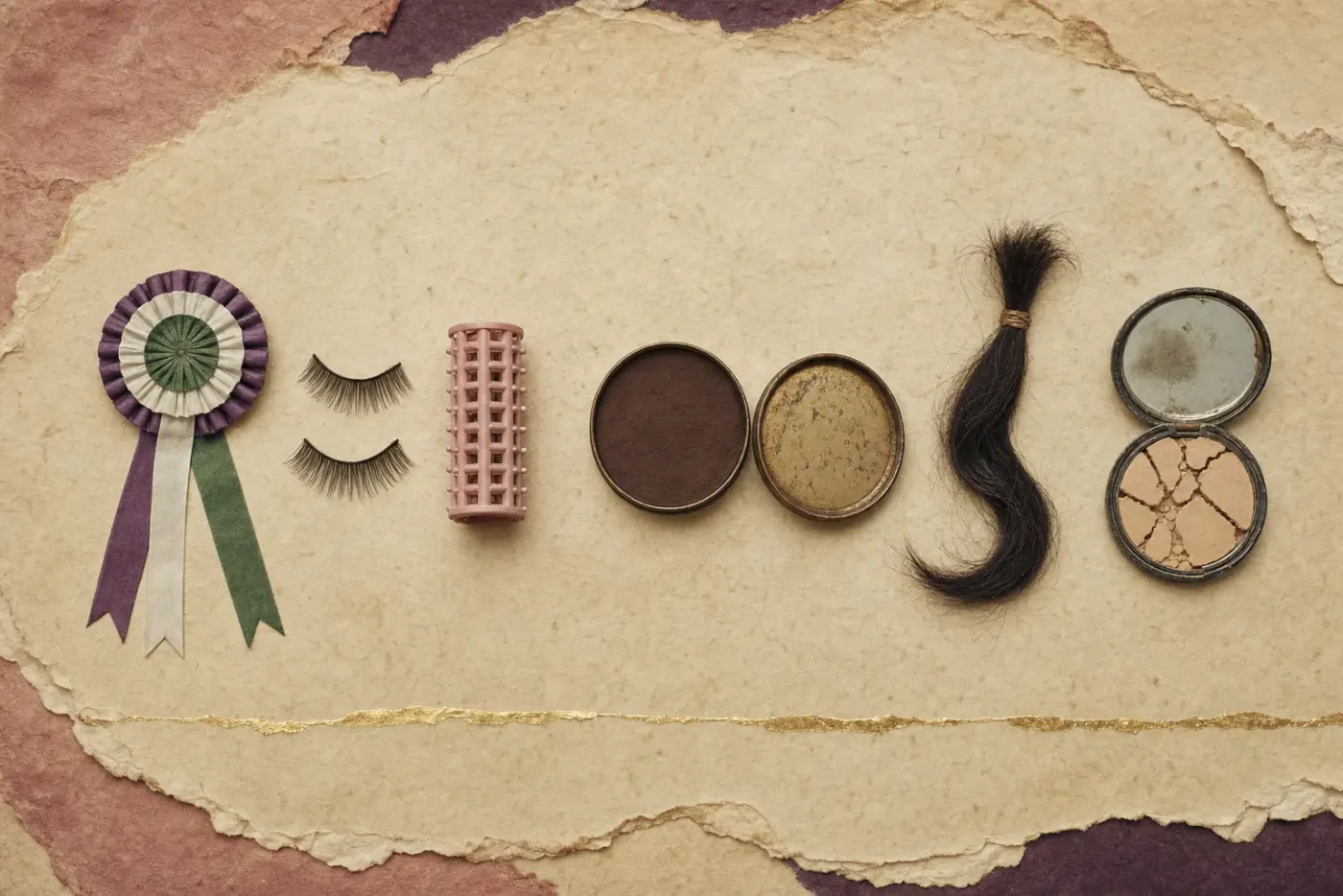
The British campaign for women's suffrage made a deliberate decision about appearance, and the decision was conservatism. The Women's Social and Political Union adopted purple, white and green in 1908, chosen by Emmeline Pethick-Lawrence ahead of the Hyde Park demonstration that June, and asked members to wear white with accessories in the colours.[1]
The strategy was defensive. Opponents caricatured suffragists as unsexed, ugly and mannish, and the movement answered by presenting itself as conventionally feminine, well dressed and respectable - a calculation Wendy Parkins's study of the campaign's use of fashion sets out in detail.[1]
White was also practical: cheap enough that women of different means could take part, and legible in a crowd and in a photograph. The politics of the suffrage face were, first of all, the politics of photographing well.
The Lipstick That Is Not in the Record
The story is told in several incompatible forms, and the inconsistency is itself the first piece of evidence. Elizabeth Arden, standing outside her Fifth Avenue salon during a New York suffrage march in 1912, hands tubes of red lipstick to the marchers, and red becomes a colour of defiance. In most retellings the march is led by Elizabeth Cady Stanton, who had died in 1902, ten years earlier; in some Arden supplies enough lipstick for every woman present; in others Cady Stanton appears only as a famous name attached to the cause. Lucy Jane Santos's summary is that for such a simple story there is a great deal of inconsistency surrounding it, which is the signature of an account being copied rather than recorded.[2]
The documentary difficulties are worse. The march of 4 May 1912 was the largest for suffrage New York had seen, and the press covered the planning and the clothing closely: the white straw suffragette hats made by the Women's Political Union, the black riding habits of the mounted brigade, the purple, green and white cockades, the carriages in buttercup yellow. Not one report mentions lipstick of any colour, and at a moment when visible lip colour would have been remarked on, that silence is worth something.[2] The Makeup Museum went through Library of Congress photographs of the marches and the New York Times coverage of November 1912 and found the same nothing, and could document no Venetian Lip Paste or Venetian Arden Lip Pencil before 1919.[3] What Arden sold in 1912 was skin care.[2]
The objection usually reached for - that the swivel tube did not exist yet - is the weakest one available, and it is also wrong. Metal lipstick cases were being sold well before 1912: a British lip preparation in a metal tube no later than 1892, nickel cases with push-up and slide mechanisms in a Dorin catalogue of 1893, an American newspaper advertisement for lip pomade in metal cases in February 1913.[4] Mason's screw-driven case, the earliest known patent for a swivel mechanism, was not granted until October 1923,[5] but nothing about 1912 forbids a tube. What is missing from the story is not a container. It is any lip product of Arden's to put in one.
Santos also found where the legend comes from, and it is recent. She finds no telling of it before Jessica Pallingston's 1999 book Lipstick, which already carries the Cady Stanton error, after which it was repeated through other popular histories of makeup with a variety of spins. It got its real boost in 2012, when Elizabeth Arden Limited launched a limited-edition red lipstick alongside a campaign called March On, raising money for UN Women, and made much in the publicity of the launch marking a hundred years since the supposed gift.[2]
None of this makes red lipstick apolitical. It makes this particular origin story an advertisement that acquired a bibliography.
Every generation decides that the last one's makeup was false consciousness and its own is a choice.
Atlantic City, 1968
On 7 September 1968 women's liberation activists demonstrated outside the Miss America pageant in Atlantic City. They set up a Freedom Trash Can on the boardwalk and invited women to throw in what the organisers called instruments of female torture: girdles, curlers, high heels, false eyelashes, bras and copies of women's magazines.[6]
Nothing was burned. The boardwalk was wooden and the city would not allow a fire; the phrase bra burning came out of press coverage afterwards, and corrections from participants and historians have had no noticeable effect on its circulation.[6]
The same evening, a few blocks away, the first Miss Black America pageant was held, organised in protest at the exclusion of Black women from Miss America. It made the opposite argument: not that beauty contests degraded women, but that Black women had been shut out of one. Georgia Paige Welch's study treats the two events as a single episode rather than a coincidence.[7]
Whether the Product Existed at All
The other argument of the same years was not about whether to wear makeup but about whether it was made. For most of the twentieth century foundations and powders were manufactured for a narrow range of pale complexions. Kathy Peiss's history of the American industry documents both sides of that market: a mainstream trade that did not make the shades, and a substantial Black beauty industry that did, alongside a skin-bleaching trade selling the opposite proposition to the same customers. The best-known fortune in that industry, Madam C. J. Walker's, was made in hair rather than in complexion products - growers, pressing oils, shampoos and scalp preparations. The firm that built its business on face powder for Black complexions was Anthony Overton's Overton Hygienic Manufacturing Company, founded in 1898, whose High Brown Face Powder was among the earliest and best-selling of its kind.[8]
The post-war answers are usually dated to two firms, and the dates come from the companies rather than from independent records. Flori Roberts says it was, in 1965, the first cosmetics brand developed specifically for women of colour, and says separately that it was the first such brand sold in major department stores - without giving a date for the second claim.[9] Fashion Fair, founded in 1973 inside the Johnson Publishing Company, grew into what the trade press calls the largest Black-owned cosmetics company in the world, and was sold in 2019 to Desiree Rogers and Cheryl Mayberry McKissack.[10]
The politics were never settled. Black is beautiful was a rejection of a white standard; a shade range is a demand that an industry serve customers it had ignored. Those are not the same argument, and a company could answer the second while leaving the first where it stood.
The Beauty Myth and Its Numbers
The best-known feminist critique of the industry is Naomi Wolf's The Beauty Myth, published in 1990. Its argument is that as women gained legal and economic ground, an intensified standard of appearance took up the work of constraint that law had been doing.[11]
The book is still widely taught. Several of its statistics are also unreliable, which is a matter of record rather than opinion. Its most quoted figure - that 150,000 women a year died of anorexia in the United States - came from a source reporting the number of sufferers rather than of deaths. A paper published in Eating Disorders in 2004 compared the book's eating-disorder figures with peer-reviewed epidemiology and found most of them overstated by a wide margin.[12]
Both things are true at once, and on a site about evidence it is worth saying which is which. The critique of an appearance standard does not depend on the numbers. The numbers were still wrong.
Escape the Corset
The most recent large-scale refusal is South Korean. From 2018, under a slogan usually translated as escape the corset, young women posted photographs and video of cut hair and destroyed cosmetics, rejecting an appearance standard that in South Korea is unusually explicit and expensive. A study published in 2024 analysed the movement's social media output and describes it as resistance to what participants call the appearance-corset, catalysed by the country's MeToo movement.[13]
It arrived against the opposite reading, dominant in English-language commentary since the 1990s: that cosmetics are self-expression, that using them is a choice, and that criticising the choice is itself a constraint on women.
Both positions share a weakness: neither can be tested. Whether a practice is chosen or imposed is not a fact about the practice but a claim about the conditions around it, and those vary by country, by decade and by who is asking.
What the record does support is narrower and more useful. Cosmetics have been politically available in every direction - as respectability, as defiance, as exclusion, as redress, and as something to throw in a bin on a boardwalk. A material that can carry all of those meanings does not have one of its own.
Sources
- [1]'The Epidemic of Purple, White and Green': Fashion and the Suffragette Movement in Britain 1908-14, in Fashioning the Body Politic: Dress, Gender, Citizenship Berg, 2002.
- [2]History of Lipstick: Elizabeth Arden Red lucyjanesantos.com, 2019.View source (opens in a new tab) Accessed 2026-09-22.
- [3]Elizabeth Arden and the suffragettes, continued The Makeup Museum.View source (opens in a new tab) Accessed 2026-09-22.
- [4]Lipsticks Cosmetics and Skin, 2009.View source (opens in a new tab) Accessed 2026-09-22.
- [5]US Patent 1,470,994 - Toilet article United States Patent Office, 1923.View source (opens in a new tab) Accessed 2026-09-22.
- [6]Fifty Years Ago, Protesters Took on the Miss America Pageant and Electrified the Feminist Movement Smithsonian Magazine, 2018.View source (opens in a new tab) Accessed 2026-09-22.
- [7]'Up Against the Wall Miss America': Women's Liberation and Miss Black America in Atlantic City, 1968 Feminist Formations 27.2, 2015.View source (opens in a new tab)
- [8]Hope in a Jar: The Making of America’s Beauty Culture Metropolitan Books, 1998.
- [9]About Us Flori Roberts (company website).View source (opens in a new tab) Accessed 2026-09-22.
- [10]Johnson Publishing Company Sells Fashion Fair Cosmetics BeautyMatter, 2019.View source (opens in a new tab) Accessed 2026-09-22.
- [11]The Beauty Myth: How Images of Beauty Are Used Against Women Chatto and Windus, 1990.
- [12]A critical appraisal of the anorexia statistics in The Beauty Myth: introducing Wolf's Overdo and Lie Factor (WOLF) Eating Disorders 12(2), 2004.View source (opens in a new tab)
- [13]'Escape The Corset' Movement in South Korea: An Exploratory Study Focusing on Social Media Data Analysis Journal of Fashion Business 28(6), 63-76, 2024.View source (opens in a new tab)
Filed under