The Beauty Counter: How Advice Became a Way of Selling
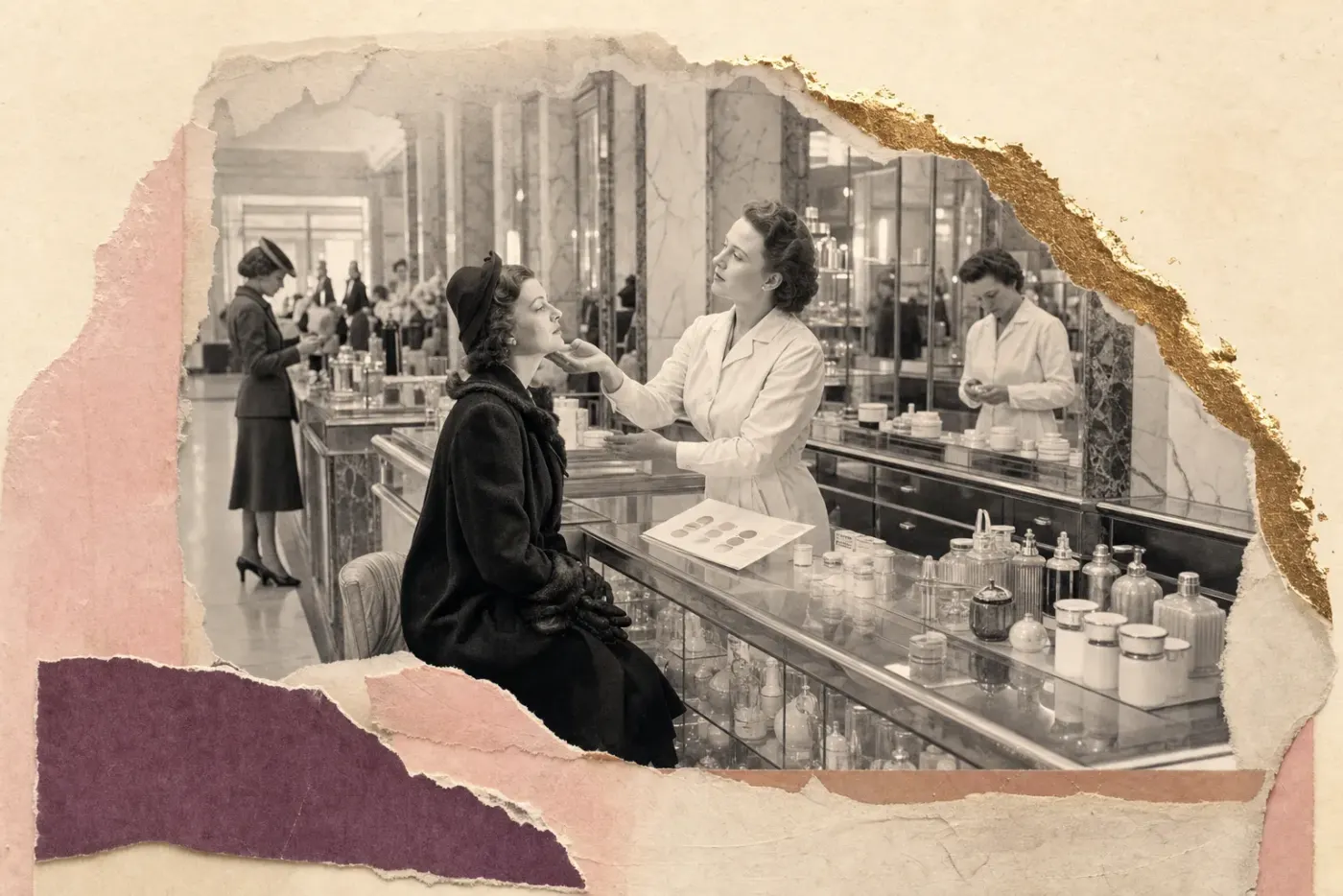
A woman in a white coat, trained by the brand she represented, standing in a shop that sold a dozen rivals beside her.
In short
In 1937 Helena Rubinstein opened a demonstrator training school at her Fifth Avenue salon, starting with fifty women drawn from leading department stores in the United States and Canada: the shop supplied the floor space, and the manufacturer supplied the expert.
- 10min read
- 6chapters
- 10sources
Vivien
Your guide through time
Listen to this essay
9 min listenVivien reads our essays aloud, word for word — every date and every name in its place — so you can listen the way you would be walked through a gallery.
An AI voice, designed for History of Makeup
A cosmetics counter is a strange piece of retail. It occupies the most expensive floor in the building, sells small objects at high margins, and staffs itself with someone who will explain, at length and before any money changes hands, what a customer’s skin is doing wrong. Very little else on a shop floor works this way.
It works this way because it was built to. The consultation is not a courtesy laid over the sale; it is the mechanism of the sale. Its shape was settled roughly between 1900 and 1950 by a handful of businesses that arrived at the same discovery more or less independently — that a woman who has been told what her face needs will buy what she has been told, and will come back to be told again.[1]
Before the Counter
Cosmetics did not begin in department stores. They were sold by druggists, by mail, by travelling agents and in the back rooms of salons. The Sears catalogue was offering rouge for lips and cheeks by the late 1890s, which indicates both that demand existed and that a good deal of it preferred to arrive in a parcel.[2]
The trade behind it was substantially woman-run. Between roughly 1890 and 1920 women owned the firms, mixed the preparations, sold them and endorsed them from their own faces, and the business grew through visiting and conversation rather more than through advertising.[3] Black beauty culture developed its own version of the same structure — schools, agents and salons instead of shop floors — and the salon in particular became an economic and civic institution in its own right, which is a different history from the one the department store tells about itself.[4]
The Salon Taught the Store
Helena Rubinstein built a business on the proposition that a face could be examined, sorted and prescribed for. Skin was classified — dry, oily, combination, sensitive — and a regimen followed from the classification. Her staff worked in white coats, and her rooms were arranged to resemble a clinic rather than a parlour. Elizabeth Arden, her lifelong rival, worked the opposite register: a Fifth Avenue salon, a red door, and the offer of a milieu rather than a diagnosis.[5]
Both methods produced the same commercial result. A customer who has been assessed has been given a reason to buy several things instead of one, and a reason to return when the assessment changes. The salon proved the technique on a small and expensive scale. The department store then bought it wholesale.[6]
Colour Harmony
Max Factor's business supplied the film studios before it supplied anyone else, and it brought a studio habit with it: the idea that the elements of a face should be chosen together rather than one at a time.[7]
The date usually attached to that idea does not survive inspection. Max Factor's authorised biographer credits the firm with first developing Color Harmony in 1918.[7] The fullest independent account of the company calls that an unverified claim, and points out that sorting customers into types was not a new idea at all but a common one among cosmetic firms in the 1920s.[8] What can be dated is the selling. In 1927 Max Factor introduced its Society range, a general cosmetic line advertised and sold nationally across the United States, and Color Harmony principles were promoted as its basis. Customers were sorted into four types — Blondes, Brunettes, Brownettes and Redheads, with occasional reference to a fifth, Titian — and a woman could fill in a form, post it to the company, and receive skin-care and make-up advice with a copy of the booklet The New Art of Society Make-Up by return mail.[8]
The commercial consequence matters more here than the theory. A single lipstick can be taken off a shelf without assistance. A harmony cannot: it requires a chart, and a chart requires somebody standing beside it who has been trained to read it. Colour matching turned a purchase into a procedure, and a procedure needs staff — or, where there were no staff, a reply-paid envelope doing the same work at a distance.
The advice was not a service attached to the sale. The advice was the sale.
The Demonstrator
The woman behind the counter usually represented one manufacturer, and increasingly she had been trained by it. Rubinstein beauty schools were running for the general public inside department stores from 1933. In 1932 the firm had reorganised its trade zones to give approved retailers local monopolies, and those retailers displayed an Emblem of Authority carrying Rubinstein's own portrait. In 1937 a demonstrator training school opened at the Fifth Avenue salon, beginning with fifty women drawn from leading department stores in the United States and Canada.[9]
The arrangement is worth stating plainly, without accusing anyone of anything. A customer crossing a shop floor met a specialist whose expertise was real, whose training had been arranged by a manufacturer, and whose stretch of counter held a single brand. Who paid for that training, and who paid the woman herself, is not recorded in the source used here, and the answer probably varied from store to store and decade to decade. It does not need to be settled for the point to hold. She was not being deceived. She was being advised inside a boundary that was invisible from her side of the glass.
The Sample and the Gift
Sampling was ordinary practice by the middle of the century, for an obvious reason: a cosmetic is hard to judge without wearing it, and a woman who has worn it has half bought it.[10]
The best-known version of the story is Estée Lauder's. By the company's own account she began by demonstrating her preparations on women sitting under salon hair dryers; she and her husband Joseph launched the company in 1946, and a year later landed their first major order, eight hundred dollars' worth of products from Saks Fifth Avenue. She offered customers a free sample when they bought a product — the practice the company credits with establishing Gift with Purchase as an industry standard — and she attended the opening of nearly every new store, staying a week each time to instruct the beauty advisors in selling and display.[11]
That account is a primary source about what the firm wants believed rather than a neutral history of the technique, and the technique was not hers alone. But the distinction its own wording preserves is worth keeping: what was given away was a sample, not a product. A sample costs a fraction of the thing it advertises, obliges the person who accepts it without costing her anything, and returns her to the same counter when it runs out. That is the whole economics of the method, and it is why the gift with purchase became a permanent fixture of the counter and remains one.
Self-Service
What eventually loosened the counter’s grip was a shop layout. Dominique Mandonnaud opened a perfumery in Limoges in 1969 and, in 1979, a store called Shop 8 built on what he termed assisted self-service: a large open floor, products arranged by category instead of by brand, and everything within a customer’s reach. He acquired the Sephora chain in 1993 and applied the format to it. LVMH bought the business in 1997, and the first American store opened in New York in 1998.[12]
The expert did not disappear. She became optional, which is a different job with different incentives. A customer could now compare eleven foundations without being assigned to any one of them, and for the first time in a century the consultation had to compete with the shelf.
Sources
- [1, 3, 6]Hope in a Jar: The Making of America’s Beauty Culture Metropolitan Books, 1998.
- [2]Consumers Guide, Catalogue No. 104 1897.
- [4]Beauty Shop Politics: African American Women's Activism in the Beauty Industry University of Illinois Press, 2010.
- [5]War Paint: Madame Helena Rubinstein and Miss Elizabeth Arden — Their Lives, Their Times, Their Rivalry John Wiley & Sons, 2003.
- [7]Max Factor: The Man Who Changed the Faces of the World Arcade Publishing, 2008.
- [8]Max Factor Cosmetics and Skin.View source (opens in a new tab) Accessed 2026-09-22.
- [9]Helena Rubinstein (1930-1945) Cosmetics and Skin, 2009.View source (opens in a new tab) Accessed 2026-09-22.
- [10]Beauty Imagined: A History of the Global Beauty Industry Oxford University Press, 2010.
- [11]Our Founder The Estee Lauder Companies.View source (opens in a new tab) Accessed 2026-09-22.
- [12]Sephora Holdings S.A. International Directory of Company Histories, via referenceforbusiness.com.View source (opens in a new tab) Accessed 2026-09-22.
Filed under