What the Crash Did Not Take: Cosmetics After October 1929
The decade ended in a way that should have destroyed a luxury trade. It did not, and the reason is what the decade had made of the product.
In short
Cosmetics proved markedly more resilient than most discretionary goods through the depression that followed October 1929, an outcome that makes sense only because the 1920s had turned them from occasional luxuries into an everyday routine with a job attached.
- 11min read
- 5chapters
- 3sources
Vivien
Your guide through time
Listen to this essay
6 min listenVivien reads our essays aloud, word for word — every date and every name in its place — so you can listen the way you would be walked through a gallery.
An AI voice, designed for History of Makeup
A trade in small, optional, pleasurable purchases is the first thing one expects to fail in a depression. Cosmetics are discretionary by definition: nobody needs a rouge. The reasonable prediction for the industry after October 1929 is a collapse.
It did not happen in that form. The sector contracted, firms failed and prices came under pressure — but cosmetics held up considerably better than the discretionary category they nominally belonged to, and the explanation lies in what the preceding decade had done to the product.[1]
A Habit Is Not a Luxury
The decade's achievement was to convert an occasional indulgence into a daily routine. A woman who has worn powder and lip colour every working day for eight years is not making a fresh decision each morning; she is maintaining a face she and everyone who sees her regards as her ordinary one.[2]
Routines survive austerity far better than treats do. They get cheaper, they get stretched, the same lipstick lasts longer — but they are given up late, and reluctantly, because giving them up is visible.[2]
The Appearance of Employability
There is a harder economic reason underneath. By the end of the 1920s a groomed face had become part of what a woman presented in order to get and keep waged work — particularly the shop, office and service work that had expanded through the decade.[3]
In a labour market with far more applicants than positions, that stops being an indulgence and starts being an expense one cannot easily cut. A cosmetic attached to employment is defended in a way a cosmetic attached to pleasure is not.[3]
The expectation was rarely written down, which is part of why it is hard to measure and easy to underestimate. It appears instead in advertising that addresses the working woman directly, in instruction aimed at the office rather than the evening, and in the plain fact that the categories of work expanding fastest were the ones where an employer saw the employee all day. A requirement nobody states is still a requirement, and it is paid for out of the same wage.[3]
Routines survive austerity far better than treats do.
Small Purchases Hold Best
Unit price matters. A lipstick is among the cheapest discretionary objects a person can buy, and it delivers a visible change for that price — which makes it the kind of purchase that survives when larger ones stop.[4]
The industry noticed and adapted: smaller sizes, lower price points, and an emphasis on value and durability in advertising. That is a trade responding to its market rather than an inherent property of cosmetics, and it is worth separating the two.[5]
The adaptation ran the other way as well. Firms that had sold on exclusivity through the 1920s found the premise harder to maintain, and the decade that follows is one in which the expensive salon brand and the chain-store line converge on the same customer from opposite directions. A trade that had spent ten years teaching every woman a routine could not easily go back to selling it to a few.[4]
What the Decade Handed Forward
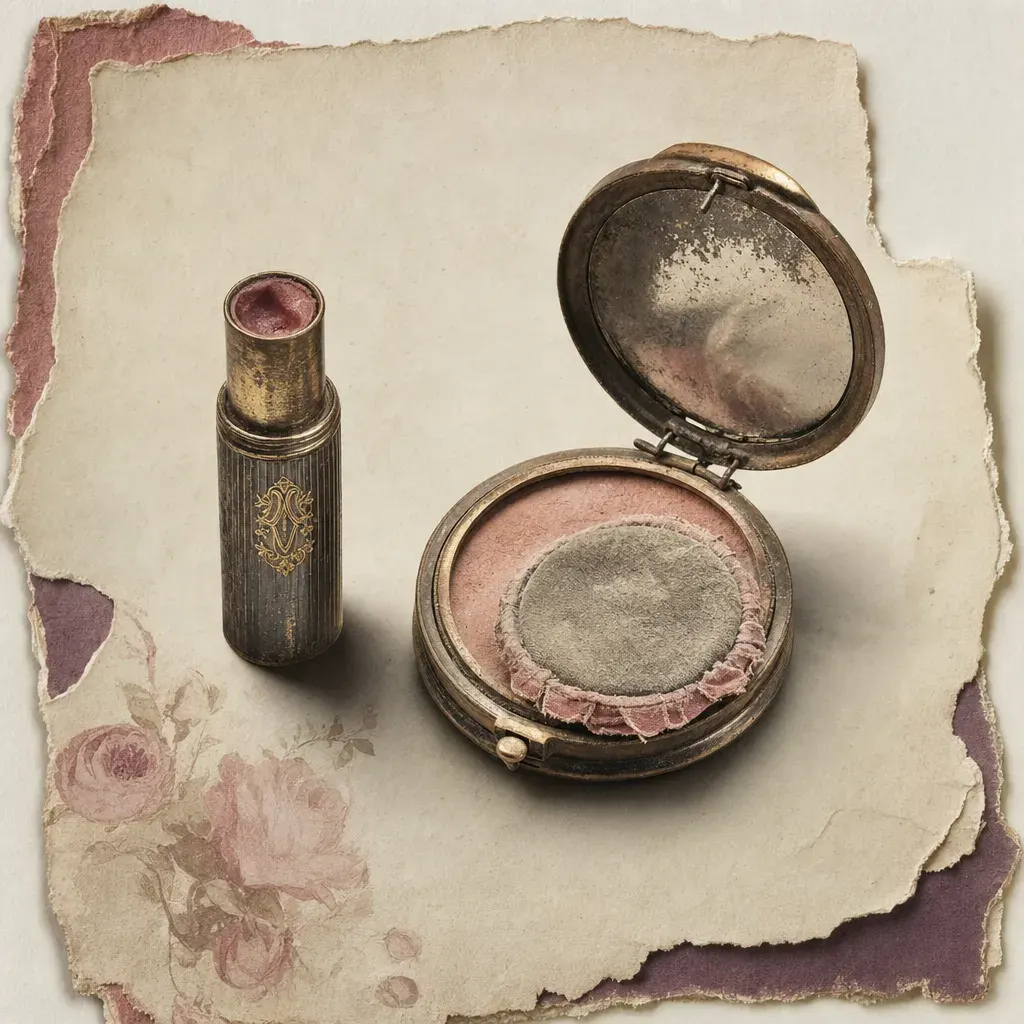
Three things survived intact into the 1930s and have not really left since. The sealed portable container, which made reapplication public. The coordinated set, which made a range rather than a product the unit of sale. And the counter, which made instruction part of the transaction.[6]
The look did change, and quickly — the thin brow and small mouth of the mid-1920s date badly and were gone within a few years. Confusing the look with the structure is the commonest error in writing about the period. The structure is what lasted.[7]
It is a useful test to apply to any decade. Ask what was a style and what was an arrangement: the style is what photographs of the period make obvious, and the arrangement is what is still in place when nobody notices it any more. Almost everything that makes the 1920s recognisable at a glance had gone by 1935. Almost everything it built about how cosmetics are packaged, sold and taught is still standing.[6]
What Is Not Known
The "lipstick index" — the claim that lipstick sales rise during downturns — is frequently attached to this period retrospectively. It is a much later formulation, the evidence for it across different recessions is mixed, and it should not be cited as a finding about 1929.[8]
What can be said is comparative and cautious: the sector held up better than many discretionary categories. Precise figures for the period are partial, differ by market, and come substantially from firms with an interest in the answer.[8]
Sources
- [1, 4, 6, 8]Beauty Imagined: A History of the Global Beauty Industry Oxford University Press, 2010.
- [2, 3, 5]Hope in a Jar: The Making of America’s Beauty Culture Metropolitan Books, 1998.
- [7]Fashions in Makeup: From Ancient to Modern Times Peter Owen, 1972.
Filed under