The Eyelash Curler: A Clamp for the Face
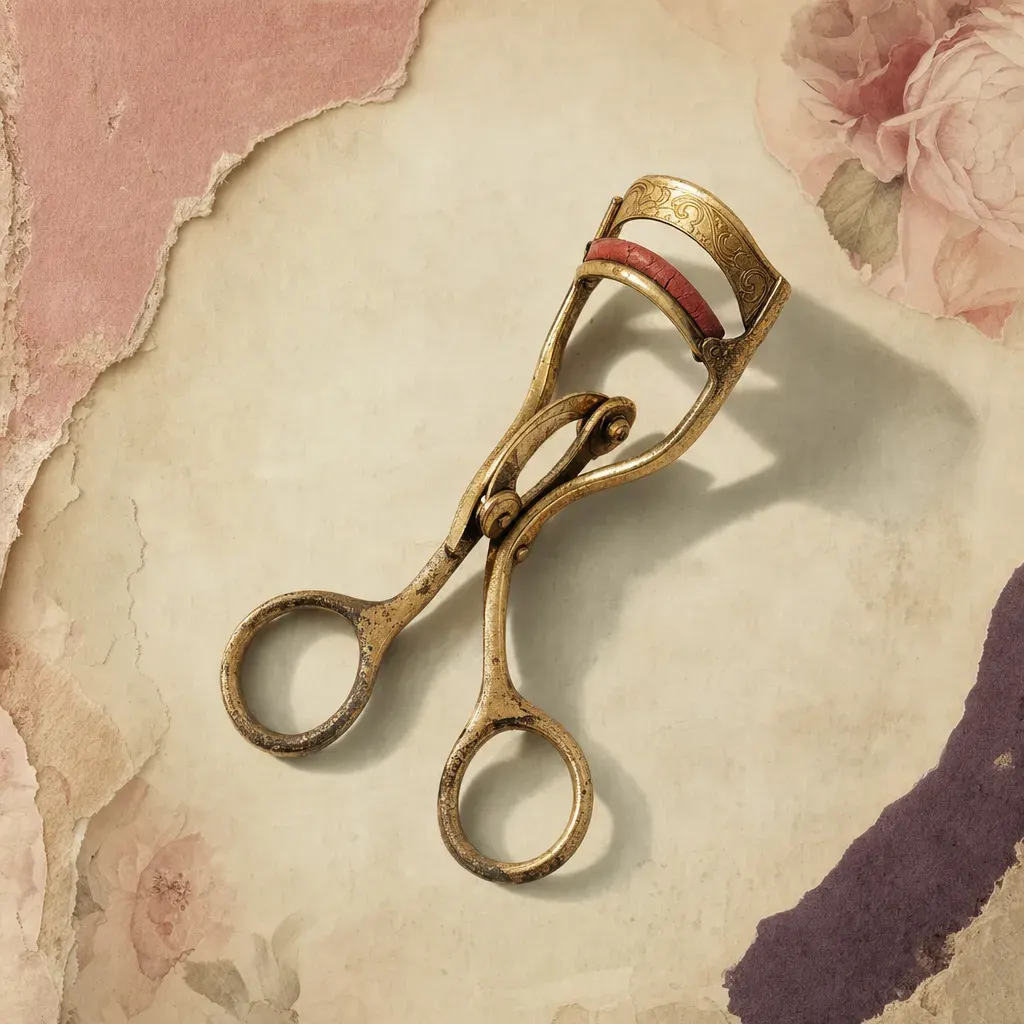
It looks like a surgical instrument, and from 1923 it was sold as the promise of longer-looking lashes without pastes, creams or heat.
In short
The Kurlash eyelash curler went on sale in 1923 at five dollars in gold or two in silver, was redesigned by 1924 into a form close to today's curlers and cost a dollar by the end of that year.
- 3min read
- 5chapters
- 1source
Vivien
Your guide through time
Listen to this essay
4 min listenVivien reads our essays aloud, word for word — every date and every name in its place — so you can listen the way you would be walked through a gallery.
An AI voice, designed for History of Makeup
The eyelash curler went on sale in 1923. A group of investors founded the Stickel Company in Rochester, New York, that year to market the Kurlash Natural Eyelash Curler, invented by Charles W. Stickel. It came in two forms: a gold model at five dollars, in a blue Morocco leather case, and a silver-finished model at two dollars in a plush-lined box.[1]
The first advertisement made the promise plainly: prettier eyes without use of pastes, creams, artificial lashes or even heat. Curl the lashes upward, it said, and they appear longer.[1]
Two Inventors
Stickel's patent, granted in 1925, was for a device sometimes called the bear trap. It was only briefly on the market. By 1924 it had been replaced by a more sophisticated model, similar to a design patented in 1929 by Stickel and William E. McDonell, a Rochester neighbour known for his many inventions for the eye.[2]
The curler's historian credits both men. Two other curlers were patented before Stickel's patent came through, but his application went in first and his was the first to be sold; and because the 1924 redesign so closely resembles the curlers sold today, he names McDonell as co-inventor.[2] A patent records who filed and when. It does not settle who had the idea, and here the design that lasted was the second, not the first.
From Five Dollars to One
The price fell fast. By the end of 1924 a Kurlash cost a dollar. The company hired salesmen to get it stocked in shops across the country and set up a mail-order business for women who could not find one locally, and it began advertising on the radio in 1926.[3]
A dollar turned the curler from a novelty into an ordinary purchase. Its sales, the historian records, actually rose between 1929 and 1931, through the first years of the Depression, helped by radio, by new products and by its adoption by Hollywood film stars.[3]
A curler is a tool that only makes sense once lashes are meant to be seen.
A Routine Built Around a Tool
The curler built a company around the eye. In 1930 Kurlash added a tweezer, a liquid mascara, a stick of cake mascara called Lashpac, a lash-growing cream and a compact eyeshadow, Shadette.[4] By 1936 the company was selling them as a six-step routine in which the curler sat in the middle: tweeze, condition, shade the lids, then curl the upper lashes, touching their tips with mascara while they were still held in the Kurlash.[4]
The firm that sold the tool sold everything that went with it, which is the logic the eye kit still follows.
Copies
Production stopped in 1943, when the factory went over to war work. By the time it resumed, the Kurlash patents had expired, and before the end of the decade near-copies of its design were on the market.[5] The historian's verdict is that the brand faded while its design did not: its influence lives on in the many Kurlash-like curlers still sold.[5]
What Is Not Known
What people used to curl their lashes before 1923, and how many curlers were sold in the first decade. The history cited here gives prices, patents and marketing, not sales figures.[6]
Sources
- [1, 2, 3, 4, 5, 6]Kurlash Cosmetics and Skin.View source (opens in a new tab) Accessed 2026-09-25.
Filed under