The Arched Brow: The Most Redrawn Feature on the Face
Plucked out in the fifteenth century, pencilled thin in the 1920s, grown back in the 2010s: a feature with no settled shape.
In short
The eyebrow is the most frequently redrawn feature on the human face for a mechanical reason: hair grows back, so a brow removed in one decade can be restored in the next, and it has been reversed roughly every twenty years since 1920.
- 8min read
- 6chapters
- 12sources
Vivien
Your guide through time
Listen to this essay
9 min listenVivien reads our essays aloud, word for word — every date and every name in its place — so you can listen the way you would be walked through a gallery.
An AI voice, designed for History of Makeup
The eyebrow is the most frequently redrawn feature on the human face, and the reason is mechanical. Hair grows back. A brow can be plucked out completely, drawn somewhere else, allowed to return, darkened, shaved, tattooed and grown again, and none of it is permanent in the way a bone structure is permanent. A feature that can be undone is a feature that can be restyled every decade.[1]
What it signals moves with the shape. The brow has stood for refinement, for foreignness, for health, for artifice, for severity, and most recently for the absence of artifice. It has very rarely meant nothing.
Egypt and Rome
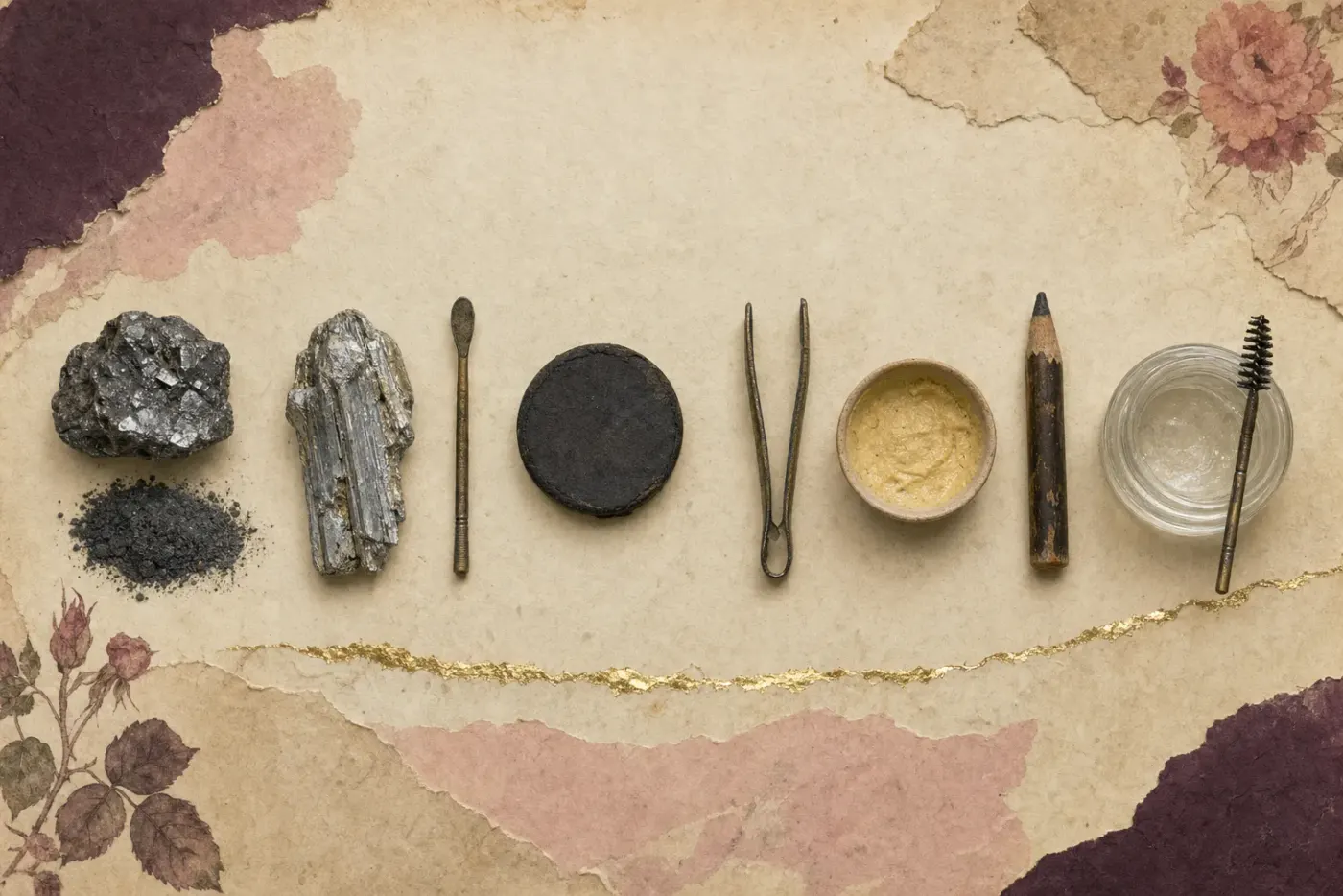
Egyptian eye paint did not stop at the lash line. The brow was darkened, and the line around the eye was carried outwards past the outer corner, and both were made from the same preparations — galena ground for the grey-black, malachite for the green.[2] Egyptian convention draws them as two separate bands rather than one continuous shape, but they come from the same pots and the same sitting: the brow is part of the decoration of the eye rather than a feature handled on its own terms.
Rome inverted a modern preference. The joined brow — a continuous line across the bridge of the nose — appears in Latin writing as a mark of beauty rather than a defect, and women without one are described filling the gap. The darkening agent was stibium, antimony sulfide, which Pliny lists among the eye preparations in the Naturalis Historia.[3] Roman writing about cosmetics is overwhelmingly satire and has to be read as such, but the materials it names are the materials that turn up.[4]
The Character Eight
Tang China treated the painted brow as a composition in its own right. Women painted their brows with dai, a dark mineral preparation, in a repertoire of named shapes, and the face was assembled rather than merely coloured.[5] Chinese brow fashion neither began nor ended with the Tang — it has a long history on either side of it — but the Tang is where the surviving naming is thickest, and it is the period most of the scholarship on named brow shapes rests on.
The best contemporary description of it is a complaint. The poet Bai Juyi included Shishi zhuang, on the fashion of the times, as the thirty-fifth poem in his Xin yuefu series, composed in the fourth year of the Yuanhe reign — 809. It records lips darkened with a black ointment and brows drawn low in the shape of the character for eight, two short strokes angled downwards.[6] He disapproved, which is exactly why the detail survives. A great deal of what is known about how faces were painted comes from people who objected to the painting.
Plucked Away
In late medieval northern Europe the brow largely disappears from the painted face. Portraits from the fifteenth-century Low Countries show a high bare forehead, the hairline raised and the brows reduced to a faint line or removed altogether — a convention consistent enough, across enough painters, to be read as a fashion rather than one workshop's idiom.[7]
Recipes for removing hair sit alongside the pictures. The Trotula, the twelfth-century Salernitan compilation on women's medicine and cosmetics, includes depilatory preparations, several of them caustic — quicklime and orpiment among the ingredients.[8] What the pictures and the recipes together do not establish is how far the practice spread, or how far down the social scale it reached. Portraits record the people who could commission portraits, and a recipe book records what one compiler thought worth writing down.[7]
A feature that can be undone is a feature that can be restyled every decade, and the brow has been.
Eyebrows of Mouse
Georgian England is credited with false eyebrows cut from mouse skin and glued into place. The claim is repeated everywhere and it does rest on real texts — but the texts are satires. Jonathan Swift's A Beautiful Young Nymph Going to Bed, published in 1734, undresses its subject item by item and removes, among much else, her eyebrows from a mouse's hide, stuck on with art on either side.[9]
Satire records what an audience finds plausible, not what is ordinary. Eighteenth-century English cosmetic practice did include heavy white paint, and shaped or removed brows were part of the repertoire.[10] How many people actually wore mouse skin cannot be recovered from a poem written to humiliate an invented woman. The defensible position is the narrow one: the idea was current enough to work as a joke, and nothing in the record establishes how often it was done.
Thin, Thinner, Thick Again
The twentieth century ran the brow through its whole range in about eighty years. The 1920s took it thin, long and angled downwards, a shape made practical by the eyebrow pencil, which Max Factor's Hollywood business did as much as anyone to standardise and sell.[11] The 1930s took it thinner still, into a plucked arc redrawn entirely by hand.[12]
The 1950s reversed it: heavier, squarer, darker, on screen and off.[12] The 1990s reversed it again, back to a narrow high line. The 2010s reversed it a third time, towards a fuller brow, and brought a tool the earlier cycles had not had — pigment implanted into the skin by a technician, sold alongside setting pomades and tinted gels. In the United States that implanted pigment is not a cosmetic applied to the face but a tattoo, and is regulated as one.[13]
Each swing was presented as the natural one, and each required work. The thin brow required plucking. The thick brow requires filling, setting and, often, an appointment.
Dye, and What Is Actually Permitted
The brow sits next to the eye, which is why it is the part of the face where cosmetic regulation is tightest. In 1933 and 1934 the Journal of the American Medical Association reported injuries from Lash Lure, an eyelash and eyebrow dye containing para-phenylenediamine; users suffered ulceration of the eyelids and some were blinded.[14] American regulators exhibited the case publicly as part of the campaign that produced the Federal Food, Drug, and Cosmetic Act of 1938.[14]
The position has not since loosened. The United States Food and Drug Administration states that no colour additive is approved for permanently dyeing or tinting eyelashes or eyebrows, with one narrow exception: silver nitrate, listed at 21 CFR 73.2550 by a final rule published on 6 October 2021, for professional use only, at up to 4 per cent by weight in a viscous gel, not for distribution or direct sale to consumers, not intended for anyone under the age of sixteen, and not applied for longer than one minute.[15] That is the entire permission, and it is United States law only; no claim is being made here about any other jurisdiction. Implanted brow pigment is handled elsewhere again: the agency notes that it has not approved any pigment for injection into the skin for cosmetic purposes, and that tattooing, including permanent makeup, is regulated by state and local jurisdictions rather than federally.[16]
Sources
- [1, 7, 10, 12]Fashions in Makeup: From Ancient to Modern Times Peter Owen, 1972.
- [2]Sacred Luxuries: Fragrance, Aromatherapy, and Cosmetics in Ancient Egypt Cornell University Press, 1999.
- [3]Naturalis Historia, Books XXXIII–XXXV 77.
- [4]Cosmetics in Roman Antiquity: Substance, Remedy, Poison The Classical World 102.3, 2009.
- [5]Empire of Style: Silk and Fashion in Tang China University of Washington Press, 2019.View source (opens in a new tab) Accessed 2026-09-22.
- [6]Shishi zhuang (時世妝, The Fashion of the Times), poem 35 of the Xin yuefu (新樂府) Chinese Wikisource, 809.View source (opens in a new tab) Accessed 2026-09-22.
- [8]The Trotula: A Medieval Compendium of Women’s Medicine University of Pennsylvania Press, 2001.
- [9]A Beautiful Young Nymph Going to Bed London, 1734.
- [11]Max Factor: The Man Who Changed the Faces of the World Arcade Publishing, 2008.
- [13, 16]Tattoos and Permanent Makeup: Fact Sheet US Food and Drug Administration.View source (opens in a new tab) Accessed 2026-09-22.
- [14]Lash Lure and Paraphenylenediamine: Toxic Beauty Past and Present American Academy of Ophthalmology.View source (opens in a new tab) Accessed 2026-09-22.
- [15]Eye Cosmetic Safety US Food and Drug Administration.View source (opens in a new tab) Accessed 2026-09-22.
Filed under