Helena Rubinstein and the Invention of the Consultation
She sold the diagnosis first and the cream second, and built the structure the skincare trade still uses.
HOM · Person1872 – 1965Cosmetics manufacturer
In short
Helena Rubinstein did not invent the division of skin into normal, dry and greasy, which Paris salons were already using, but she turned that classification into a repeatable consultation and carried it across three continents in a little over a decade.
- 3min read
- 5chapters
- 4sources
Vivien
Your guide through time
Listen to this essay
5 min listenVivien reads our essays aloud, word for word — every date and every name in its place — so you can listen the way you would be walked through a gallery.
An AI voice, designed for History of Makeup
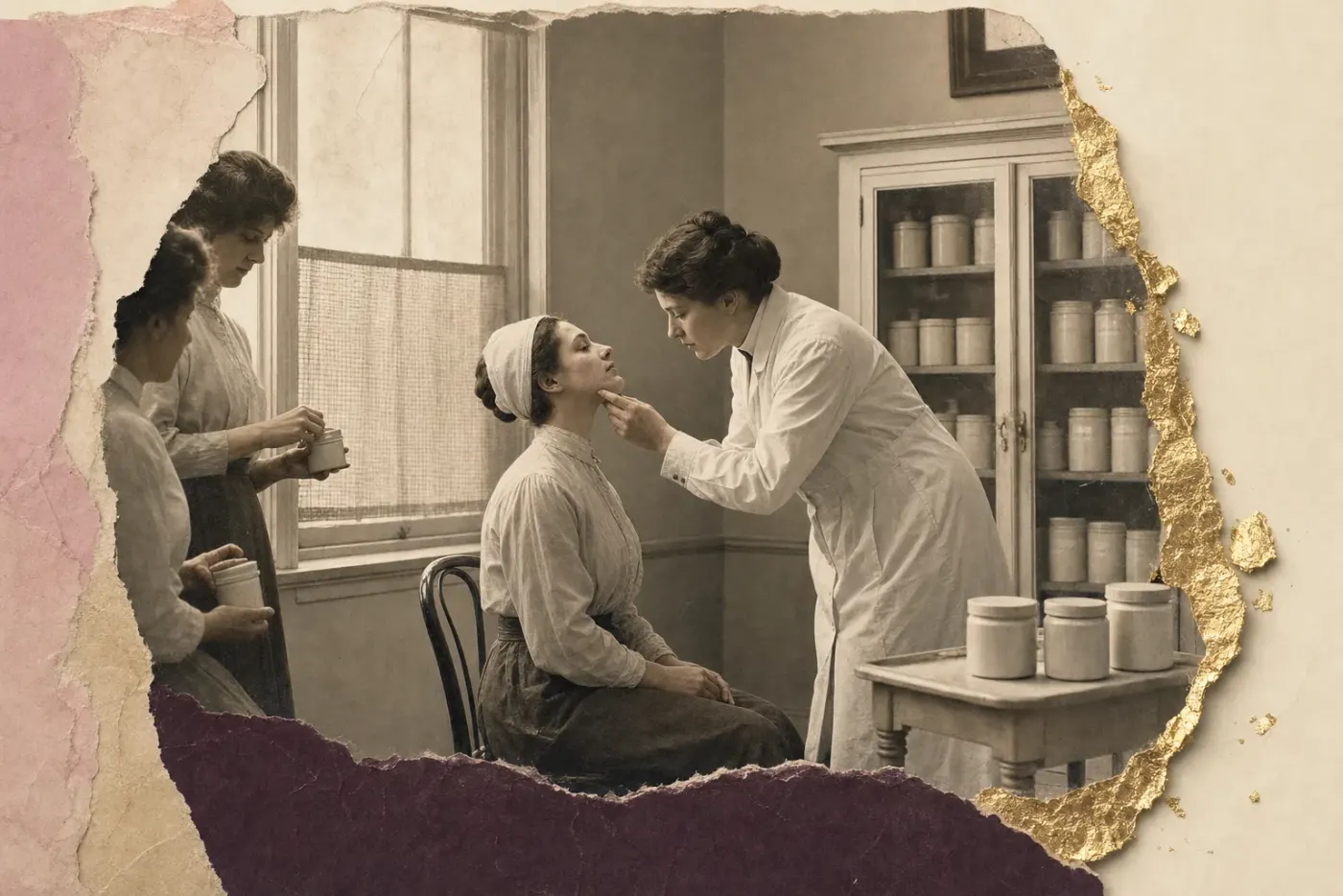
Helena Rubinstein sold face cream by first telling a woman what kind of face she had. The diagnosis came before the product, it was delivered by a woman in a white coat, and it took place in a room arranged to look like a clinic rather than a shop.
That sequence is now the default structure of the skincare trade, from the department-store counter to the online questionnaire. Rubinstein did not originate every part of it. She industrialised it, and she carried it from Melbourne to New York by way of Europe in a little over a decade.[1]
Kraków to Melbourne
She was born Chaja Rubinstein in Kraków, then in Austria-Hungary, on 25 December 1872, the eldest of eight daughters. The year is not entirely settled, and the unsettlement is visible on a single page: the National Portrait Gallery in Canberra heads its entry 1872 and then dates her c. 1870 in the body of the biography underneath.[2]
She emigrated to Australia in the 1890s. In 1902 she opened a beauty salon at 138 Elizabeth Street, Melbourne, on borrowed capital, selling a cream called Valaze.[3] Hairdressers, manicurists and massage rooms were already common in Australian cities. A business organised entirely around the condition of the skin was not.
Crème Valaze
Rubinstein said Valaze was compounded from rare herbs gathered in the Carpathians to a formula devised by a Hungarian doctor named Lykusky. No independent evidence for the herbs or the doctor has been found.[4]
Her long-serving assistant Patrick O'Higgins later reported seeing an early formula that listed ceresine wax, mineral oil and sesame, which are the ordinary constituents of a cold cream.[5] The cream was most likely manufactured for her by the Melbourne druggists Felton, Grimwade and Co. Lanolin, cheap and abundant in a wool economy, is the material most often named in accounts of what she was actually selling.
The diagnosis came before the product. That sequence is the skincare trade's most durable invention.
Normal, Dry, Greasy
Rubinstein sorted skin into normal, dry and greasy, and sold a different regimen for each. This classification is the single achievement most often credited to her personally, and that credit does not hold: the Institut de Beauté in Paris, trading as Klytia, was working with the same three categories before her.[6]
What she did was turn the classification into a transaction. The consultation identified a type, the type implied a fixed sequence of products, and the sequence could be reproduced by any trained assistant in any city on any continent. She delivered it in a laboratory coat, and the coat was doing a great deal of the work.[7]
The Chain
Sydney followed in 1906 at 158 Pitt Street, Wellington in 1907 at 9 Brandon Street, London in 1908 at 24 Grafton Street and Paris in 1909 at 255 Rue Saint-Honoré. The war brought her to New York in 1914, and she opened an American salon there the following year.[8] The rivalry with Elizabeth Arden began from that address and lasted the rest of both their working lives.[9]
They are not known to have met. They competed by address, by price and by advertising, each watching what the other charged. Between them they did more than anyone else to move cosmetics from something a respectable woman denied using to something she was sold openly on a shop floor.
Selling and Buying Back
In 1928 Rubinstein sold the American business to Lehman Brothers for $7.3 million. The crash of 1929 took the share price down with everything else, and she bought the business back for a fraction of what she had been paid for it.[10]
She died in New York on 1 April 1965. The company she left behind had manufacturing on several continents, a research operation, and a name that still trades under other owners.[11] The salon rooms are gone. The consultation she standardised in them is everywhere.
Sources
- [1, 3, 4, 6, 8, 11]Helena RubinsteinView source (opens in a new tab) Accessed 2026-09-22.
- [2]Helena Rubinstein (1872-1965)View source (opens in a new tab) Accessed 2026-09-22.
- [5, 9, 10]War Paint: Madame Helena Rubinstein and Miss Elizabeth Arden — Their Lives, Their Times, Their Rivalry John Wiley & Sons, 2003.
- [7]Hope in a Jar: The Making of America’s Beauty Culture Metropolitan Books, 1998.
Filed under