Max Factor: Making a Face for the Camera
He treated make-up as a technical problem with a measurable output, then sold the answer to everyone.
HOM · Person? – 1938Cosmetics manufacturer and film make-up artist
In short
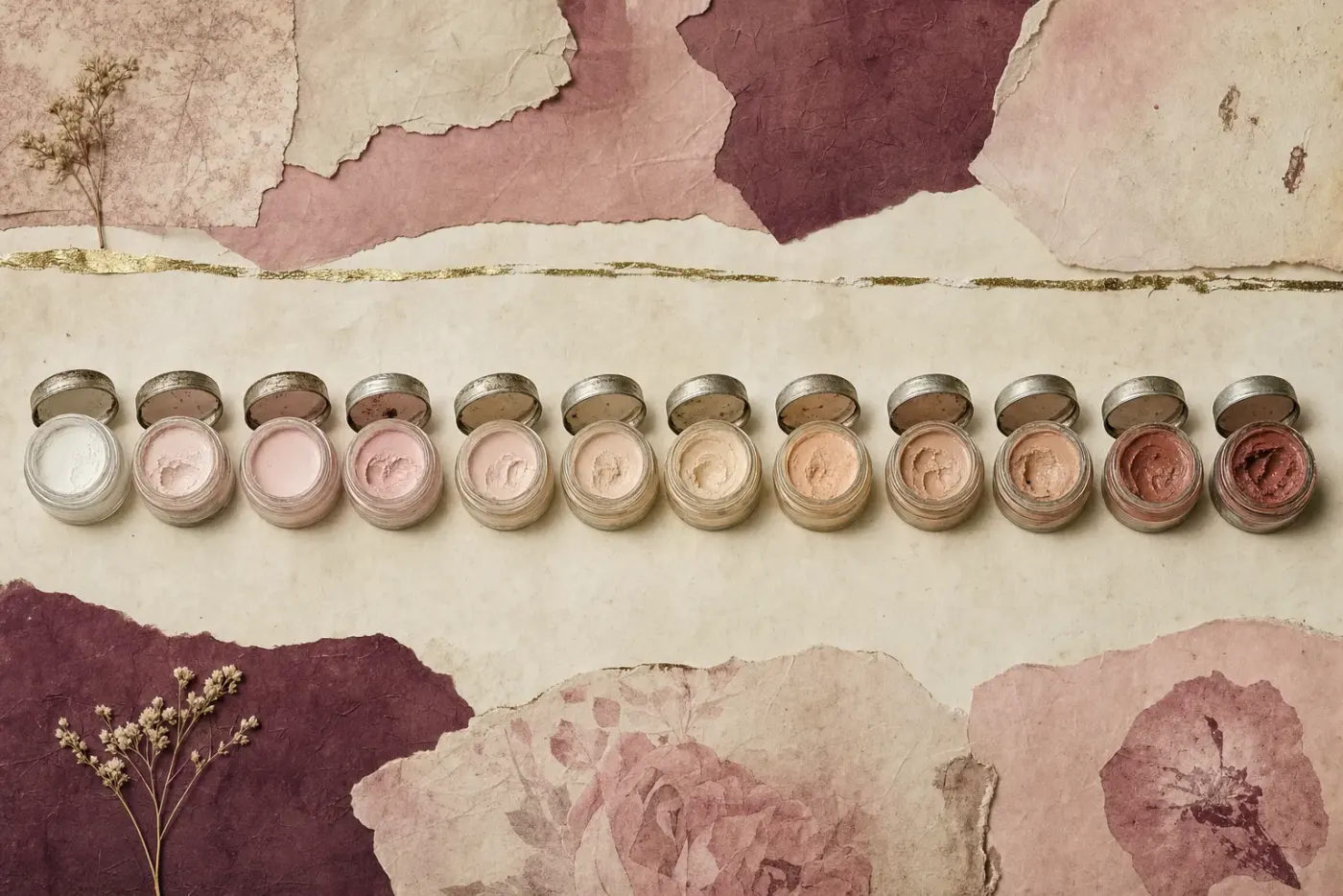
Max Factor built cosmetics for the camera rather than the mirror: a flexible greasepaint in twelve graded shades, and, from 1937, a pressed cake made for three-strip Technicolor that outsold everything else the company made.
- 4min read
- 5chapters
- 5sources
Vivien
Your guide through time
Listen to this essay
7 min listenVivien reads our essays aloud, word for word — every date and every name in its place — so you can listen the way you would be walked through a gallery.
An AI voice, designed for History of Makeup
Max Factor made cosmetics for a client that could not talk: the camera. The client also changed its mind repeatedly. Orthochromatic stock, standard until about 1926, was effectively blind to red, so that an ordinary stage face read on it as a mask. Panchromatic stock, which replaced it, saw red and changed the requirement completely. Two-strip Technicolor, and then three-strip from 1932, changed it again.[1]
His response was to treat make-up as an engineering problem with a measurable output. A product either photographed correctly or it did not, and the test was the print. That approach, more than any single product, is what travelled from the studio floor into ordinary bathrooms.
From Poland to Los Angeles
Maksymilian Faktorowicz was born in Russian-ruled partitioned Poland, at Zduńska Wola or at Łódź — the documentary reconstruction of his papers gives Łódź — and his birth date is not settled at all. His 1906 naturalisation petition gives 3 December 1875 and his 1922 passport application gives 15 May 1875; neither can be right, because his mother died of cholera in 1874.[2] He was apprenticed young to a wigmaker and worked in pharmacy and perfumery before emigrating.[3]
He reached the United States in 1904 and took a concession at the World's Fair in St Louis. In January 1909 he opened the Antiseptic Hair Store at 1204 South Central Avenue in Los Angeles, selling wigs, theatrical make-up and perfume, a few years before the film business concentrated in the city.[2] The timing was luck. What he did with it was not.
Greasepaint That Did Not Crack
Stage greasepaint was built to be seen from thirty feet. Under a lens it caked, and it cracked whenever an actor's face moved. Factor's answer was Supreme Greasepaint, made in twelve graded shades, thin enough to sit as a film on the skin and flexible enough to move with it.[4] It was not a stick and it was not a tube: pigments were worked into a base of vegetable oils, and the product was supplied as a cream in jars.[5]
Its date is not settled either. Fred Basten's company-authorised biography puts it at 1914.[4] Factor himself said later that it was in 1923 that he was first able to present a flexible make-up to the profession, and a Los Angeles press account of the mid-1920s agrees with him.[5] The twelve shades were the innovation whenever they arrived. Matching a face to a stock became a matter of selection from a range rather than improvisation with a palette knife, and the idea that a foundation belongs to a particular person rather than to a particular role starts here.[6]
The camera did not care what a face looked like in a mirror. It cared only what the film could record.
Colour Harmony and the Calibrator
The company claimed the principle it called Color Harmony from 1918: complexion, hair and eye colour matched as a set rather than chosen one at a time. That attribution comes from Basten's biography and is not independently verified. What is documented is the Society line of 1927, which sorted customers into four types — Blondes, Brunettes, Redheads and Brownettes — and sold a matched set to each.[7] It was a merchandising system as much as a theory, and it is the direct ancestor of every shade-matching counter since.
The Beauty Calibrator, a headpiece of adjustable metal strips completed in 1932, measured a face against a set of proportions so that make-up could be directed at the deviations. Very few were built and it worked mainly as publicity, but it states the underlying premise without embarrassment: a face was a set of measurements, and make-up was the correction applied to them.[8]
Pan-Cake
Three-strip Technicolor broke the existing products. The panchromatic make-up then in use left a faint sheen that picked up the colour of everything nearby, which mattered little in black and white and a great deal in colour.[9]
Development began in 1936 and ran for about two years. The result was a pressed cake applied with a damp sponge, giving a matte, even and largely opaque finish. It was first used on screen in 1937, in Vogues of 1938, and was added to the consumer range in 1938. Sales soon exceeded those of every other Max Factor product combined, and the format was copied across the trade.[10]
Whose Invention
Max Factor senior was hit by a delivery truck on North Highland Avenue in 1936, the year the Pan-Cake development began, and he was recovering through much of it.[11] Later accounts credit the leadership of that development to his son Frank, who afterwards took the name Max Factor Jr; the trade record contemporary with the work does not say who led it, and the attribution should be read as a later one. Max Factor senior died on 30 August 1938, the year the product reached shops.[11] The signature achievement attached to the name is not straightforwardly the achievement of the man.
The same caution applies to the other figures in the company's story. The claim that ninety-six per cent of the world's film studios were using its products by 1933 is the company's own count, not an audited one.[11] Business historians of the industry have shown how much of its founding lore was generated by the firms themselves, and this house had enough documented technical history not to need any of it.[12]
Sources
- [1, 3, 4, 8, 10]Max Factor: The Man Who Changed the Faces of the World Arcade Publishing, 2008.
- [2, 5, 7]Max Factor Cosmetics and Skin.View source (opens in a new tab) Accessed 2026-09-22.
- [6]Hollywood Before Glamour: Fashion in American Silent Film Palgrave Macmillan, 2013.
- [9, 11]Max Factor (1930-1945)View source (opens in a new tab) Accessed 2026-09-22.
- [12]Beauty Imagined: A History of the Global Beauty Industry Oxford University Press, 2010.
Filed under