Elizabeth Arden, the Red Door and a Story That Will Not Die
She made a room into the product, and a century later a story she never told is told about her every March.
HOM · Person1878 – 1966Cosmetics manufacturer and salon owner
In short
The story that Elizabeth Arden handed red lipstick to suffragists marching in 1912 fails on the evidence: the contemporary press coverage of those marches records no lipstick of any colour, her range that year was skin care, and the legend cannot be traced back further than the late 1990s.
- 4min read
- 5chapters
- 6sources
Vivien
Your guide through time
Listen to this essay
6 min listenVivien reads our essays aloud, word for word — every date and every name in its place — so you can listen the way you would be walked through a gallery.
An AI voice, designed for History of Makeup
Florence Nightingale Graham took a trade name from a former partner's first name and a surname of her own choosing, painted a door red, and spent five decades making the room behind that door the thing she was actually selling.
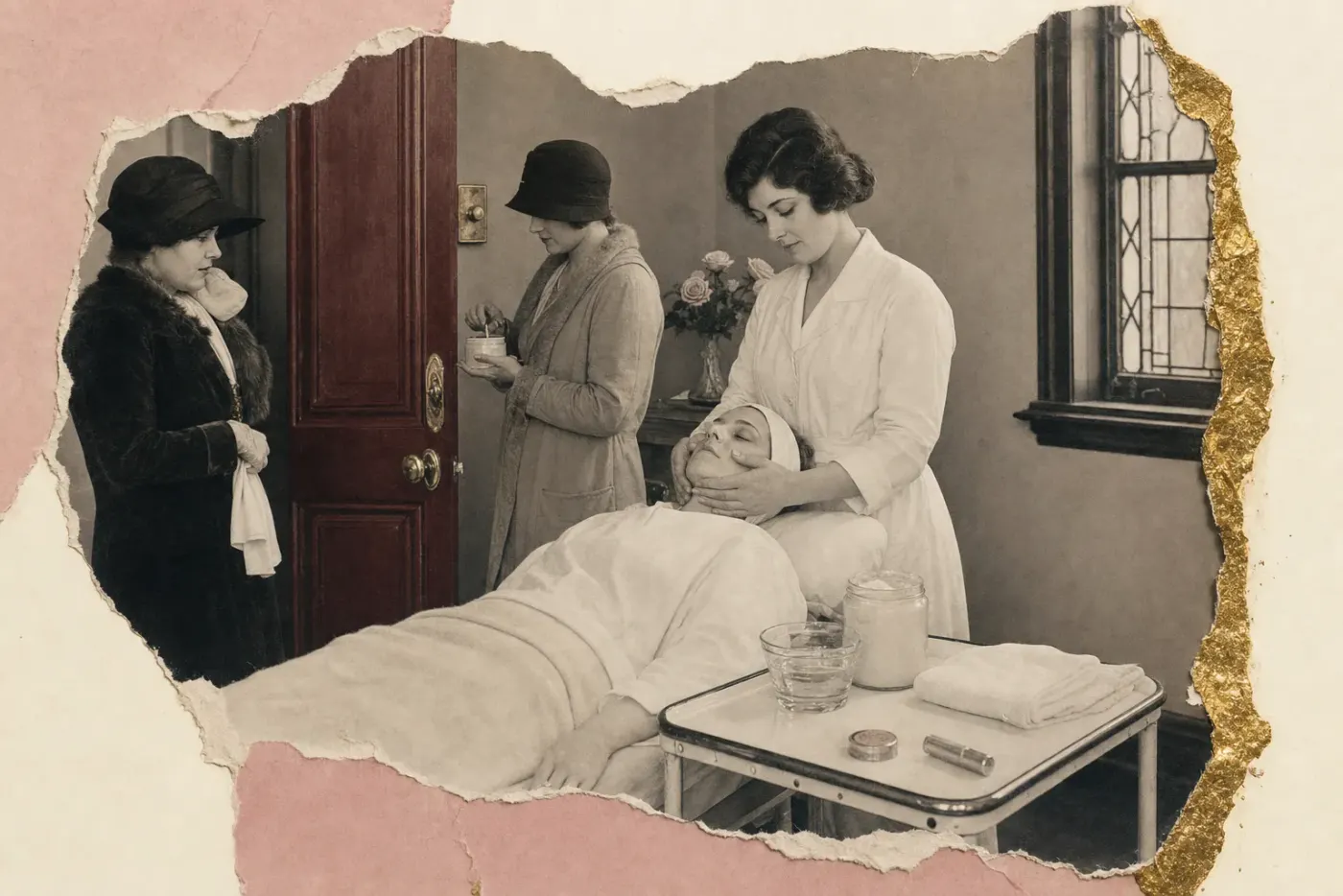
Elizabeth Arden sold creams and later colour. What she built was a place: a salon where treatment was administered rather than bought, and where the purchase followed the treatment as its natural conclusion.[1]
Florence Nightingale Graham
Her birth is not cleanly documented, and the confusion is on the record rather than behind it. The Library of Congress prints 31 December 1881 in the narrative of its own business-history page and 1878 in the catalogue heading attached to the same entry, and gives her birthplace only as Canada.[2] She began training as a nurse, left, and moved to New York in 1908, where she worked for the beauty specialist Eleanor Adair.
In 1909 she went into partnership with Elizabeth Hubbard at 509 Fifth Avenue, on the third floor of the Walton Building. The partnership ended quickly. She kept the lease, had the sign-writer take the surname off the gold lettering and put Arden in its place, and traded under her own name from the following year.[3] Where the Arden came from is not settled either. Tennyson's Enoch Arden is the usual answer; E. H. Harriman's Orange County estate, also called Arden and in the newspapers when its owner died in September 1909, is the other. Both are speculation.[3]
The Red Door
In 1912 Arden travelled to France, toured the Paris beauty salons to study their facial massage technique, and bought perfumes and cosmetics to bring home for analysis. She noted that Parisian women wore more make-up than was then acceptable in America. Eye make-up entered her own range in 1914, and lip cosmetics, a wider rouge range and more face powders followed it.[4]
The Venetian line ran alongside: Venetian Cream Amoretta, Arden Skin Tonic, a sequence of preparations applied in the salon and then sold for use at home. The red door became the company's mark and was reproduced at every new address. It advertised a threshold. Inside was expertise, and expertise was the thing being charged for.[5]
Inside the red door was expertise, and expertise was the thing being charged for.
The Suffrage Lipstick
The story is retold every March. Arden, it is said, stood at her Fifth Avenue door and handed tubes of red lipstick to women marching for the vote in New York in 1912, making red lips a badge of suffrage.
The record does not support it. The historian Lucy Jane Santos worked through the contemporary press coverage of the 1912 marches, which described the routes, the banners and the clothing in detail, and found no mention of lipstick of any colour.[6] The Makeup Museum went through Library of Congress photographs of the marches and the New York Times coverage of November 1912 and found the same nothing; it could document no Venetian Lip Paste or Lip Pencil before 1919, and could trace the legend itself no further back than 1999.[7] What Arden was selling in 1912 was skin care, and her range did not turn to colour until after the Paris trip of that year, with eye make-up in 1914 and lip cosmetics after it.[8] The story is a piece of recent marketing attached to a real woman who did not need it.
What She Did Change
Eye make-up entered the Arden range in 1914, following the Paris trip, at a period when visible cosmetics were still associated with the stage and with prostitution.[9] The firm would later present this as having brought eye make-up into general use across North America. That is a claim the firm makes about its own effect on a whole market, of the kind this entry declines to take on trust anywhere else, and nothing independent of the company establishes it.
What can be shown is the structure. She kept treatment and colour coupled, so that a lipstick arrived as the last step of a regimen rather than as a separate indulgence, and by the 1930s the company was running salons internationally and selling through department stores, with the salon operating as the advertisement for the counter.[10] That structure was adopted by the whole trade and has never been abandoned.
Endings
Arden ran the company until her death in New York on 18 October 1966. It was sold to Eli Lilly in 1971, to Fabergé in 1987, to Unilever in 1989, to French Fragrance in 2001, and to Revlon in 2016.[11]
The name has outlived her by more than half a century and has passed through all of those hands. The red door is still printed on the packaging, which is a reasonable summary of what she actually made.
Sources
- [1, 5]Hope in a Jar: The Making of America’s Beauty Culture Metropolitan Books, 1998.
- [2, 11]Cosmetic Entrepreneur Elizabeth Arden Born, This Month in Business HistoryView source (opens in a new tab) Accessed 2026-09-22.
- [3, 4, 8, 9]Elizabeth ArdenView source (opens in a new tab) Accessed 2026-09-22.
- [6]The Myth of the Red-Lipped Suffragette Literary Hub.View source (opens in a new tab) Accessed 2026-09-22.
- [7]Elizabeth Arden and the Suffragettes, ContinuedView source (opens in a new tab) Accessed 2026-09-22.
- [10]Beauty Imagined: A History of the Global Beauty Industry Oxford University Press, 2010.
Filed under