Powder and the Compact: The Mirror in the Handbag
Loose powder needed a room, a box and a flat surface. Pressed powder in a hinged case needed only a spare minute.
In short
Pressing face powder into a tablet — first with gums, soaps and a stearate, and by the 1930s sometimes with no binder at all — is what made the mirrored compact possible, and the compact is what moved powdering out of the bedroom.
- 12min read
- 6chapters
- 6sources

Vivien
Your guide through time
Listen to this essay
11 min listenVivien reads our essays aloud, word for word — every date and every name in its place — so you can listen the way you would be walked through a gallery.
An AI voice, designed for History of Makeup
A box of loose face powder is an object with requirements. It needs a flat surface, a puff, somewhere to spill, and a mirror that is already on the wall. It is not a thing that can be used standing up, in a coat, on a train. For as long as powder came in a box, powdering was something done in a room set aside for it.
Pressing the powder into a solid tablet and setting that tablet in a hinged metal case with a mirror in the lid removed every one of those requirements at once. The compact is one of the clearest examples in the whole history of cosmetics of an object changing a behaviour rather than a behaviour calling up an object. The dated examples cluster between 1917 and 1925 — though anyone standing in 1935 would still have said the question was open.[1]
What Powder Was
Face powder is a blend of minerals and starches chosen for how they sit on skin, and the compressed powders of the 1920s were built on much the same materials as the loose powders beside them on the counter: a high proportion of talc, which compacts well, with kaolin, zinc oxide, rice starch, magnesium carbonate or precipitated chalk making up the rest, and colour added to taste.[2]
Two of those materials have a history worth separating out. Zinc oxide displaced the bismuth compounds that had carried face powder through the nineteenth century; Henry Tetlow of Philadelphia was an early adherent, working it into his powders from 1866, including the very successful Swan Down. Titanium dioxide came in later still, a more brilliant white than zinc oxide.[3]
The lustre those nineteenth-century powders had was bismuth's. Bismuth oxychloride, which had a pearly sheen, and bismuth subnitrate, which was more astringent, were the bismuth-whites, sold under names like pearl powder, pearl white and blanc de perles, and valued for a soft skin feel and for sticking where they were put. Coated mica now supplies that lustre instead — and supplies it without the defect the bismuth-whites were notorious for, which was a tendency to go grey on the face in the sulphurous air of a city burning coal gas and coal fires.[3]
None of that is an obstacle to portability. A powder is already a powder, and it was already being sold by the box to people who wanted it on their faces. The problem was never the formula. It was the container, and the fact that loose powder in any container remains loose.[2]
The Trouble With a Box
The trade press of the period was blunt about what was wrong. Loose powder containers were bulky, needed refilling, and leaked and spilled. A note from 1925 puts the commercial reading of it plainly: a customer, it says, follows the line of least resistance and will not burden herself with the added task of filling or spilling a box full of loose face powder.[4]
That is a sentence about convenience, and convenience is generally where changes in behaviour come from. The interesting part is what the inconvenience had been preventing. A woman who cannot carry her powder cannot use it away from home, and a cosmetic that can only be used at home is a cosmetic that stays private, whatever anybody thinks about it.
How to Press a Powder
Compressing a powder into a tablet that behaves is harder than it sounds. The tablet had to be thin to fit a small portable container, which made it liable to crack or break when rubbed with a puff; and making it strong enough to resist flaking generally came at the cost of coarsening the powder, or of making it harder for the puff to lift any off — a low pay-off, in the trade's word.[5]
The early solutions were various. Gum mucilages served as binders — tragacanth, karaya, arabic, quince seed, carragheen — along with sugars, aromatic tinctures and soaps, in assorted combinations arrived at by trial and error. One published damp-compression formula runs 40 per cent Italian talc, 20 per cent zinc oxide, 12 per cent fine kaolin, 10 per cent rice starch, 10 per cent magnesium carbonate and 8 per cent zinc stearate; a dry-process alternative drops the starch and the stearate for precipitated chalk and a soap binder, and is compressed directly rather than stamped out as a paste and dried. Talc was generally held under half the mixture, because more raised the risk of the tablet cracking. Where the powder was moulded wet, starch partly gelatinised during mixing and acted as a binder in its own right — though too much of it made the tablet hard and cut the transfer to the puff.[5]
Pressure was the other variable, and it was critical. Too light and the tablet was soft and crumbled; too heavy and the surface glazed over and yielded nothing at all. By the 1930s there were compressed powders on the market using no binder whatever, softer than the earlier sort and with a noticeably better pay-off. The puff had to change as well: lifting powder off a tablet took enough pressure that swansdown was effectively useless, so chamois, lamb's wool and cotton velour were used instead.[5]
The tablet had to be firm enough to survive a handbag and weak enough to surrender to a puff.
The Early Compacts
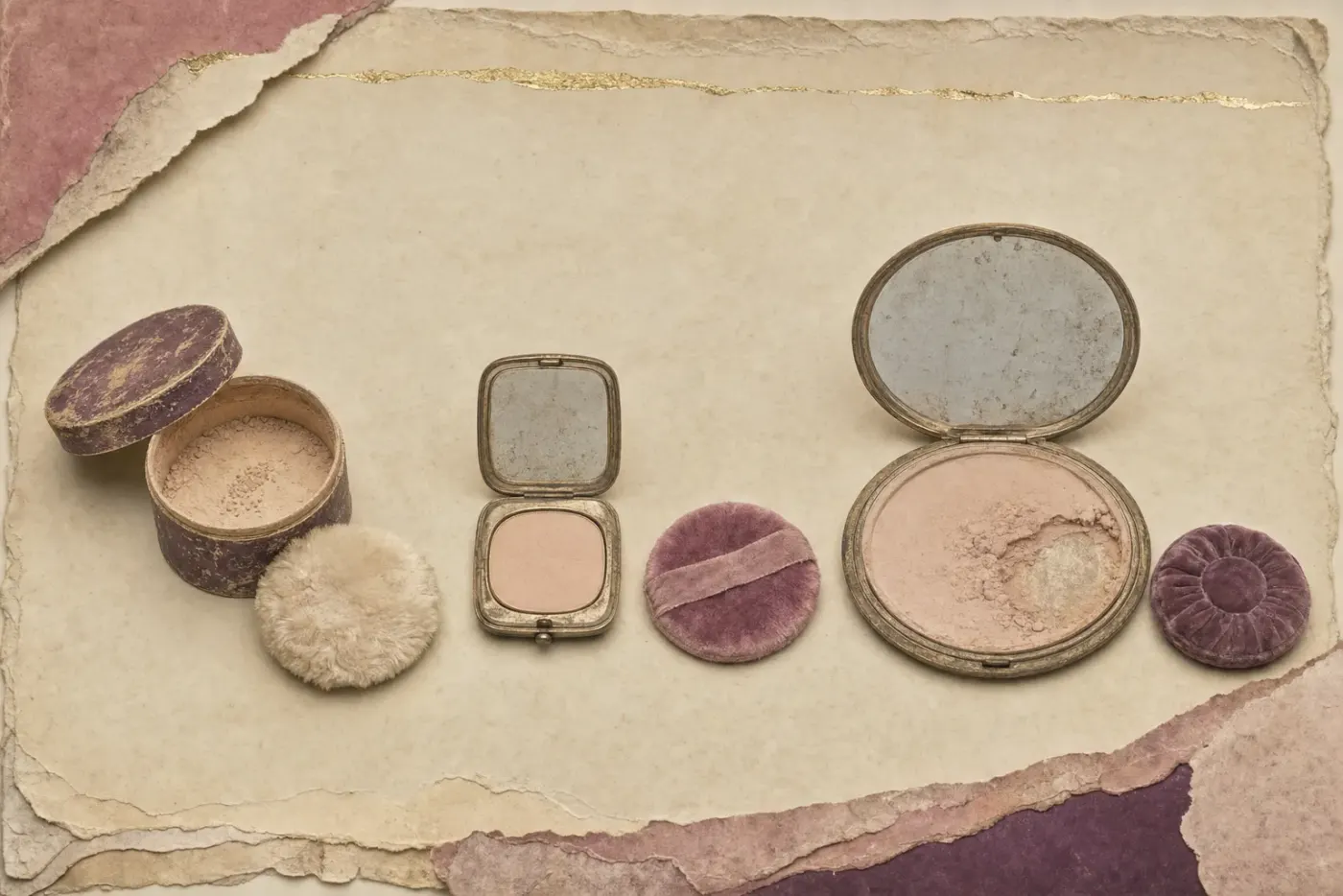
The dated examples arrive close together. A patent for a clip to hold a compressed powder in a compact belongs to 1917, the same year as Dubarry's Powdrette — a solid, portable face powder which, the record is careful to say, was not made using a compressor at all. Then La Dorine Compact Powder in 1919, a Jonteel compressed powder in 1921, Colgate's Compact Powder in 1923 and Lablache's in 1924. The first metal compacts had been made in Europe, large and awkward enough to be called trunks or puff boxes; they got smaller and more elegant, and by 1925 the container was being referred to as a compact, the noun having detached from the adjective.[6]
Then the object grew again. In the early 1930s the Flapjack became very popular: a flat disc around 100 millimetres across, up to twice the size of the compacts that preceded it. It had been designed for use on a dressing table. Women carried it about anyway, to take advantage of the larger mirror and the larger supply of powder.[6] That is the more interesting fact, and the better evidence: the users overrode the designers.
It is worth recording how open the question still was. Loose powder compacts were improving at the same time — tighter machine tolerances, then metal and later fabric filters — so that by the 1930s a woman could carry loose powder with little risk of spilling it. Looking forward from 1935 it would have been difficult to predict whether the loose or the compressed powder compact would become dominant, and some manufacturers hedged by making compacts that would take either. In the event neither held first position for long: the decline of both began with the release of Pan-Cake make-up in 1938.[6] The outcome looks inevitable now only because it happened.
An Object Meant to Be Seen
A compact that comes out at a restaurant table is on show, and the trade understood that immediately. The Victoria and Albert Museum holds a powder compact made in Paris between 1930 and 1940 by Zundel Lipec for the jewellers Ostertag: gold and silver, decorated in bands of vertical and short horizontal lines, with diamonds and cabochon rubies set on the catch, a little over eight centimetres by six and a half. The museum’s own note observes that for some owners the cigarette case, the compact and the vanity case became the successors of the gold box.[7]
That lineage is the point. The gold box was an eighteenth-century object for being seen to own. The compact inherited the role and added a function, which is an unusual combination in the decorative arts and a fairly direct piece of evidence about how the thing was actually used.
Powdering in Public
The mirror in the lid is the component that did the work. Without it a compact is only a smaller box; with it, the wall, the room and the dressing table all become unnecessary. The evidence for that is behavioural rather than theoretical. When the Flapjack arrived, what drew women to carry about an object designed for a dressing table was the larger mirror set in it.[8] And everything required to repair a face fits in one hand: the Ostertag compact described above is barely more than a centimetre deep.[9]
What followed was a public gesture, and it was read as one. Liz Conor's study of the 1920s, whose material is Australian, describes the made-up woman in the street as understood to be something looked at, the looking being part of the arrangement.[10] Richard Corson's chronological survey of the period records how widely and how visibly makeup was worn in these years across Europe and America,[11] and commentary on women attending to their faces in company is plentiful, which is the surest indication available that they were doing it.[12] Disapproval is a form of documentation.
By the end of the decade the pair was complete. A tube for the mouth, a case for the complexion, both sealed, both small enough for a handbag, and both designed to be opened in front of other people.[12]
Sources
- [1, 2, 4, 5, 6, 8]Compressed Face Powders Cosmetics and Skin.View source (opens in a new tab) Accessed 2026-09-22.
- [3]Pearl Powders Cosmetics and Skin, 2009.View source (opens in a new tab) Accessed 2026-09-22.
- [7, 9]Powder compact, Zundel Lipec for Ostertag, Paris, 1930-1940 (museum no. M.161&A-1987) Victoria and Albert Museum.View source (opens in a new tab) Accessed 2026-09-22.
- [10]The Spectacular Modern Woman: Feminine Visibility in the 1920s Indiana University Press, 2004.
- [11]Fashions in Makeup: From Ancient to Modern Times Peter Owen, 1972.
- [12]Hope in a Jar: The Making of America’s Beauty Culture Metropolitan Books, 1998.
Filed under