Kohl, Malachite and the Manufactured Face
The materials survive in their thousands. The meanings do not, and most of the confident explanations are modern.
HOM · Culturec. 4000 BCE - 30 BCEMaterial & Inference
All of The Nile Valley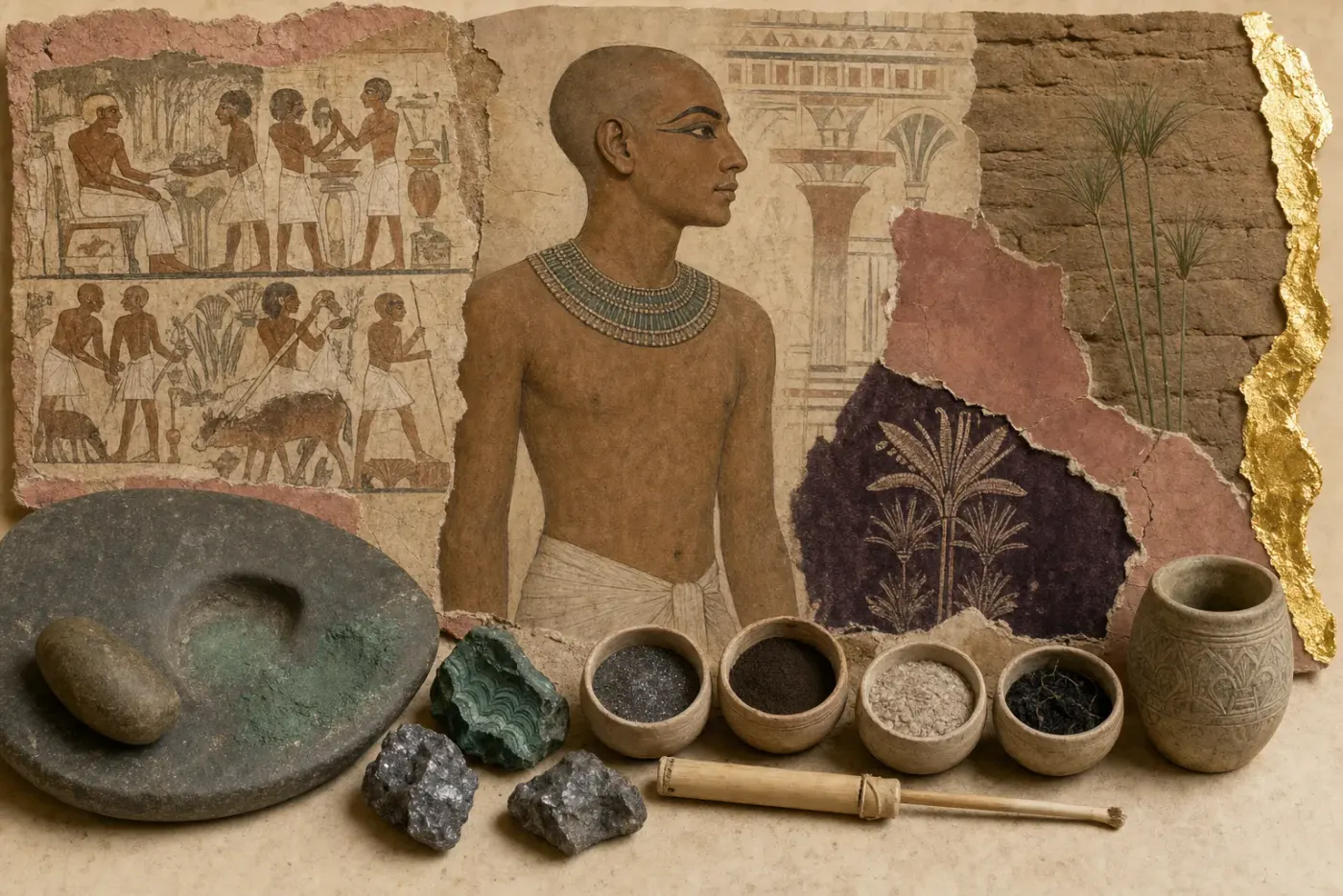
In short
Analysis of eleven kohl containers in the Petrie Museum, published in 2022, found recipes built on manganese, silicon and carbon as well as on lead, which means there was never one Egyptian kohl but a family of them.
- 8min read
- 6chapters
- 9sources

Vivien
Your guide through time
Listen to this essay
8 min listenVivien reads our essays aloud, word for word — every date and every name in its place — so you can listen the way you would be walked through a gallery.
An AI voice, designed for History of Makeup
Before Egypt had pyramids it had palettes. Flat slabs of stone, worn down in the centre by grinding, turn up in Predynastic graves in numbers that make them ordinary rather than remarkable. Lumps of malachite ore — a green copper carbonate that occurs in the Eastern Desert and in Sinai — are found lying beside those palettes and their grinding pebbles, presumably for grinding into powder; galena and pyrolusite are attested in the same Predynastic contexts.[1]
The habit lasted roughly three thousand years. Pots, tubes, sticks, spoons and mirrors were buried with their owners as a matter of course, at every level of society that could afford a burial at all. What survives is therefore unusually good evidence for what Egyptians put on their faces, and unusually poor evidence for what they thought they were doing.[2]
Green Before Black
Malachite is the pigment found most often on Predynastic palettes, and it did not stay on the palette. Human remains from the site of Adaima in Upper Egypt still carry malachite residue around the eyes, and a painted clay head from tomb H.97 at el-Mahasna has green malachite around its eyes as well. The same project is careful about what that does not show: there is no evidence for malachite being used as a paint in the Predynastic period, where pottery and other objects carry ochre- and gypsum-based paints instead. In that period malachite was a cosmetic, applied to the body.[3]
Green did not last. Malachite eye paint belongs to the early tradition and thins out of the later record, while the grey-black preparations built on galena and other dark minerals continue.[4] The reason is not documented. Ready explanations exist — a change in trade, in fashion, in religious association — and none of them rests on an Egyptian text that says so.
Kohl Was Never One Recipe
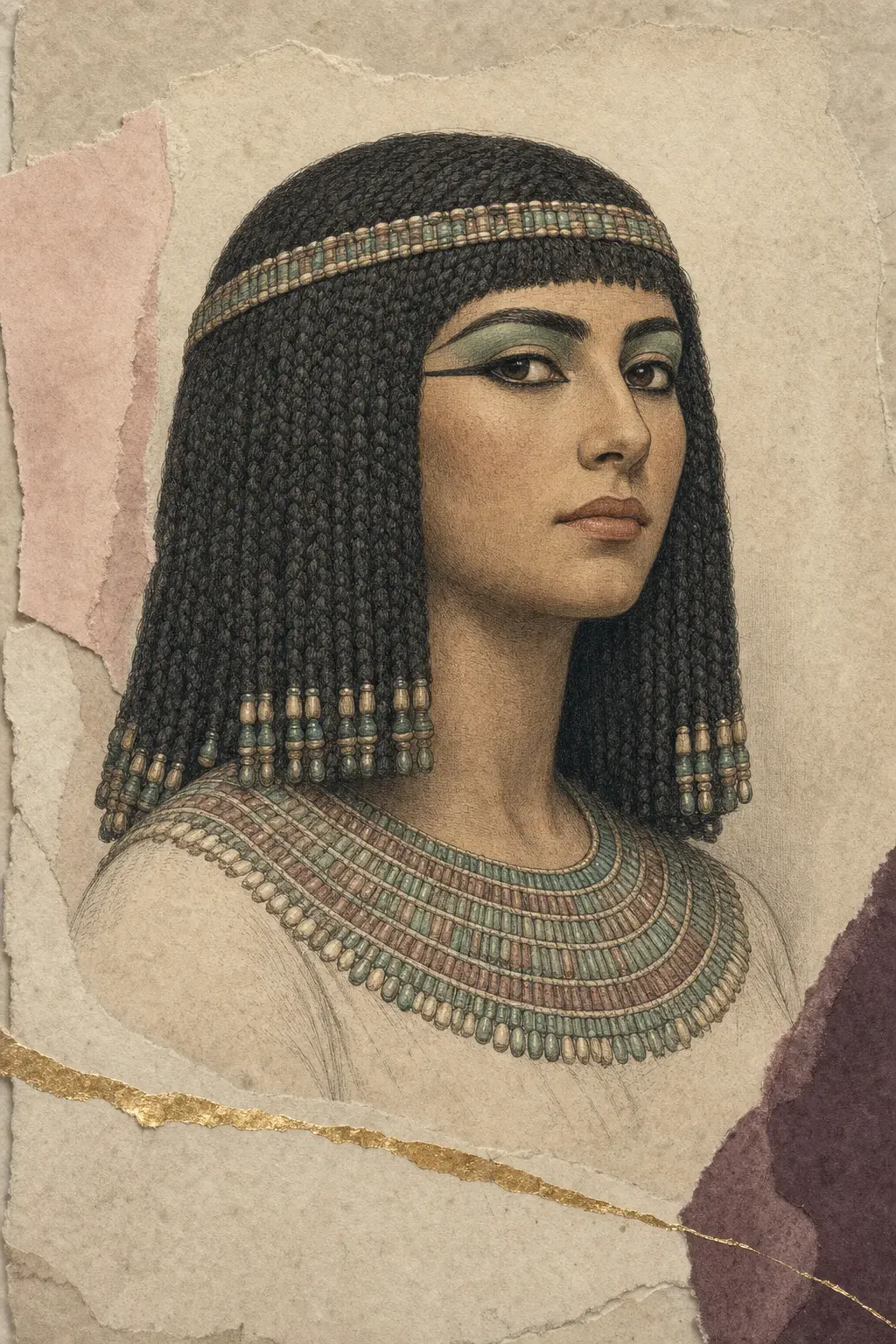
For most of the twentieth century kohl was described as ground galena: lead sulfide, dug up and crushed. In 1999 a team analysing samples held in Paris found four lead compounds in Egyptian eye paints, two of which — laurionite and phosgenite — do not occur in Egypt in quantities that could supply a trade. They had been made, by a wet process in which a lead oxide is reacted with salt and natron in water over something like a month.[5]
A second study, published in 2022, examined the contents of eleven kohl containers in the Petrie Museum in London, chosen to span a wide range of dates and places. Two samples were lead-based. Three were built on manganese. One was silicon-based and six were carbon-based, and organic material of plant and animal origin was common, in some cases forming the main constituent. The work identified eight minerals not previously recorded in Egyptian kohl at all: biotite, paralaurionite, lizardite, talc, hematite, natroxalate, whewellite and glushinskite. What it could not do was confirm soot specifically, since identifying amorphous carbon black needs Raman spectroscopy and the project did not have it.[6]
Stimmi is possessed of certain astringent and refrigerative properties, its principal use, in medicine, being for the eyes. … it being extensively employed in the calliblepharie preparations of females, for the purpose of dilating the eyes.
Who Wore It
Egyptian eye paint was not a women's product. It appears on men and women, on the living and the dead, on gods and on labourers, across the whole span of the dynastic period. The equipment that carried it ranges from plain reed tubes and rough pots to carved stone and inlaid wood, which is a reasonable proxy for how far down the social order the practice reached.[8]
It belonged to the dead as much as to the living. Cosmetic kit is standard funerary provision, supplied because the deceased would need it. That is a stronger statement about what the painted face was for than any surviving Egyptian explanation of it.[8]
The Argument About Eyes
Classical writers reported that Egyptian eye preparations were used against eye disease, and the 1999 synthesis work observed that manufactured lead chlorides would be an odd thing to go to such trouble for if colour were the only object.[9] In 2010 a French team published amperometric measurements on single cells indicating that lead ions at very low concentrations stimulated nitric oxide production, and proposed this as a mechanism by which the preparations might have supported an immune response in the eye.[10]
That is a proposed mechanism, not a demonstration that the practice worked, and it sits beside the plain fact that these were lead compounds applied to the eye. The United States Food and Drug Administration states that none of the materials sold as kohl, kajal, al-kahal, surma, tiro, tozali or kwalli has been approved and listed in its colour additive regulations, and that lead, usually as lead sulfide, sometimes accounts for more than half the weight of a kohl product.[11]
Where the Material Came From
Kohl was a traded commodity, and lead isotopes make part of that trade visible. Eleven kohl samples from Bronze Age Lower Nubia, in what is now Sudan, were analysed in 2024. They fall into two isotopic groups: five of the eleven matched ore from Gebel el-Zeit on the Egyptian Red Sea coast, and the other six point to a galena source that has not been identified.[12]
So for under half the samples a cosmetic material can be watched moving south out of Egypt, and for the majority the route is not legible at all. Even that much matters for how the material should be read. A substance mined at a known source, carried hundreds of miles, made to a repeatable formula and buried with the dead is not a trinket.[13]
What Is Not Known
The meanings are the weak part of the record. Eye paint is routinely explained by reference to the protective eye of Horus, to the sun, to rebirth. Those readings are plausible, and they are largely inferences drawn by modern scholars from images and associations rather than statements Egyptians made about their own cosmetics.[14]
The same caution applies to the most famous Egyptian face of all. Detailed accounts of what Cleopatra VII wore — this pigment on that feature, in that colour — circulate freely, and we have not been able to trace any of them back to a source contemporary with her. That is this page's own judgement rather than a sourced finding, and it is offered as such. What can be said is which materials were available in Egypt in the first century BCE. What she did with them is not on record, and an account that supplies the detail is filling a gap rather than reporting one.
Sources
- [1]Cosmetic materials (Digital Egypt for Universities) University College London, 2001.View source (opens in a new tab) Accessed 2026-09-22.
- [2, 4, 8, 13, 14]Sacred Luxuries: Fragrance, Aromatherapy, and Cosmetics in Ancient Egypt Cornell University Press, 1999.
- [3]Pigment Stories: Eternal Green in Predynastic Egypt University College London, 2020.View source (opens in a new tab) Accessed 2026-09-22.
- [5, 9]Making make-up in Ancient Egypt Nature 397, 483–484, 1999.
- [6]Recipes of Ancient Egyptian kohls more diverse than previously thought Scientific Reports, volume 12, 2022.View source (opens in a new tab)
- [7]Naturalis Historia, Books XXXIII–XXXV 77.
- [10]Finding Out Egyptian Gods' Secret Using Analytical Chemistry: Biomedical Properties of Egyptian Black Makeup Revealed by Amperometry at Single Cells Analytical Chemistry 82 (2), 457-460, 2010.View source (opens in a new tab) Accessed 2026-09-22.
- [11]Kohl, Kajal, Al-Kahal, Surma, Tiro, Tozali, or Kwalli: By Any Name, Beware of Lead PoisoningView source (opens in a new tab) Accessed 2026-09-22.
- [12]Bronze age supply chains between ancient Egypt and Nubia revealed by lead isotope analysis of kohl samples Scientific Reports 14, article 27488, 2024.View source (opens in a new tab)
Filed under