The Rock Crystal Fish: A Kohl Pot That May Be One
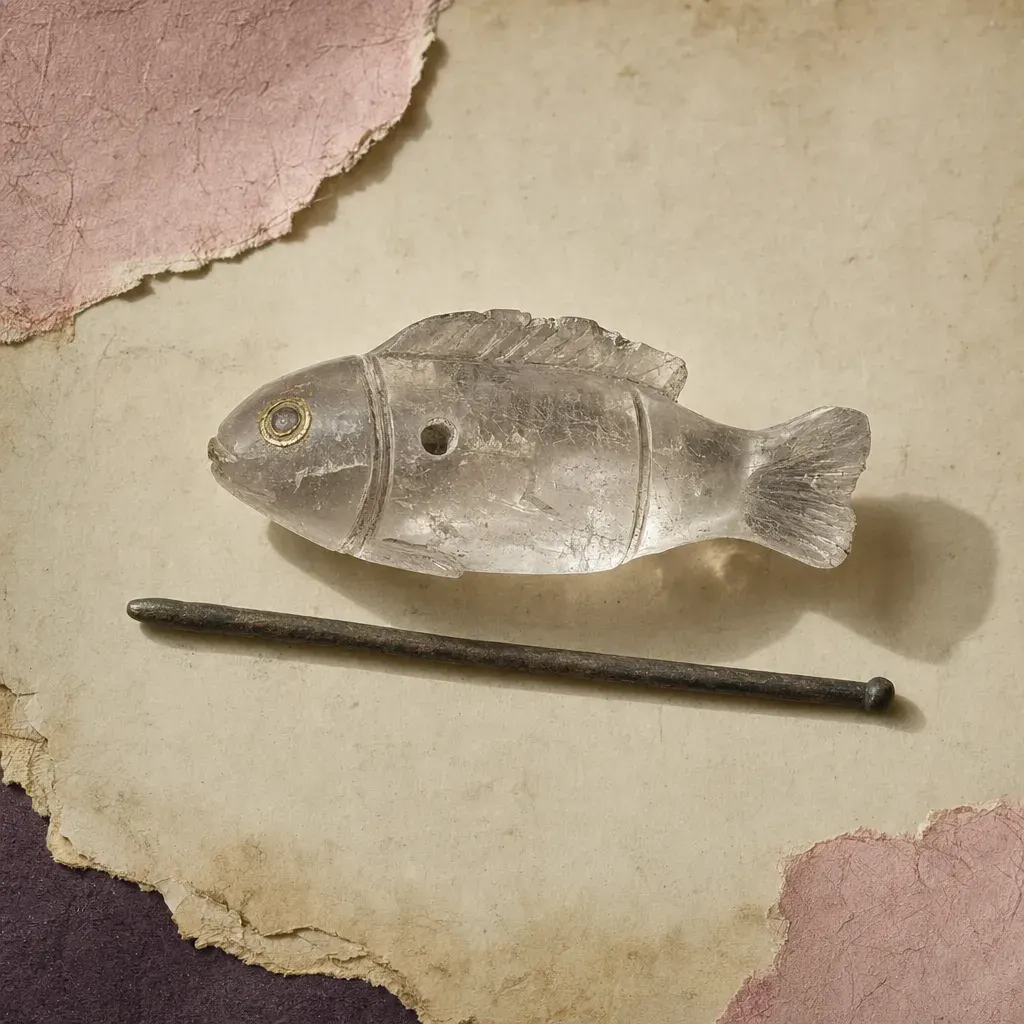
A fish carved from rock crystal and drilled with a hole a rod would fit. The museum that owns it says it may have held kohl, and the may is the point.
In short
The Victoria and Albert Museum holds a rock crystal container carved as a fish in Egypt or Iraq in the late ninth or early tenth century, drilled from one end with a hole a kohl rod would fit; the museum says it may have been used for kohl.
- 3min read
- 4chapters
- 4sources

Vivien
Your guide through time
Listen to this essay
4 min listenVivien reads our essays aloud, word for word — every date and every name in its place — so you can listen the way you would be walked through a gallery.
An AI voice, designed for History of Makeup
The object is a little over five centimetres long. It is a fish, carved from rock crystal, with a fin along its back and two deeply cut bands dividing it into head, body and tail. A horizontal hole has been drilled into the body from one end.[1]
The Victoria and Albert Museum dates it to the late ninth or early tenth century, gives Egypt and Iraq as its possible places of origin, and describes it with a care worth copying: the piece may have been used as a pot for a cosmetic such as kohl, which was applied with a tiny rod that would have fitted into the hole.[1]
One of a Group
The fish is not unique. The museum places it in a group of similar rock crystal fish, with comparable pieces in the Kunsthistorisches Museum in Vienna and the Bibliothèque nationale in Paris.[2] A form repeated in a hard and costly stone suggests a recognised type of object, made for buyers who knew what it was for, even if that purpose now has to be inferred from its shape.
The inference is a good one. A narrow well in a small container, with a stick kept alongside it, is the arrangement of the Egyptian kohl tube, which the Metropolitan Museum catalogues together with its applicator.[3]
Kohl in the Islamic World
Whatever this fish held, kohl had standing in the world that made it. The collections of the Prophet's customs report that he used ithmid kohl and applied it to each eye before sleep,[4] and ithmid is the Arabic name both for stibnite and for the best kohl.[5] A practice with that authority behind it was not a vanity to be hidden. It was one to be kept in a container worth carving.
That same standing is why the word kohl is so unhelpful as a chemical description. A survey of forty-seven samples sold as kohl found that the name covered quite different mineral bases.[5] A container tells us that a dark powder was kept and drawn out on a rod. It does not say which powder.
A container tells us that a dark powder was kept and drawn out on a rod. It does not say which powder.
Why Rock Crystal
Rock crystal is clear quartz, hard to carve and slow to work, and a container cut from it is a luxury before it is anything else. That matters for what the fish can tell us.
Like the finest Egyptian cosmetic spoons, it belongs to the class of objects that were collected and kept because they were beautiful. That makes it good evidence for how cosmetics were valued at the top of society, and poor evidence for how most people kept theirs, in containers of clay, reed and bone that nobody thought to collect.
What Is Not Known
Whether this fish ever held kohl. No residue is reported in the museum's record, and its use as a kohl pot is an inference from its form and from its companions in Vienna and Paris; the museum's own physical description says only that it was perhaps used as one.[6] It may have held a perfume, a medicine or nothing at all.
The honest description is the museum's, hedge included: it may have been used for kohl.
Sources
- [1, 2, 6]Flask (rock crystal container in the shape of a fish), museum number A.20-1926View source (opens in a new tab) Accessed 2026-09-25.
- [3]Kohl Tube and Applicator, accession number 30.8.150 Department of Egyptian Art, The Metropolitan Museum of Art.View source (opens in a new tab) Accessed 2026-09-22.
- [4]Ash-Shama'il al-Muhammadiyya, chapter on the kohl of the Messenger of God Sunnah.com edition.View source (opens in a new tab) Accessed 2026-09-22.
- [5]Composition of eye cosmetics (kohls) used in Oman Journal of Ethnopharmacology 60(3), 223-234, 1998.View source (opens in a new tab)
Filed under