Piety, Pallor and the Recipes Behind Both
A thousand years in which painting the face was condemned from the pulpit and written down, in detail, by physicians.
HOM · Era500 – 1500Faith & Adornment
All of The Medieval Era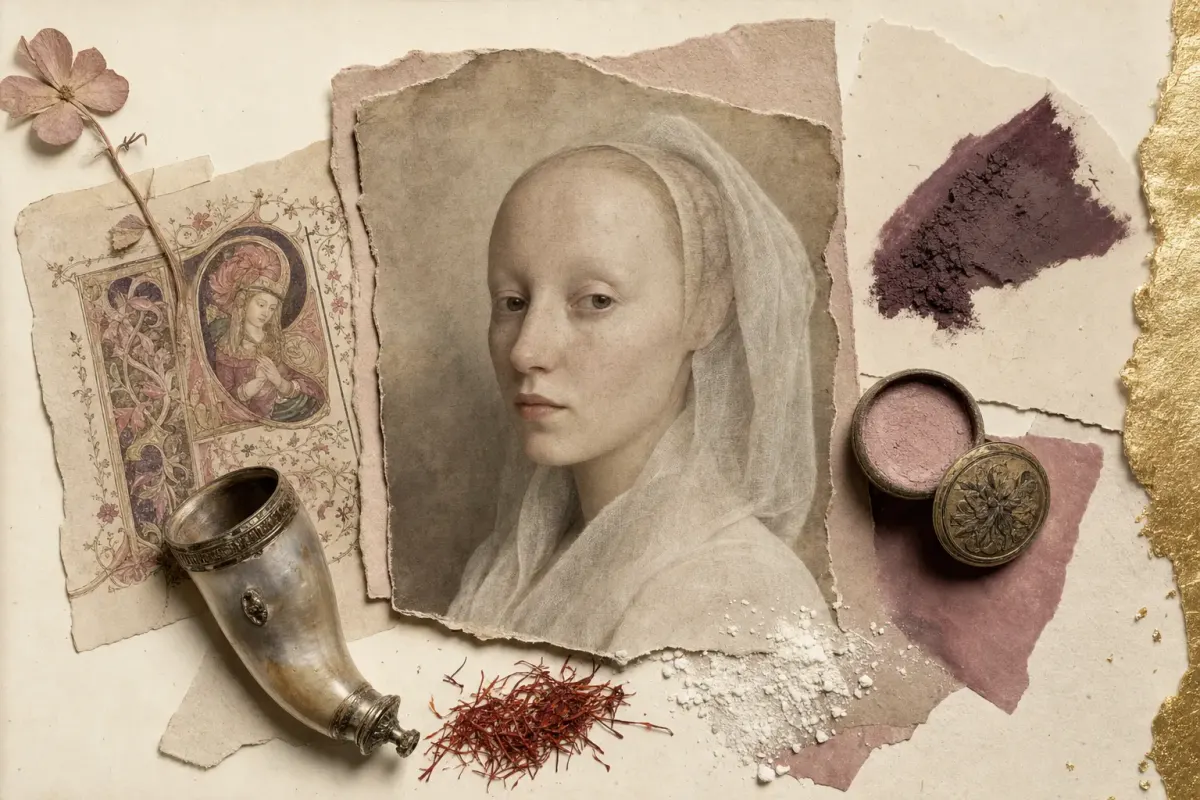
In short
Medieval Europe condemned cosmetics as an interference with God’s work while its physicians wrote them down as medicine: the twelfth-century Salernitan compendium known as the Trotula devotes an entire treatise, De ornatu mulierum, to preparations for the skin, hair, teeth and face.
- 9min read
- 5chapters
- 7sources
Vivien
Your guide through time
Listen to this essay
7 min listenVivien reads our essays aloud, word for word — every date and every name in its place — so you can listen the way you would be walked through a gallery.
An AI voice, designed for History of Makeup
Two bodies of medieval writing describe cosmetics, and they appear to contradict each other completely. The sermons say that painting the face is a sin — an improvement on creation offered by a woman who has no standing to improve it. The medical manuscripts give instructions: how to whiten skin, redden lips, lighten hair, clean teeth, remove hair, treat blemishes.
They do not actually contradict. Preachers do not spend a thousand years denouncing a practice that has died out. The condemnation is the evidence.
The Ideal: Visibly Untouched
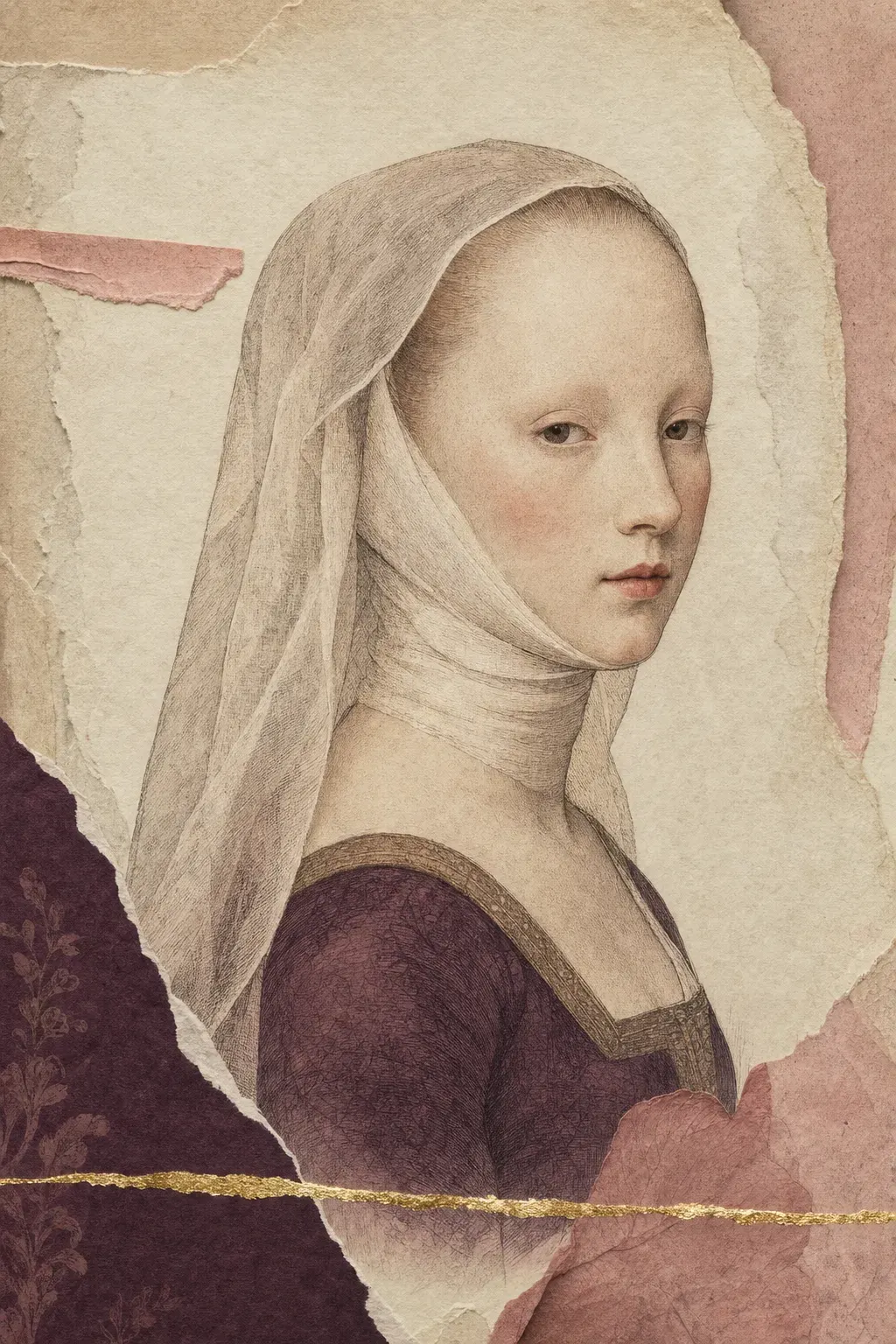
What the medieval face aimed at was not a painted look but an unpainted one — achieved by whatever means were required. The complexion should be pale and even, with a natural-seeming flush at the cheek. The forehead should be high, broad and bare, which meant plucking the hairline back, sometimes considerably. Eyebrows were thinned to almost nothing. The mouth was small.[1]
This is a demanding specification, and it is the opposite of the 1920s in one revealing respect: where the flapper's face announced itself as made, the medieval face had to deny that anything had been done to it. Artifice was permitted as long as it was undetectable — a distinction that survives intact into the "no-makeup makeup" of the present day, and rests on exactly the same anxiety.
Fair hair was prized, and there were means. Solutions built on saffron, alum and other mordants were applied and the wearer sat in the sun, which is a genuinely effective and thoroughly unpleasant procedure.[2]
…it is one thing to counterfeit a beauty one has not, and another to hide a disfigurement arising from some cause such as sickness or the like. For this is lawful…
The Trotula and the Recipes That Survive
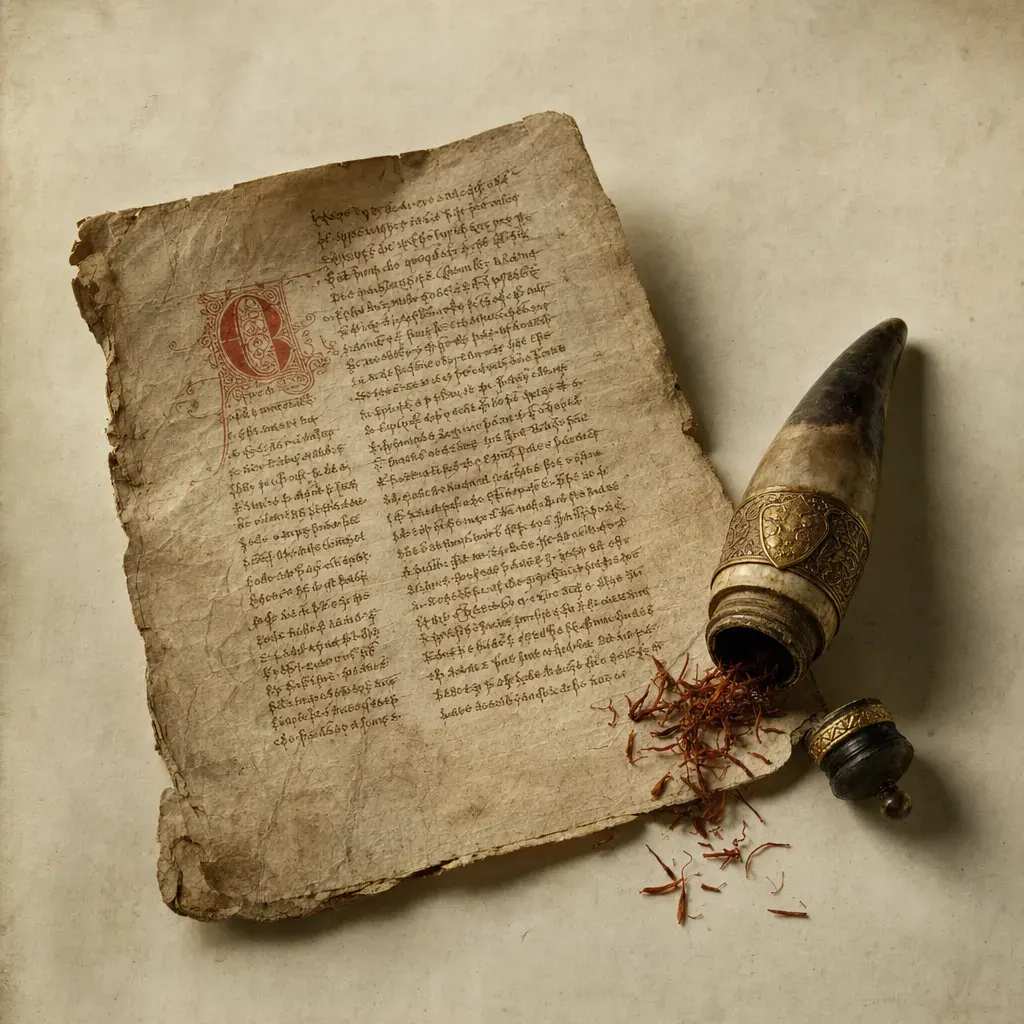
The single most important source is a group of texts from Salerno, the southern Italian medical centre, which circulated from the twelfth century onward under the collective name Trotula. One of the three is De ornatu mulierum — "on women's cosmetics" — and it is not a footnote to the others. It is a full treatise: preparations for the face, the hair, the teeth, the lips, for depilation and for the skin generally.[4]
The attribution is more interesting than the legend. A woman named Trota did practise and write at Salerno, and material genuinely associated with her sits inside the compendium — but the three texts have different authors, and the medieval habit of bundling them under one name has caused several centuries of confusion about who wrote what.[4]
What matters for this archive is the framing. These recipes are not filed as vanity. They appear inside medical literature, next to obstetrics and gynaecology, as part of the care of the body — which tells you that the people writing them did not consider cosmetics a separate and lesser category, whatever the preachers said.
What Came Through al-Andalus
Much of the technical sophistication available to medieval Europe arrived from the Islamic world. Around the year 1000 the Andalusian physician al-Zahrawi — Albucasis to Latin readers — completed Kitab al-Tasrif, a thirty-volume medical encyclopaedia, and gave an entire book of it to adwiyat al-zinah, the medicines of adornment.[5]
The contents are striking: preparations for the skin and hair, scented compounds, early descriptions of solid rolled perfumes, and a treatment of cosmetics as a legitimate branch of medicine rather than an indulgence attached to it. Translated into Latin from the twelfth century onward, al-Zahrawi's work became part of the European medical curriculum — and his cosmetic chapter travelled with the rest.[5]
The same routes carried materials. Mediterranean and Levantine trade supplied pigments, gums, resins and aromatics that did not grow in northern Europe, which is why the wealth of a household is legible in the contents of its cosmetic box long before there is any such thing as a cosmetics industry.[6]
The Materials, and Their Cost
White lead did not go away. The Greek and Roman complexion standard carried straight through the medieval centuries and out the other side, because nothing else available produced the same flat, opaque whiteness. Red came from plant sources — brazilwood, madder, safflower — and from ochres; more expensive reds came from insect dyes traded at distance.[7]
Ingredients also came from the kitchen and the byre. Animal fats and beeswax carried pigment and sealed the skin. Wine lees, vinegar and lemon were used as mild acids. Ground bone, chalk and cuttlefish cleaned teeth.[8]
Perfume and scented waters sat inside the same category, distilled from roses, lavender and orange flower where the plants grew and imported at cost where they did not. Scent was not a separate luxury from cosmetics in the medieval mind; both were preparations applied to the body for its improvement, and both were bought from the same trade.
It is worth resisting the temptation to read all of this as grotesque. A medieval woman applying a lead-based whitener was doing what a Roman woman had done and what a Venetian woman would do three hundred years later, with the same materials and the same information. The mistake was continuous, and it was not hers alone.
What the Medieval Period Established
The lasting inheritance is not a look. It is a posture toward looks — the idea that cosmetic effort must be concealed, and that being caught having made an effort is itself the failure. That posture outlives every material in this article.
The second inheritance is documentary. Because cosmetics were written down as medicine, they were written down at all. The recipes of a thousand years survive in manuscripts about the body, and we know what medieval women put on their faces largely because a physician thought it worth recording next to how to deliver a child.
The Renaissance inherits both: the same insistence on a natural-seeming face, and a far larger technical literature with which to fake it.
Sources
- [1, 7]Fashions in Makeup: From Ancient to Modern Times Peter Owen, 1972.
- [2]The Artificial Face: A History of Cosmetics David & Charles, 1973.
- [3]Summa Theologiae, Secunda Secundae, q. 169 a. 2: Of Modesty in the Outward Apparel New Advent English edition.View source (opens in a new tab) Accessed 2026-09-22.
- [4]The Trotula: A Medieval Compendium of Women’s Medicine University of Pennsylvania Press, 2001.
- [5]Kitab al-Tasrif, Book 19: on adwiyat al-zinah (the medicines of adornment) 1000.
- [6]For Appearance’ Sake: The Historical Encyclopedia of Good Looks, Beauty, and Grooming Oryx Press, 2001.
- [8]A History of Make-up Macmillan, 1970.
Continue in The Medieval Era
Faith & Adornment
Browse all 19 articles