Al-Zahrawi: The Surgeon Credited With Lipstick
A physician near Córdoba filed cosmetics under medicine. A modern slogan filed him under lipstick.
In short
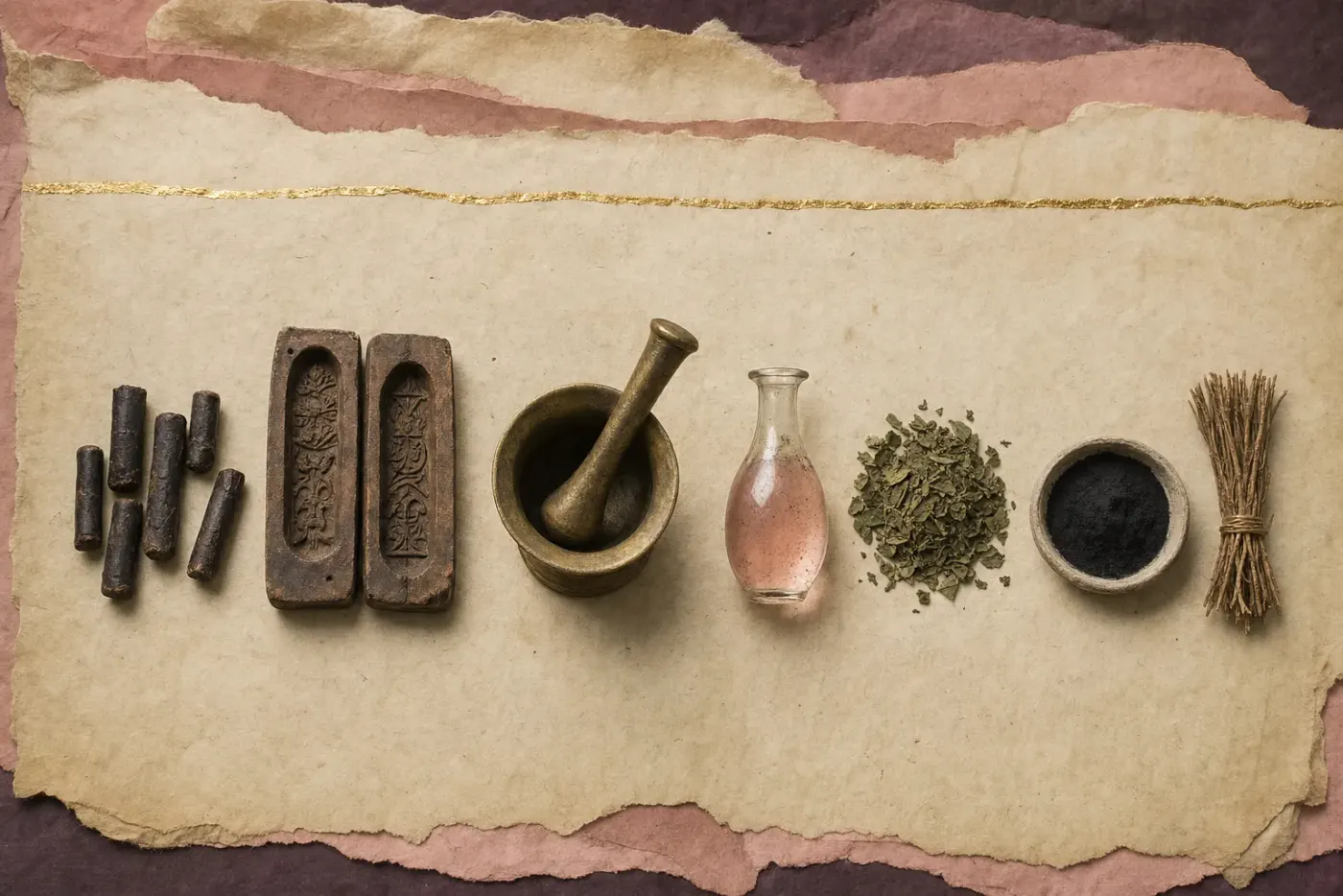
Abu al-Qasim al-Zahrawi's encyclopaedia of around 1000 describes solid perfumes rolled and pressed in moulds among its medicines of adornment; calling them the first lipstick is a modern gloss, not a rendering of his text.
- 3min read
- 4chapters
- 3sources
Vivien
Your guide through time
Listen to this essay
4 min listenVivien reads our essays aloud, word for word — every date and every name in its place — so you can listen the way you would be walked through a gallery.
An AI voice, designed for History of Makeup
Abu al-Qasim al-Zahrawi, known to Latin readers as Albucasis, practised as a physician near Córdoba and completed a medical encyclopaedia, the Kitab al-Tasrif, around the year 1000. Medicine remembers him for its surgical volume.[1] Beauty history remembers him for something he did not quite do.
Ask who invented lipstick and his name comes back. The claim rests on a single passage, and the passage says something narrower and, in its way, more interesting.
Book Nineteen
The encyclopaedia runs to thirty books. The nineteenth is devoted to adwiyat al-zinah, the medicines of adornment, and treats them as a branch of medicine rather than an appendix to it.[2] The standard pharmaceutical study of the work lists what that book covers: hair dyes, depilatories, dentifrices, preparations for the underarm, and solid perfumes rolled and pressed in moulds.[3]
The register is technical. It is a formulary of preparation, concerned with how a substance is ground, mixed, perfumed and shaped, and written for people who made things. It has very little to say about what is beautiful.
The Lipstick Claim
The moulded solid perfumes are where the modern claim begins. Read backwards from the lipstick bullet, perfumed sticks pressed in a mould look like its ancestor, and from there it is a short step to calling them the invention of lipstick itself. The study that describes them does not take that step: the description of those sticks as the first lipstick is a later gloss, and not a rendering of al-Zahrawi's text.[4]
The gloss fails on its own terms. A stick of solid perfume and a stick of colour for the lips share a shape and a method of manufacture, and nothing else that is recorded. Coloured preparations for the lips are far older than al-Zahrawi, and pressing a paste into a mould is a technique, not a product. What the passage does document is real: a physician specifying how to make a solid, portable cosmetic in a standard form. That is genuine manufacturing history, and it does not need the extra claim.
The moulded sticks are in the text. The word lipstick is not.
How the Book Travelled
The Tasrif was prized in Latin Europe above all for its surgery, and it was carried into Latin from the twelfth century onward.[5] A complete Latin text of the encyclopaedia was printed at Augsburg in 1519.[6]
The book of adornment travelled inside a work that readers were acquiring for other reasons, which is how a great deal of cosmetic knowledge survived at all. Nobody needed to value the cosmetics for them to be copied.
What Is Not Known
How many of the preparations in the book of adornment were ever made, by whom, and whether any of them were used on the lips. A formulary records what a physician thought worth specifying; compilers copied compilers, and a recipe could survive for centuries without anyone mixing it.[7]
His own dates are approximate too. The completion of the encyclopaedia around the year 1000 is a conventional placement rather than a recorded date, and the details of his life come to us through the study of the book more than through any account of the man.[8]
Sources
- [1, 3, 4, 8]A Pharmaceutical View of Abulcasis al-Zahrawi in Moorish Spain, with Special Reference to the Adhan E. J. Brill, Leiden, 1963.
- [2, 5, 7]Kitab al-Tasrif, Book 19: on adwiyat al-zinah (the medicines of adornment) 1000.
- [6]Liber theoricae necnon practicae Alsaharavii qui vulgo Acararius dicitur Augsburg: Siegmund Grimm and Marcus Wirsung; copies in the Wellcome Collection, London, 1519.View source (opens in a new tab) Accessed 2026-09-22.
Filed under