Ithmid, and What Kohl Names: A Colour, Not a Composition
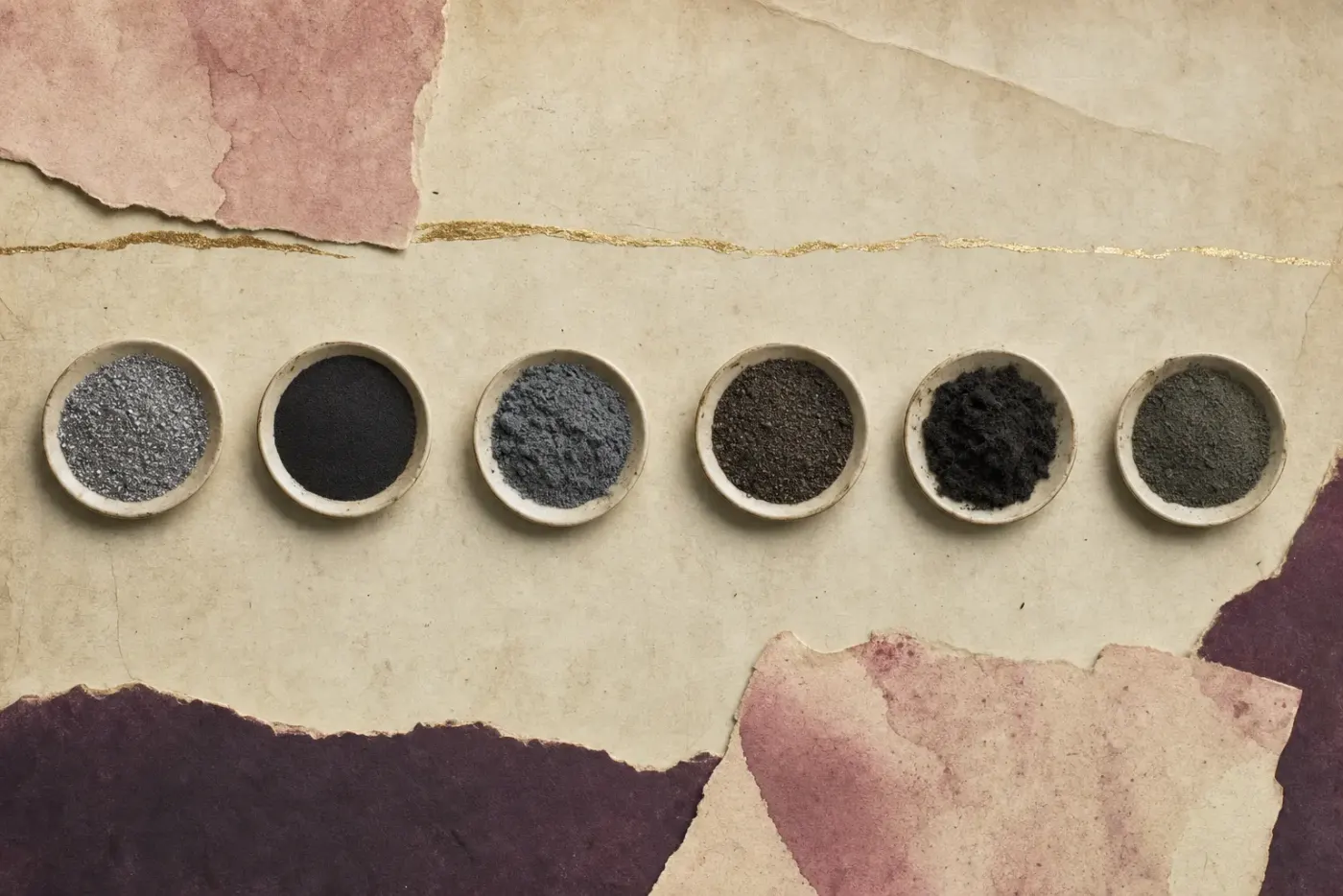
Forty-seven samples went into an X-ray diffractometer and came out as several different substances sharing one word.
In short
An X-ray diffraction survey of forty-seven kohl samples used in Oman is the clearest demonstration that ‘kohl’ names a colour rather than a composition; ithmid is the Arabic name of stibnite and of the best kohl.
- 13min read
- 6chapters
- 5sources

Vivien
Your guide through time
Listen to this essay
5 min listenVivien reads our essays aloud, word for word — every date and every name in its place — so you can listen the way you would be walked through a gallery.
An AI voice, designed for History of Makeup
Almost every argument about kohl — historical, medical and regulatory — goes wrong in the same place, by treating one word as one substance.
An X-ray diffraction survey of forty-seven samples used in Oman settles it: kohl names a colour, not a composition.[1]
What Ithmid Is
Ithmid — also written ethmid — is the Arabic name of stibnite, and the name of the best kohl.[2] Those are two claims in one word: a mineral identification and a quality judgement.
In the Arabic and Unani traditions ithmid is identified with antimony, and a hadith recommends it — which gives the material a standing that no merely fashionable preparation would have.[3]
Why a Named Best Grade Implies the Rest
You do not name the best of something unless there are worse ones. A tradition that identifies ithmid as the finest kohl is a tradition that knows kohl comes in grades and that not all of them are antimony.[4]
Which is exactly what the modern survey found, eight centuries later. The vocabulary already encoded the variation that diffraction later measured, and the word was never meant to fix a formula.[4]
That is worth holding onto when reading any historical source on the subject. A medieval writer specifying ithmid was doing what a modern label does not: naming the actual material rather than the effect, and the precision was available to anyone who cared to use it.[4]
The loss of that precision is the modern part of the problem. A pot sold today as kohl carries a word that once distinguished grades and now distinguishes nothing, so the vocabulary has become less informative over time rather than more.[4]
Nobody names the best of something unless there are worse ones.
The Word That Became Alcohol
Arabic al-kuhl, the fine powder used to darken the eyelids, passed into Medieval Latin as alcohol in the specific sense of a powdered ore of antimony. Paracelsus generalised it to any fine powder or volatile sublimate; by the 1670s it meant any sublimated substance, the pure spirit of anything; and by 1753 the intoxicating ingredient of liquor.[5]
The direction of travel is specific to general, not general to specific — which is the opposite of how the etymology is usually told, and it means the word for a cosmetic powder became the word for a spirit by successive widening rather than by any resemblance between the two things.[5]
Why the Ambiguity Became a Regulatory Problem
Because a regulator cannot approve a colour. The United States treats kohl and its cognate names as unapproved colour additives and warns about lead, which is the only workable position when the word does not determine the contents.[6]
The instrument behind it is Import Alert 53-06, revised 17 November 2023, whose red list includes eye-area cosmetics whose labels declare non-permitted kohl, kajal or surma; the earlier kohl-specific alert was deactivated and its firms folded into this one.[7]
The consolidation is telling. Folding a substance-specific alert into a general colour-additive one is an administrative acknowledgement that the problem is not one substance but a category of products whose contents the label does not disclose.[7]
What the Health Literature Actually Shows
Less agreement than either side of the argument tends to claim. The review used here reports conflicting findings on blood lead in kohl users and takes no settled position on them.[8]
That is the predictable consequence of the naming problem. A study of ‘kohl users’ is a study of people using several different substances, so conflicting results across studies may be reporting real differences in what was in the pots rather than disagreeing about the same thing.[9]
Resolving it would require analysing what each cohort actually used, which is a harder study to run and a more expensive one.[9]
What Is Not Known
How the proportions of the different compositions have changed over time is not established. The survey is a snapshot of one country, and medieval texts name grades without quantifying how much of each was in use.[10]
Whether the material a medieval writer called ithmid is chemically the same as the material sold under that name now is also open, and it is precisely the question the naming problem makes hard to answer.[11]
Nor does anything here establish how the compositions vary between regions. The survey covers one country, and a word used across North Africa, the Middle East and South Asia may well name different materials in each.[10]
Sources
- [1, 2, 4, 9, 10]Composition of eye cosmetics (kohls) used in Oman Journal of Ethnopharmacology 60(3), 223-234, 1998.View source (opens in a new tab)
- [3, 8, 11]Kohl (surma): retrospect and prospect Pakistan Journal of Pharmaceutical Sciences 22(1), 107-122, 2009.View source (opens in a new tab) Accessed 2026-09-22.
- [5]kohl (n.) Online Etymology Dictionary, 2026.View source (opens in a new tab) Accessed 2026-09-22.
- [6]Kohl, Kajal, Al-Kahal, Surma, Tiro, Tozali, or Kwalli: By Any Name, Beware of Lead PoisoningView source (opens in a new tab) Accessed 2026-09-22.
- [7]Import Alert 53-06: Detention Without Physical Examination of Cosmetics That Are Adulterated and/or Misbranded Due to Color Additive Violations U.S. Food and Drug Administration, Office of Regulatory Affairs, 2023.View source (opens in a new tab) Accessed 2026-09-22.
Filed under