Lac on Lips and Feet: A Red an Insect Makes
The red came from a resin secreted by an insect on a host tree, and one of its names attached itself to the practice rather than the material.
In short
Lac, the resin an insect secretes on its host tree, supplied a red used on lips and on feet in South Asia; laccaic acids have been identified in dated textiles from Xinjiang of the second to ninth centuries CE, giving a secure early date for its working and its movement along trade routes.
- 12min read
- 6chapters
- 4sources

Vivien
Your guide through time
Listen to this essay
5 min listenVivien reads our essays aloud, word for word — every date and every name in its place — so you can listen the way you would be walked through a gallery.
An AI voice, designed for History of Makeup
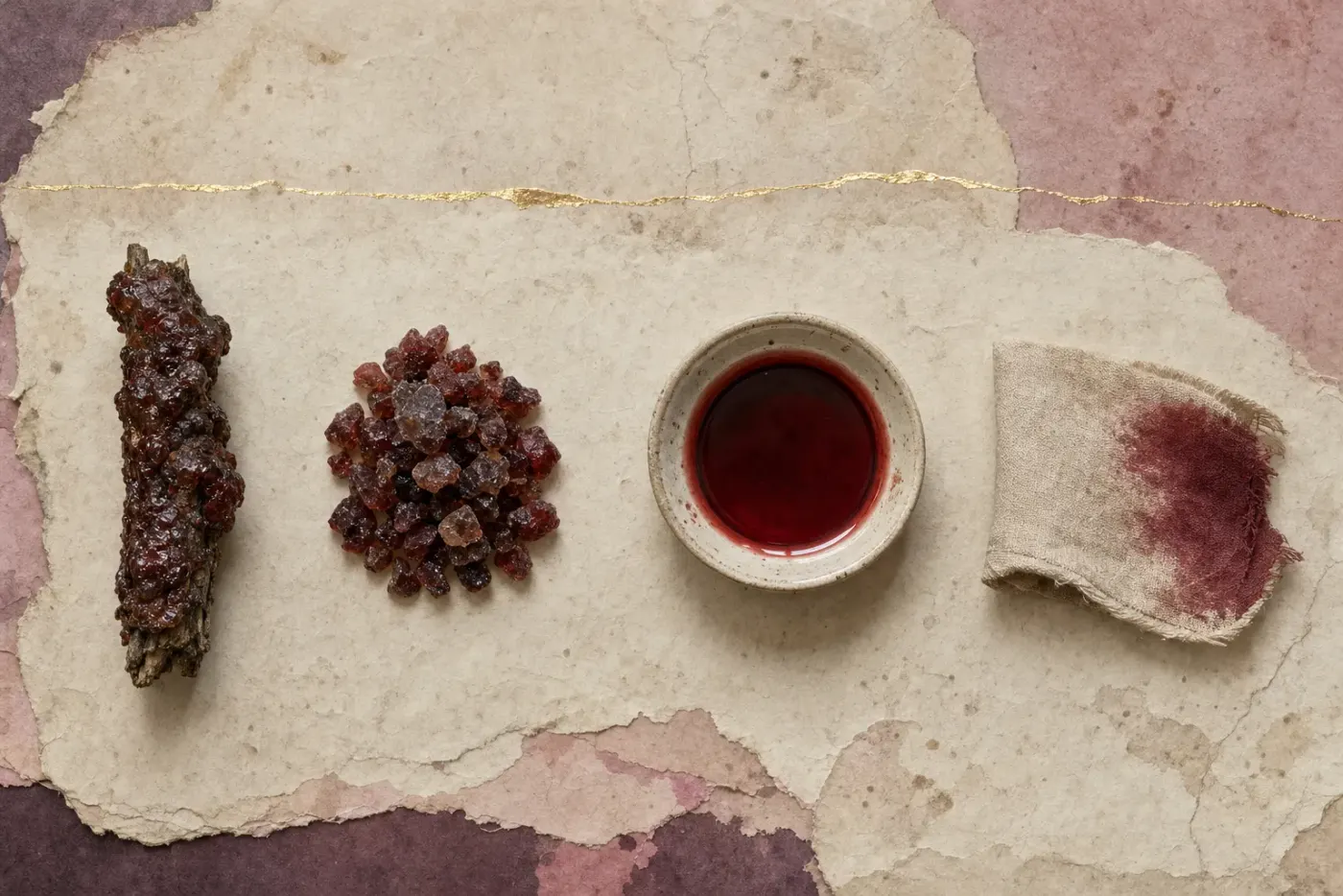
Most historical reds are minerals or plants. Lac is neither: it is a resin an insect secretes onto the tree it feeds on, harvested from the branch.[1]
It coloured textiles, and it coloured people. In the South Asian record it appears on lips and on feet, and one of its names — alaktaka — attached itself to the practice rather than staying with the substance.[1]
Feet, Not Palms
The detail is worth getting right because it is usually got wrong. In the text behind this account the clotted lac colours feet.[2]
Palms appear instead in most retellings, probably by assimilation to henna, which is a different material with a different chemistry and a different history. Two red-staining substances used in the same region slide into one another very easily, and here the sources do not.[2]
They are also different in behaviour, which makes the conflation worse than a naming slip. Henna stains by binding to protein and develops slowly; a resin-derived colourant is applied and is the colour it will be, so the two demand different techniques and different amounts of patience.[2]
Six Kinds, Seven Names
The lexicographical record is dense enough to trip over itself: the Amarakosa’s lac-dye names are called six kinds in the survey used here, which then prints seven.[3]
Rather than a defect, that is a symptom of the thing being described. A material with many grades, many preparations and many regional names accumulates more words than any tidy count can hold, and a discrepancy of one is what a living vocabulary looks like from the outside.[3]
It is worth flagging rather than tidying away. A reader who finds six in one account and seven in another has found the join between them, and a history that silently picks one number hides the fact that the sources disagree.[3]
Six kinds, and seven names printed underneath. That gap is the vocabulary, not an error.
How Far It Travelled
Laccaic acids have been identified in dated textiles from Xinjiang of the second to ninth centuries CE, which gives both a secure early date for the working of lac and direct evidence of its movement along the trade routes north and east.[4]
That is the same class of evidence as the lead isotopes in Nubian kohl and it is better in one respect: a dyed textile carries its date, its colourant and its findspot in a single object, so the distance the material covered is measured rather than inferred.[5]
Why It Can Be Identified at All
Because the colourants are specific molecules. Lac dye is identified by its laccaic acids, and the analytical methods for finding them in historic textiles and lake pigments are now well developed.[6]
This is why insect reds are among the best-documented colourants in history while plant reds often are not: a distinctive molecule survives, and a distinctive molecule can be matched to a source in a way that a general redness cannot.[6]
A Dye That Is Also a Resin
The same secretion yields shellac, which has its own long industrial and cosmetic life — safety data exist for cosmetic formulations containing up to six per cent shellac, across the product categories in which it was used.[7]
So one insect on one tree supplied a textile dye, a cosmetic red and a film-forming resin, and the three trades pulled on the same harvest. Very few cosmetic materials in this history have that range.[7]
The overlap has a practical consequence too. A material wanted simultaneously by dyers, by varnishers and by people colouring their own lips is a material whose price is set by the largest of those trades, and the cosmetic use will always have been the smallest of the three.[7]
What Is Not Known
How lac was prepared for use on the body, as against on cloth, is not established by anything cited here. Fixing a colourant to a fibre and to skin are different problems with different solutions.[8]
Who wore it, and on what occasions, is also not recoverable from a lexicon. A word for a practice establishes that the practice was nameable, and nothing about how common it was.[9]
The relationship between the cosmetic use and the textile trade is also unmapped. Both are attested, the same material underlies both, and nothing cited here establishes whether one grew out of the other or the two ran alongside each other from the start.[8]
Sources
- [1, 2, 3, 9]Cosmetics and Coiffure in Ancient India Journal of the Indian Society of Oriental Art 8, 62-145, 1940.View source (opens in a new tab) Accessed 2026-09-22.
- [4]Chemical evidence for the spread of lac colorant in Xinjiang from the 2nd to 9th centuries CE npj Heritage Science, 2025.View source (opens in a new tab)
- [5, 6, 8]Lac dye colours: A review of the origin, history and identification techniques in textiles Journal of Cultural Heritage, 2025.View source (opens in a new tab)
- [7]Final Report on the Safety Assessment of Shellac Journal of the American College of Toxicology, volume 5, issue 5, pages 309-327, 1986.View source (opens in a new tab)
Filed under