Al-Kindi Writes Down the Distillations: Chemistry Aimed at a Product
Two kinds of distillation were being done in the ninth century. Only one of them was trying to make something a customer could buy.
In short
Al-Kindi’s Kitab Kimiya’ al-’Itr wa-l-Tas’idat describes distillation as practical craft chemistry directed at making a product, in contrast with the alchemical distillation of the Jabirian corpus, which aimed at transmutation.
- 12min read
- 6chapters
- 3sources
Vivien
Your guide through time
Listen to this essay
6 min listenVivien reads our essays aloud, word for word — every date and every name in its place — so you can listen the way you would be walked through a gallery.
An AI voice, designed for History of Makeup
The same apparatus can serve two entirely different projects, and in the ninth century it did.
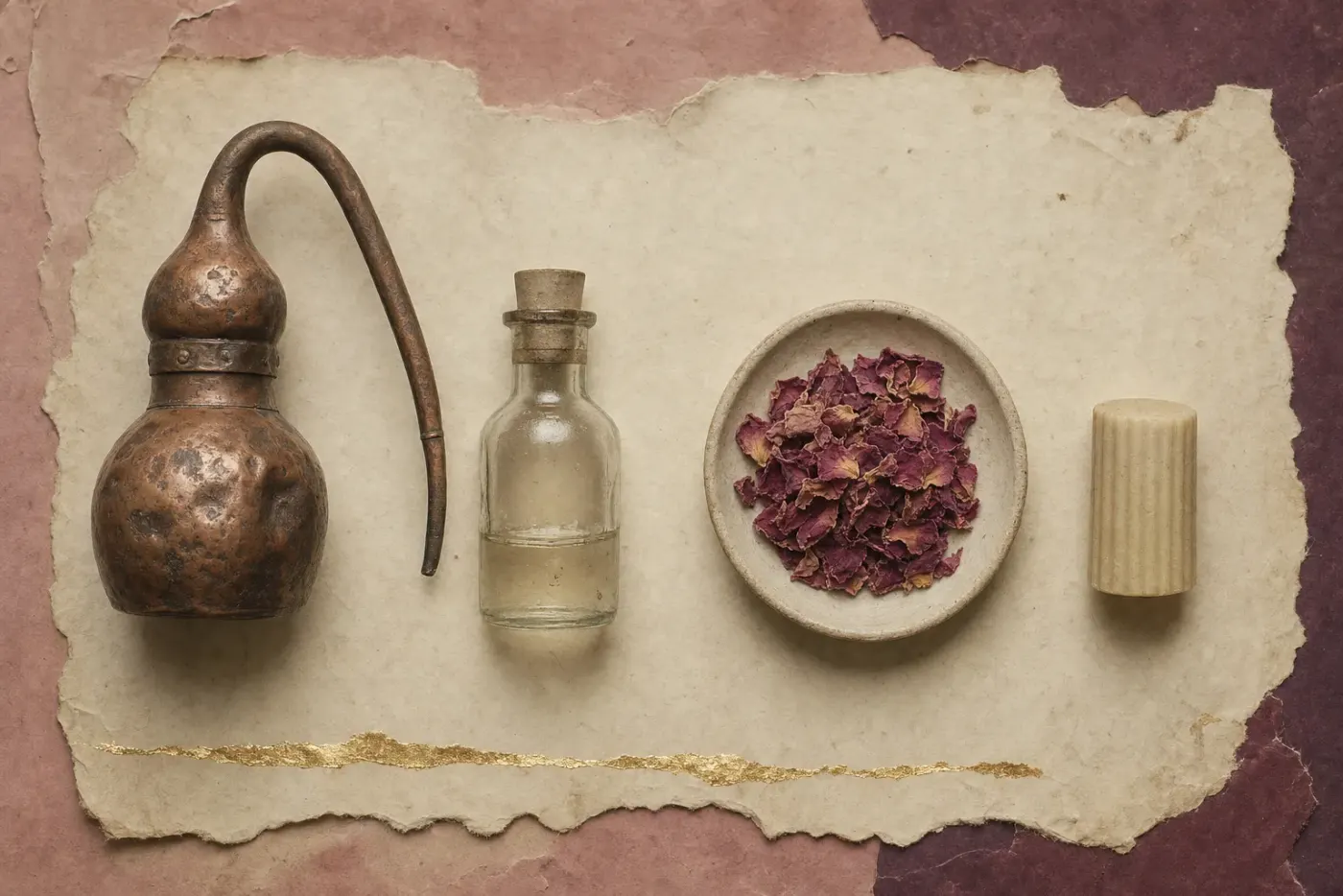
Al-Kindi’s treatise on the chemistry of perfume and distillation describes a practical craft aimed at a product, and it stands in deliberate contrast to the alchemical distillation of the Jabirian corpus, which aimed at transmutation.[1]
Why the Distinction Is Not Merely Philosophical
Because it determines what counts as success, and therefore what gets written down. An alchemical distillation succeeds if a substance changes into another substance; a perfumer’s succeeds if the result smells right and can be made again next week.
Repeatability is the whole difference. A craft aimed at a product needs quantities, times and temperatures that another person can follow, which is why craft chemistry generates usable recipes and speculative chemistry generates theory.[2]
The two also fail differently, which is the deeper point. A craft failure is obvious immediately — the batch is wrong and the customer says so — while a speculative failure can always be attributed to an impurity, a wrong hour or an incomplete understanding, and so need never be conceded.[2]
What a Treatise Like This Establishes
That there was a trade worth writing for. Nobody compiles operational instructions for a practice nobody is doing, so the existence of the treatise implies practitioners, customers and enough variation between workshops to make a written standard useful.[3]
It also implies materials arriving from somewhere. Distillation is applied to things, and a treatise on perfume presupposes a supply of aromatics reaching the place where it was written.[3]
And it implies buyers who could tell one product from another. Instructions precise enough to be worth recording are only worth recording where the difference between a good batch and a poor one is noticed and paid for.[3]
One distillation was trying to change a substance. The other was trying to make next week’s batch smell like this week’s.
A Figure This Article Will Not Give
The number of recipes in the treatise circulates widely and is not supplied here. The study used is a source for the treatise’s existence and practical character, and it is not a source for that count.[4]
Omitting a number is a peculiar thing to do deliberately and is worth explaining. A specific figure is what readers remember and what other writers copy, so putting one in on the strength of a source that does not carry it would launch it onward with a false warrant.[4]
The count may well be right. It is simply not established by what is cited here, and a figure that cannot be sourced is not improved by being plausible.[4]
The Same Impulse, a Century and a Half Later
Al-Zahrawi’s Kitab al-Tasrif, from around the year 1000, gives adornment a treatise of its own and treats it as a branch of medicine rather than as a separate craft.[5]
Its nineteenth treatise covers hair dyes, depilatories, dentifrices, underarm preparations and solid perfumes rolled and pressed in moulds — an operational range that sits naturally alongside a manual of distillation, and belongs to the same habit of writing practice down.[6]
What Those Moulded Sticks Are Not
They are solid perfumes rolled and pressed in moulds, and the modern description of them as the first lipstick is a later gloss rather than a rendering of the text.[7]
The gloss is understandable and still wrong. A shaped solid preparation for the body does resemble a modern object, and resemblance is not identity; reading a lipstick out of it is reading our category back into a text that had its own.[7]
The cost of the gloss is the interesting part. Calling it the first lipstick makes the text sound like an ancestor of a modern product line, when what it actually documents is a medical compendium treating shaped solid preparations as one technique among many.[7]
What Is Not Known
How widely the treatise circulated, and whether working perfumers used it or it recorded what they were already doing, is not established here. Both are possible and a manual can be either.[8]
The reading of adornment as a branch of medicine rather than an appendage to it is also an interpretive judgement belonging to the modern study, not a statement al-Zahrawi makes about his own arrangement.[9]
The relation between the two works is also unmapped here. A perfume treatise of the ninth century and a medical compendium of the eleventh belong to a shared culture of written practice, and nothing cited establishes that either drew on the other.[8]
Sources
- [1, 2, 3, 4, 8]Al-Kindi's Attack on Alchemy and His Perfume Making Orient 52, 72-92, 2017.View source (opens in a new tab) Accessed 2026-09-22.
- [5]Kitab al-Tasrif, Book 19: on adwiyat al-zinah (the medicines of adornment) 1000.
- [6, 7, 9]A Pharmaceutical View of Abulcasis al-Zahrawi in Moorish Spain, with Special Reference to the Adhan E. J. Brill, Leiden, 1963.
Filed under